Now Playing . . .: Using Podcasts and Kidcasts in the Library

 Kitty Felde is host and executive producer of the Book Club for Kids podcast. She’s a public radio veteran, an award-winning playwright, and middle grade novelist. Book Club for Kids began as a segment on Felde’s award-winning public radio talk show. It launched as a podcast in 2015. The Literacy Network of Greater Los Angeles honored the show with its Literacy in Media award. Pamela Rogers is a children’s librarian and host and producer of Buttons & Figs, a podcast for kids about nonsense literature. Buttons & Figs began in September 2016 and is co-hosted by Sarah Torbey, also a children’s librarian. The podcast was started as a way to share great works of nonsense and to inspire kids to create nonsense of their own. Pamela is also a consultant and trainer on topics such as ALA’s Every Child Ready to Read, early literacy, family engagement, and leadership.
Podcasts created for kids, and often by kids, are quickly growing in number, scope, and popularity. The list of recommended podcasts on Zooglobble, a kids’ music and audio review site, has grown to include almost eighty. And podcasts for kids, also called “kidcasts,” are not just for earphones and home speakers.
Podcasts for kids are taking the stage. Ear Snacks, hosted by professional “kindie” (kid-indie) musicians, recently performed at the San Francisco Public Library and at San Francisco’s Recess Urban Recreation Center. Book Club for Kids tapes live shows at book festivals all across the eastern seaboard. The Secret Diaries of Tara Tremendous, superhero adventure stories produced by Wonkybot Studios, was even turned into a Broadway musical.
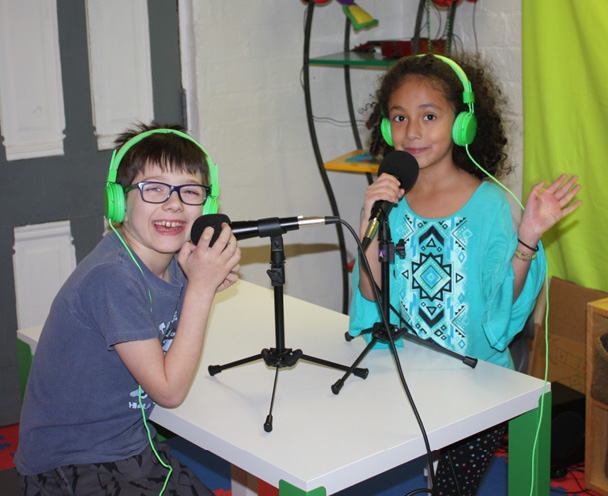
Cy and Chloe recording the podcast, “Buttons & Figs.”
And now podcasts are turning up in the library. Buttons & Figs, a librarian-hosted podcast about nonsense literature, will be part of the summer reading fun at the Oak Park (IL) Public Library, where kids can record a joke, tell a story, or simply make a silly sound effect to be featured in an upcoming episode.
Parents and caregivers are increasingly turning to libraries to help their kids succeed in school. Podcasts for kids can be another arrow in the quiver for librarians, as listening leads to better learning. In an August 2016 NeverEnding Search blog post, School Library Journal noted that “kids actually listen more attentively than most adults—they listen to understand, to retain, and to do something relating to what they learn.”1
Kathleen Scalise and Marie Felde, authors of the book Why Neuroscience Matters in the Classroom, say podcasts target those “more likely to pop in earbuds than pull out a library card.” They argue that listening to podcasts can, “in a unique and satisfying way, [support] literacy, reading, and representation of language in the brain.”2 How, then, can libraries engage these earbud-wearing kids?
Programming with Kidcasts
Children’s library services have always engaged children through stories. Kidcasts can fit seamlessly into existing library programming or even inspire new programming.
For the youngest patrons, here are some ways to incorporate podcasts.
- Play a story, such as “Dazzling Dinosaurs” from the Story Time podcast produced by Bedtime FM, during storytime. Share information for parents or caregivers about how to keep listening at home, in the car, or wherever they are.
- Create a flannel board or pull out some puppets and play “The Cat Who Caught the Moon” from Stories Podcast, “Little Fox” from Little Stories for Tiny People, or “Hot Tea and Warm Rugs” from Baalgatha, a podcast sharing Indian stories in English and Hindi. Act out the story along with the audio.
- Why not include a song from a podcast in your storytime? There are many great kidcasts with original music, including Sugarcrash Kids; Spare the Rock, Spoil the Child; Ear Snacks; April Eight; Chloe’s Friendship Circle; and Space Station Kiwi.
Or, to engage school-age kids, consider these tips.
- Your library likely hosts a book club, so how about a pod club for middle school students? Kids could share their own “picks of the week”—episodes from their favorite podcasts.
- Use a podcast to launch a book club discussion. Host a pod or book club where the books are selected from the ones discussed on the podcast Book Club for Kids. During the meetings, play some of the discussions and interviews, allowing time for the kids to discuss their own thoughts and the thoughts of those on the episode.
- Create a mystery podcast club. Play an episode from the scripted serial podcast The Unexplainable Disappearance of Mars Patel and have the club try to guess what will happen next at the end of each meeting.
Along with the explosion in STEM and STEAM programming, podcasts offer a great resource to inspire curiosity and further inquiry-based thinking as part of your programs.
Take a topic from a science podcast and enhance your programs.
- Host a STEM podcast program series. Select inquiry-based episodes for each program, such as the Tumble episode, “The Secrets of Bugs and Bats,” which includes kid questions like, “Why is it good for bugs to have six legs instead of four?” or “Why do mosquitoes drink blood?” Stop the episode and ask the kids what they think. Discuss their ideas and then play the answer. Actual bugs on site are optional.
- Another great podcast for this type of open dialogue programming is But Why?, which has episodes such as “How Do Popcorn Kernels Pop?” You could even serve popcorn as the kids toss around their own hypotheses. Then, play the answer. Brace yourself for when they find out they’re eating endosperm. You can continue this type of guessing game along with the rest of these episodes.
- Host a program about dinosaurs and play the Brains On! episode “Dinosaur Bones: How Do We Know Their Age?” while kids make an amber craft using glass stones and pictures of different types of dinosaur bones. Invite an educator from a local nature center or a local paleontologist with actual amber specimens to view. Encourage everyone to check out those great dinosaur books in your collection.
- Host a STEAM maker program series by playing a two-minute episode from Science Underground such as “Can We Make a Transporter?” For this one, offer a lot of different recycled electronic materials and boxes and challenge the kids to design a transporter that won’t break you apart on the other end! You can also select maker projects from the book Maker Lab: 28 Super Cool Projects by Jack Challoner and share an interview with the author from the podcast The Show about Science, hosted by Nate, a six-year-old who loves science.
Many librarians are ahead of the game, discovering ways to make podcasts part of their reading programs. Jenny Shanker, librarian at Gunston Middle School in Arlington, Virginia, says students at a number of mid-Atlantic schools have been issued tablets. Teachers and librarians are scrambling to find creative ways to use them.
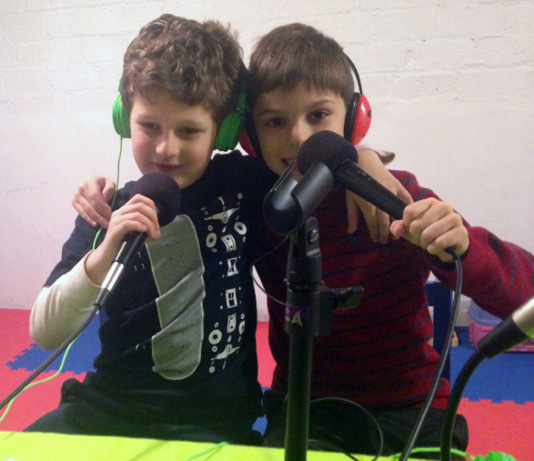
Recording a podcast is a lot of fun!
It was her suggestion that the Book Club for Kids podcast create QR codes (those funny-looking, black-and-white, patterned squares) for each episode. You open the QR reader app on your phone or tablet, point the device’s camera at the code, and it takes you to a website with more information, or in this case, to a podcast.
Shanker suggests that librarians print out the QR codes (available for free from Book Club for Kids) and paste each one to the back cover of a book discussed in a particular podcast. Students scan the back of the book with the QR reader app on their tablets and can immediately listen to the twenty-minute podcast. This hopefully inspires them to want to know more about the book . . . which they will already have in their hands.
There’s no reason QR codes can’t be used the same way for science, music, or storytelling podcasts.
- If a Tumble science podcast is talking about trash in the ocean, why not create your own QR code for the episode (tools to do this are available at a number of free websites) and attach it to a copy of Plastic, Ahoy!: Investigating the Great Pacific Garbage Patch by Patricia Newman and Annie Crawley?
- Want to turn that frequently checked-out copy from the Harry Potter series into a discussion about ethics? Create a QR code for the Australian ethics podcast Short & Curly episode, “Is Dumbledore as Great as He Seems?”
- Want to extend your “letters” storytime theme? Create a QR code for the Ear Snacks episode “Letters” and display it near your alphabet books or on an Ear Snacks CD in your collection.
- If the April Eight songs and stories podcast is talking about the joys of winter, play a segment from the episode “Snowflakes” during your storytime and hand out some bells so attendees can shake and listen. Have a QR code posted in your storytime area so families can listen to April’s beautiful voice on their way home.
Want to take it one step further? Create your own kidcast. Jose Rodriguez teaches at the Ambassador School of Global Education in Los Angeles, a public school built on the site of the old Ambassador Hotel. Rodriguez says he’s created podcasts in the classroom over the years to reinforce the learning.
One special series was on environmental issues, leading up to Earth Day. His new project, a lunchtime club called Globe Trotter Radio, will create podcasts to help his students learn more about geography and world cultures.
Kidcast Reference
Children’s librarians are uniquely situated to help with curating kids’ podcasts and referring patrons to listen and engage with them. Librarians can create evaluation tools to confidently point parents, caregivers, educators, and other librarians toward high-quality podcasts for kids and their families.
Kidcasts tackle everything from ethics to literature to science. But how can librarians help parents and caregivers find these great podcasts for young listeners?
- Jennifer Norborg and Anne Bensfield, librarians with Oak Park Public Library, had the great idea to host a podcast petting zoo. The library set up a program room where kids and adults could come in and sample snippets from various podcasts. Each iPad or computer station had a placard listing information about the podcast and the target age for the show, and a pair of headphones for listening to a bit of a selected episode. Based on their discoveries, one family might want to continue listening to the sci-fi serial podcast The Alien Adventures of Finn Caspian to find out what aliens Finn will encounter next. A middle-school kid might want to tune in to the next episode of the serial The Unexplainable Disappearance of Mars Patel to find out why Mars’s mother is acting so strangely when his middle school friends ask why he was missing from school. Or an imaginative child might be inspired to call the podcast What If World and tune in later when Mr. Eric creates a special episode inspired by his or her question.
- The Poudre River Public Library District in Ft. Collins, Colorado, includes a link to Book Club for Kids on the homework page of its website and the Madison (WI) Public Library posted a list of kidcasts recommended by a kid listener on their library blog.
- Put a curated list of kidcasts on the iPads or computers in your library and share the list with families at check-out.
But how can libraries be confident about which kidcasts they recommend to parents and caregivers? Look for reviews and member organizations defining and advocating for high-quality content for kids, and find a seat “at the table” so you can be a part of defining what that means too. Here are just a few:
- Members of Kids Listen (www.kidslisten.org), a grassroots advocacy organization of kidcasters, are defining and promoting high-quality audio content for children. They are transparent about their mission to build best practices around the medium.
- Zooglobble is a high-quality review site for kids’ indie music, audio, and now kidcasts. They have compiled one of the most comprehensive kid podcast lists available.
- Subscribe to a few kidcasts yourself and listen!
Join the podcast revolution! Listen, share, connect, recommend, and promote kid voices, kid ideas, and kid content by programming and promoting kidcasts at your library. &
References
- Joyce Valenza, “Kidcasts: Podcasts for Kiddos,” NeverEnding Search (blog), School Library Journal, August 8, 2016, http://blogs.slj.com/neverendingsearch/2016/08/08/kidcasts-podcasts-for-kiddos.
- Kathleen Scalise and Marie Felde, Why Neuroscience Matters in the Classroom: Principles of Brain-Based Instructional Design for Teachers (Boston: Pearson, 2017), 260–61.