Talking Strategy: A Look at ALSC’s Strategic Plan 2017–2020
In February 2017, the Association for Library Service to Children (ALSC) adopted a three-year strategic plan for 2017–2020, which is the framework to direct how ALSC will invest its valuable and limited resources in meeting the future needs of its members and influencing the evolution of the profession.
In the year prior to the adoption of the strategic plan, ALSC gained valuable insights from focus groups, an ALSC Emerging Leader project resulting in an Environmental Scan, thoughtful feedback from ALSC members, and information from its Board of Directors planning sessions that shaped the direction of the plan. What followed was the development of a comprehensive picture that identifies spheres of transformation, goal areas, and objectives influenced by major themes that emerged from the collective knowledge of ALSC members, leaders, and children’s library staff and advocates.
Spheres of Transformation
ALSC endeavors to make significant and meaningful change within the association, children’s librarianship, and the communities served by libraries to support our vision of engaging communities to build healthy, successful futures for all children. Each of these areas represent the three Spheres of Transformation that are achieved through implementation of our strategic objectives.
Areas of Strategic Action
The three main goal areas of the strategic plan and the accompanying objectives include
- Diversity and Inclusion. ALSC will become more diverse and inclusive, acting to promote these values in all aspects of library service to children.
- Advocacy. ALSC will champion the value of library service to children and the resources necessary to deliver on our vision.
- Learning and Development. ALSC will actively develop new generations of leaders.
ALSC utilizes collaborative partnerships, committees, task forces, booklists, blog posts, journal articles, webinars, conference presentations, toolkits, surveys, scholarships, and awards to gather information, develop resources, and share expertise. Here are just a few highlights of the many activities generated through ALSC members, leaders, and staff in service of the strategic plan.
Diversity and Inclusion
The ALSC Equity, Diversity, and Inclusion Implementation Task Force (EDI TF) was assembled in October 2017 and has been determining strategies to implement recommendations outlined by the previous Equity, Diversity, and Inclusion Task Force. The work of both groups has been a driving force that informs all aspects of diversity and inclusion within ALSC.
Objective 1. Increase diversity in ALSC membership and reduce barriers to participation as measured against the ALSC Diversity Within the Children’s Library Services Profession survey by September 2019. Transforming ALSC
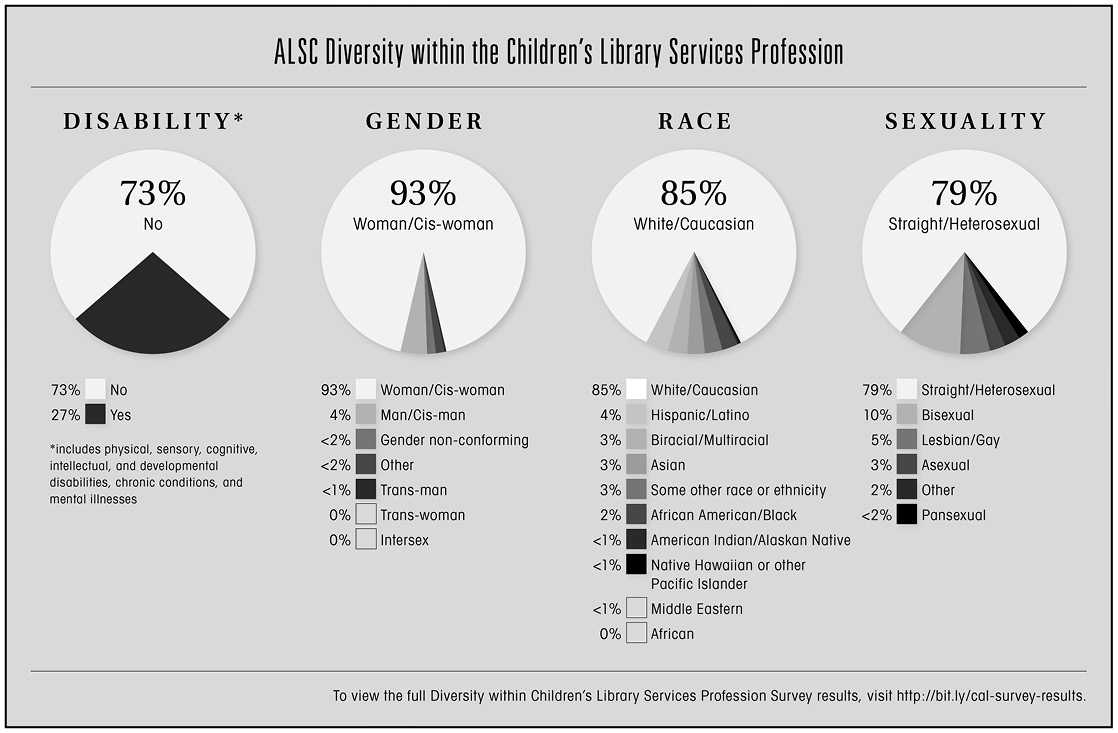
- The Diversity Within the Children’s Library Services Profession survey (http://bit.ly/cal-survey-results) was administered in November 2016 and explores demographic characteristics of children’s library staff and topics related to ALSC membership, including motivations and interests for joining or not joining ALSC. Survey results for gender, disability, orientation, and race are featured in this publication. A full infographic outlining all survey questions and results can be found on the ALSC website (http://bit.ly/cal-survey-results).
- ALSC’s 2018 Emerging Leader team worked on a project to develop a framework for cultural competency and cultural humility education and a video for ALSC members that will enhance the understanding of microaggressions—what we say and how we say it—and the impact they have on common workplace social interactions.
- ALSC has added a second ALSC Spectrum Scholarship with the 2018–2019 school year through funding from the ALSC Melcher Scholarship Endowment (http://www.ala.org/advocacy/spectrum). Through the Spectrum Scholarship Program, “the American Library Association affirms its commitment to diversity and inclusion by seeking the broadest participation of new generations of racially and ethnically diverse librarians to provide leadership in the transformation of libraries and library services.”1
Objective 2. Expand opportunities for existing members from underrepresented experiences to serve in ALSC activities, as measured by longitudinal studies and/or focus groups, by September 2020. Transforming ALSC
- Funds from Friends of ALSC (FoA) have awarded two scholarships for the 2018 ALSC National Institute attendance and a third scholarship specifically for a North Carolina ALSC member who identifies as part of the LGBTQAI+ community in response to ALSC’s cancellation of the 2016 National Institute due to the state’s adoption of discriminatory HB2 legislation.
- Demographic questions have been added to the ALSC Volunteer form, the Bill Morris Seminar application, and the Student Gift Membership midpoint survey to help determine if volunteer opportunities and ALSC programs reach a diverse audience.
Objective 3. Increase the cultural competency of library staff serving youth by developing an accessible online cultural competency training series by September 2018. Transforming Children’s Librarianship
- ALSC committees, including the EDI TF, Education Committee, and the ALSC Emerging Leader Team have been collaborating on the development of an online cultural competency and cultural humility education series for ALSC Priority Group leaders, committee chairs, committee members, and general ALSC membership to increase cultural competency and cultural humility of library staff serving youth.
- ALSC Online Community Forums and webinars include topics such as Social Justice Practice in Youth Librarianship and Nurturing Empathy through Culturally Inclusive Programming.
Additional work supports the Diversity and Inclusion area of the strategic plan.
- ALSC is working with YALSA, the ALA Governance Office, the ALA Marketing and Communications Office, the ALA Office for Diversity, Literacy, and Outreach Services, and the ALA ethnic affiliate groups to include ethnic affiliates’ book and media awards in the 2019 Youth Media Awards (YMA) Press Conference.
- The 2018 National Institute theme is All Aboard! Embracing Advocacy and Inclusion and features a diverse line-up of authors and illustrators for the Institute Keynotes and Breakfast with Bill panel discussion. A free networking reception at the National Underground Railroad Freedom Center will welcome ALSC members and colleagues interested in youth librarianship. The event, funded by the Friends of ALSC, will include networking opportunities with invited local non-library organizations representing the diversity of the host city of Cincinnati.
Advocacy
ALSC will champion the value of library service to children and the resources necessary to deliver on our vision.
Objective 1. Establish an accessible content stream of valuation tools and research updates, including customizable content for members, by September 2018. Transforming ALSC
- ALSC staff, in collaboration with contributors to the 2014 Young Children, New Media, and Libraries Survey, are working to update the survey and collect new data that will inform research on media mentorship. Continuing discussions about the role of digital media in the lives of young children highlights the need for an articulated set of information to guide children’s library staff in their roles as media mentors who help families make thoughtful decisions by sharing research, offering guidance with media-use plans, and modeling appropriate ways to select and use new media. Survey results and additional research will be published and presented by contributors at ALA, ALSC, and other youth services conferences.
Objective 2. Articulate a prioritized research agenda, including but not limited to summer learning/out-of-school time, by September 2018, and pursue avenues for conducting and/or supporting the research by September 2020. Transforming Children’s Librarianship
- The Research and Agenda Task Force created and disseminated a survey for ALSC membership to collect member ideas on potential research topics that will inform ALSC’s forthcoming research agenda.
- Collaborative efforts from the Summer/Out-of-School-Time Learning Task Force, Public Awareness Committee, and Advocacy and Legislation Committee produced a set of talking points on summer learning for National Library Legislative Day.
Objective 3. Amplify librarians’ essential role as information literacy experts through advocacy outputs, including communications, webinars, and establishing collaborations, by September 2018. Transforming Communities through Libraries
- AASL/ALSC/YALSA Interdivisional Committee on School/Public Library Cooperation has created and is promoting the Public Library and School Library Collaboration Toolkit which provides guidance to school and public librarians on how to work together to increase access and support for students.
- The Public Awareness Committee is developing a virtual toolkit, in alignment with the ALA Libraries Transform campaign, to champion the expertise of children’s librarians.
Objective 4. Increase targeted messaging to the wider library profession and the public about the expertise of ALSC and our members to demonstrate the purpose and value of strong and meaningful children’s librarianship by September 2019. Transforming Communities through Libraries
- This year the National Summer Learning Association celebrates its twenty-fifth anniversary and used this opportunity to expand the annual National Summer Learning Day (NSLD), an advocacy day in support of children’s continued learning, health, and safety throughout the summer, by collaborating with ALSC through a marketing plan designed to engage library participation across the country. On July 12, NSLD hosted its first annual Summer Learning Ambassador, 2016 Caldecott Honor recipient Bryan Collier for a national read-aloud that libraries were able to incorporate in their existing summer programming. This collaboration amplifies messaging to the public, at a national level, about the value of children’s librarians in supporting youth summer learning opportunities.
- Erikson Institute’s Technology and Children Center, in collaboration with ALSC and several partner organizations, including Association of Children’s Museums, Chicago Children’s Museum, and National Association for Media Literacy Education, were awarded a IMLS National Leadership Grant for Libraries in April for the project Building an Alliance for Media Literacy in Early Childhood Informal Learning—A National Forum. In 2019, collaborators will convene a leadership forum and a consensus-building forum with practitioners to identify and implement promising practices in media literacy for young children and families in libraries, museums, community programs, and other settings beyond the classroom.
- Committees utilize the ALSC blog to post on topics ranging from the importance of summer lunch programs to fighting fake news, funding opportunities for coding, and interviews of library staff and supporters doing grassroots advocacy.
Learning and Development
ALSC will actively develop new generations of leaders.
Objective 1. Build a discernible pathway, along with opportunities for training and mentorship, to develop ALSC members as leaders in their libraries, the profession, and/or the association by September 2020. Transforming ALSC
- The Managing Children’s Services Committee has led three ALSC webinars related to management of children’s services: Strategic Planning in the Youth Services Department, Program Evaluation, and Employee Engagement.
- The Student Gift Membership Task Force has facilitated a pilot program that gifted one hundred student ALA/ALSC memberships for two years, alerted recipients about opportunities to get involved in ALSC, and provided updates on ALSC Board of Directors work and professional development learning opportunities to keep recipients engaged in ALSC activities and share the value of continued membership.
Objective 2. Provide at least two educational opportunities in media mentorship and child development, ideally developed and/or presented with collaborative partners from other ALA units, by September 2018. Transforming Children’s Librarianship
- In September 2017, a two-part webinar series titled From Apps to Robots: How to Evaluate Digital Media for Literacy Learning—Parts 1 and 2, was led by librarians and educators and offered tips and strategies for identifying high-quality new media for ages fourteen and under that supports learning, literacy, inclusion, and family engagement.
Objective 3. Organize and promote ALSC activities to position the core competencies as central to library service to children by September 2018. Transforming Children’s Librarianship
- The National Institute Task Force correlated Institute programming with corresponding ALSC Core Competencies so participants can align their program participation based on continued development of the Core Competencies.
Objective 4. Develop a toolkit of research-based best practices for out-of-school-time learning and disseminate the toolkit and practices to members by September 2019. Transforming Communities through Libraries
- ALSC awarded fourteen mini-grants ($5,000 each) to ALSC members through funding from its eighth Dollar General Literacy Fund (DGLF) Grant. The grant program Everybody Reads—Strengthening Communities Through Libraries provides STEAM-focused learning for children during breaks and afterschool programs. Outcomes included a webinar for librarians who have implemented SCTL or similar out-of-school-time programs to share their experiences and tips. The outcomes of these grants informs the development of a research-based best practices toolkit.
ALSC members, staff, and leadership have actively engaged in thoughtful consideration of how their work can impact specific goals set for and inspired by the strategic plan. ALSC committees share their activities through quarterly reports that specifically gather information on progress toward each of the strategic plan areas. These reports and the work of ALSC staff and leadership reveal progress in each strategic plan area. Our timeline is aggressive, and we have only just begun to consider and implement activities that support strategic plan objectives. There is a great deal more for ALSC to do to realize our goals. Careful assessment of these goals and our next steps is in order.
As part of an annual review of the ALSC Strategic Plan, at Midwinter 2018, the ALSC Board of Directors began the process of evaluating strategic plan progress and will make adjustments, as necessary, to projected timelines, resources, and deliverables. The board continues to research status on goal areas, while considering priorities and challenges that have impacted or may impact strategic plan goals.
ALSC committees, task forces, discussion groups, members, staff, and leadership are continually working on activities that move the strategic plan forward. The numerous and valuable activities that each of these groups engages in could not all be listed here. Ongoing updates on ALSC activities can be found at www.ala.org/alsc/aboutalsc/governance/board-work/agendas-docs. We encourage you to follow the progress, make suggestions, and engage in activities that transform ALSC, children’s librarianship, and the communities served by libraries. &
Reference
- ALA Spectrum Scholarship Program homepage, accessed May 15, 2018, http://www.ala.org/advocacy/spectrum.