When Gym Met Dewey: The Unexpected Collaboration of the Library and Physical Education

 Dr. Breon Derby is an Assistant Professor, College of Education and Behavioral Sciences, at Black Hills (SD) State University. Emily Benvenga is the high school librarian in Spearfish, SD.
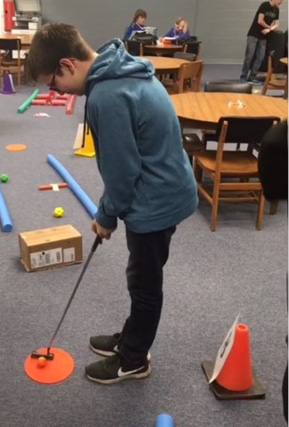
To celebrate National School Library Month and promote physical activity, Black Hills State University physical education students set up a mini golf course in the Spearfish High School Library.
A whole-school approach to education integrates multiple components of the school system to create balanced, well-rounded students who can transfer and apply knowledge and skills into their current, and future, lives.
Supporting and incorporating cross-disciplinary units, lessons, and ideas fosters student engagement, helps students build connections and form relationships between topics and disciplines, provides students a chance to explore and discover a deeper meaning and understanding of multiple concepts, and allows students to apply their knowledge and skills. One cross-disciplinary connection not often considered—or seen—is how the library can support the physical education classroom.
Traditionally, physical education has been looked at as a “bat and ball” content area. However, the new era of physical education aims to create a well-rounded, physically literate individual by equipping students with the knowledge and skills to remain physically active throughout their lifetime. The book SHAPE America National Standards & Grade-Level Outcomes for K–12 Physical Education outlines what students should know and be able to do by the time they graduate high school. Physical literacy is attained through the use of the following five standards outlined in the framework. The physical literate individual
- demonstrates competency in a variety of motor skills and movement patterns;
- applies knowledge of concepts, principles, strategies, and tactics related to movement and performance;
- demonstrates the knowledge and skills to achieve and maintain a health-enhancing level of physical activity and fitness;
- exhibits responsible personal and social behavior that respects self and others; and
- recognizes the value of physical activity for health, enjoyment, challenge, self-expression, and/or social interaction.1
Physical education not only builds a foundation for enjoyment of lifelong physical activity, but also emphasizes applying the knowledge and skills gained to make healthier choices throughout one’s life. Standard 4 reflects an additional emphasis on character building. The physical education curriculum promotes the development of responsibility, respect for self and others, self-management, problem solving, honesty, effective communication skills, and continuous reflection and goal setting for personal growth. Traditionally, libraries have been perceived as quiet environments. However, today’s libraries foster inquiry and creativity, requiring a flexible environment. Within the library, students are encouraged to pursue curiosities, develop character, and become conscientious users of information. As the learning world for students has changed and evolved, the standards for the school library have also changed and evolved, and a new picture of libraries has developed.
Three key standards in the new American Association of School Librarians (AASL, 2018) framework stand out as support components to the physical education classroom:
- Inquire: Build new knowledge by inquiring, thinking critically, identifying problems, and developing strategies for solving problems.
- Collaborate: Work effectively with others to broaden perspectives and work toward common goals.
- Explore: Discover and innovate in a growth mindset developed through experience and reflection.2
Based on the desired outcomes of the AASL and the SHAPE America frameworks, the librarian and the physical educator can collaborate to create experiences that transfer beyond the classroom. The librarian’s role emerges as one that supports collaboration in the physical education classroom. Both areas work together to achieve the common goal of immersing the learner in more than just knowledge and skills and providing experiences that carry over to the real world.
The standards lay the foundation for the following activities. Many of the concepts listed below meet multiple AASL and SHAPE America standards. The teacher or librarian can combine and interchange the standards based on the lesson focus. Consider the following scenarios:
- Elementary (K–5): The librarian comes into the classroom or gymnasium as a guest. The alphabet, or a portion of the alphabet, is emphasized at stations where the letters are tied to actions introduced by the physical education teacher (i.e., J = jump). At each station there is also a book with a title that starts with the letter J. The same stations can be set up at the students’ next library visit.
- Middle School (6–8): The librarian and physical education teacher work together to come up with fitness facts that are true and untrue. During the next physical education class, the class visits the library to play a trivia game where students view fitness facts from various sources and determine whether the fitness fact is credible or not. If the class gets the fact right, they perform a physical activity, and if the class is wrong, they perform a different physical activity.
- High School (9–12): As an out-of-class assignment, students in the physical education classroom choose a relevant topic (i.e., wellness, sport specific, fitness, etc.) to research. Students work with the librarian to learn about the research process.
Additional Ideas
- To celebrate School Library Month, the school library hosts an expert visit with upper level students or local university students who are working towards their degree in physical education. The expert students set up a mini-golf course or other activities in the library that students can complete as a team or individually during their free hour. Students view the library setting as a welcoming and actively changing place.
- The physical education teacher sets up an obstacle course or activities to mimic a story/theme being presented in the library. Alternatively, the librarian finds a virtual reality experience in the library that mimics skills/activities being taught in the physical education classroom.
Collaboration within the school environment creates a holistic, standards-based curriculum that leads to rich, diverse, memorable experiences for students that will carry on to their future lives. The library and physical education classroom have always been familiar elements to a school system. Combining the two disciplines is unexpected, but can lead to positive outcomes that have a lasting impact on students. &
References
1. SHAPE America-Society of Health and Physical Educators, National Standards & Grade-Level Outcomes for K–12 Physical Education (Champaign, IL: Human Kinetics, 2014).
2. American Association of School Librarians, AASL Standards Framework for Learners (Chicago: American Library Association, 2018).