Vaccine Education in the Library: Lessons Learned from a Hot Topic Program

 Katherine Hickey is a Children’s Librarian and Annie Emmons is an Engagement Manager at the Metropolitan Library System in Oklahoma City.
Recent data from the US Department of Health and Human Services indicate a small but growing number of unvaccinated children under the age of two.1 Low vaccination rates can result in outbreaks of preventable diseases and even death. The World Health Organization (WHO) identified vaccine hesitancy as one of the top ten threats to global health in 2019.2
Public libraries are uniquely situated to address low vaccination rates and vaccine hesitancy. They enjoy public trust and are a hub for parent education.
Vaccine Hesitancy
The term “vaccine hesitancy” refers “to delay in acceptance or refusal of vaccination despite availability of vaccination services.”3 As vaccine hesitancy increases, so do preventable diseases and related deaths, severe enough for experts to declare a generation at risk.
Vaccine hesitancy is particularly concentrated in Oklahoma, evident by low immunization rates and vocal advocacy groups actively lobbying for lax immunization-related legislation. Data from 2018 ranks Oklahoma forty-third in the country for immunization requirements.4
According to State Department of Health officials, the rate of children receiving immunization exemptions has doubled.5 Researchers point to a rise of “fake news” with fueling misinformation. Active online groups and forums tend to inflate the likelihood of vaccine injury, cater to emotion instead of science, and argue pharmaceutical companies compromise safety for the sake of profit.6
The term “anti-vaxx” is a colloquial term used to describe individuals who question the safety of vaccines. However, vaccine hesitant individuals tend to reject the term as “inflammatory and derogatory” and may choose to describe themselves instead as “vaccine-risk aware,”7 pro-parental choice, or pro-informed consent.8 To respectfully engage with the vaccine hesitant community, the term “anti-vaxx” is intentionally not used in this article.
The Belle Isle Library, a branch of the Metropolitan Library System of Oklahoma County, is located in a busy residential and commercial area in north Oklahoma City. Staff regularly receive reference questions about vaccines and immunization and overhear conversations among patrons about vaccine safety during programs. Given the data about vaccine rates in the state and patrons’ interest in this topic, the library hosted an educational program specifically geared toward vaccine-hesitant caregivers.
Program Description
Several considerations were taken into account when deciding on a program format:
- The fact that caregivers may not want to identify themselves as having questions or concerns about vaccine safety in a public setting.
- The importance of reassuring attendees they would not be judged or labeled for attending.
- The challenge of offering a program for caregivers who may not have childcare available.
With this in mind, staff borrowed a playtime format from the national Family Place program. Promoted as a Play Time, this program connects caregivers with community experts. Caregivers and children are free to play with toys, while an expert on a topic roams the room and visits with them individually.9
These programs are offered on a regular basis at the Belle Isle Library. This format was selected for its efficacy in addressing the aforementioned concerns; it grants privacy, allows caregivers to come with their children, and replicates a program community members are already familiar and comfortable attending. We held it on a Saturday at 10 a.m. A local pediatrician and immunologist volunteered his time and agreed to be the community expert.
Marketing and Promotion
We paid specific attention to the marketing and promotion of the program. It was important for the promotional materials to not appear judgmental and avoid giving the impression the program was a debate.
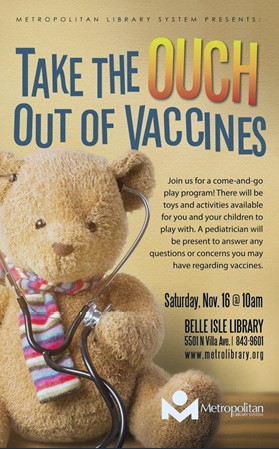
The library’s Marketing and Communications Department came up with the name “Take the Ouch Out of Vaccines” and designed a poster that was displayed in the library, along with small flyers. The program was briefly promoted at the beginning of weekly storytimes. The copy on the poster read “Join us for a come-and-go play program! There will be toys and activities available for you and your children to play with. A pediatrician will be present to answer any questions or concerns you may have about vaccines.”
Several days before the program, we shared the flyer on the library’s Facebook and Instagram accounts causing a near instantaneous reaction from the public. The post received more than 150 comments, 19 shares, and 61 reactions, ranging from enthusiasm to anger. Approximately 50 percent of the comments were positive, 15 percent negative, 30 percent neutral, and 5 percent off topic.
Positive comments largely expressed gratitude that the program was being offered; one commenter wrote, “Thanks for caring about the safety of our community and offering a neutral place for informed conversations!” Negative comments expressed concern over the perceived bias and qualifications of the pediatrician, “Is this medical professional specifically trained in vaccine ingredients, safety, and efficacy to be able to answer questions from a truly educated standpoint?” Other commenters claimed the library itself was compromising its value of neutrality by offering the program. “A library system, not a medical informational source, [has] joined a very serious debate by offering this event the way you have, with an obvious bias towards 100 percent vaccination for all, which is not right or safe.”
A user shared the post on a Facebook page known for protesting immunization-related events. Comments on the post indicated the possibility of protestors attending the program or handing out flyers. Additionally, one poster in the library was defaced with the words “don’t get any.” The divisive nature of the program soon became evident to staff and the public.
Program Preparation
To prepare for any protests the day of the event, all library staff were provided with the following talking points:
- The library is not taking a stance on vaccination.
- The program is being held in response to an increase in the number of reference questions on this topic.
- Libraries do not interpret information or provide medical advice, but instead connect people with reliable information and resources so they can make their own informed decisions.
- The program is a Play Time. A physician board certified in pediatrics and immunization will be present to answer questions about vaccines or other topics if parents have them.
- The doctor has donated his time as a library volunteer.
- The library strives to provide free access to information and resources on the topics that interest them. The library offers diverse resources to reflect the interests and needs of our community in our many physical and digital resources. Programming is an extension of this service.
Staff also discussed the following practice scenarios and appropriate responses:
- A parent whose child has recently attended playtimes at the library is concerned that the library is promoting “pro-vaccine propaganda” and threatens to stop using the library. How do you respond?
- After you respond to a customer that the library is not taking a stance on an issue, but just connecting people with resources, a customer asks when are you going to have a program about the dangers of vaccinations. How do you respond?
- A customer comes up to the desk holding the flyer for this program, saying, “I can’t believe my taxpayer dollars are funding this. This program should be cancelled. I will be writing to the director of the library to complain.” How do you respond?
- A library customer is upset because protesters held up signs with offensive imagery. How do you respond?
The library’s Marketing and Communications Department, as well as library administration, was informed of the pushback.
Day of the Event
On the day of the event, we set out toys and a play dough station for children and had a table with chairs available in a far corner for attendees who wanted to speak privately with the physician. We prepared a library display of materials about parenting, health, and immunization—including materials about the benefits of and potential dangers of vaccines. Twenty-four individuals attended the event, mostly regular library patrons who wanted to show their support of the program in light of its pushback. Two patrons spoke with the physician. There were no protestors or individuals acting in any adversarial way.
Reflection and Conclusion
We realized that immunizations continue to be a topic of interest to many community members. But in spite of the few negative comments, the response was largely positive. Promoting the event as a play program was particularly effective in creating a welcoming environment and helped attenuate concerns that the library was entering the vaccine debate.
Coordinated efforts to challenge vaccine education are increasingly carried out online.10 Therefore, it is no surprise that the social media posts garnered so much traction. The possibility of a social media pushback is a reality that libraries should consider and plan for if offering a vaccine-related, or other potentially controversial, program.
Interestingly, some of the social media profiles of the individuals contesting the event appeared not to live in or have any connection to Oklahoma. While unable to be confirmed, it is possible these profiles were “social bots” (bots on social media that comment or promote content) given their prevalence in online spaces discussing vaccines.11 This may provide some reassurance that vocal online opponents may never actually come protest in person.
As individuals express concern over the safety of vaccines, libraries may play a key role in their communities. Experts specifically identify community organizations as important agents of change and information literacy.12 This call to action fits squarely with the mission of a public library to be a hub of accessible and reliable information. It will be important moving forward for libraries to document and share their experiences promoting vaccine education to anticipate challenges and learn from each other’s successes. &
Thanks to Rick George for his wonderful poster design and to Victoria Stephens and Kim Terry for their help in promoting the program and responding to community concerns associated with the program.
References
- Holly Hill et al., “Vaccination Coverage Among Children Aged 19–35 Months —United States, 2017,” Morbidity and Mortality Weekly Report 67, no. 40 (2018): 1,123–28.
- “Ten Threats to Global Health in 2019,” World Health Organization, www.who.int/news-room/feature-stories/ten-threats-to-global-health-in-2019.
- Noni E. MacDonald, “Vaccine Hesitancy: Definition, Scope and Determinants,” Vaccine 33, no. 34 (2015): 4,161-164.
- America’s Health Rankings, 29th Annual Report (Minnetonka, MN: 2018).
- “More Oklahoma Families Opt Out of Immunizations, Citing Parent Choice,” Oklahoma’s News Channel 4, 2018, https://kfor.com/2018/08/28/are-immunizations-required-in-oklahoma.
- Margarida Arede et al. “Combating Vaccine Hesitancy: Teaching the Next Generation to Navigate Through the Post Truth Era,” Frontiers in Public Health 6 (January 2019): 381.
- Crazymothers Twitter page, https://twitter.com/crazymothers1/status/1201140183695056901.
- “Vaccines Become Untouchable Issue in Oklahoma Politics,” Oklahoma Watch, 2019, https://oklahomawatch.org/2019/06/03/vaccines-become-untouchable-issue-in-oklahoma-politics.
- Family Place Libraries, www.familyplacelibraries.org/U.
- Anna Kata, “Anti-Vaccine Activists, Web 2.0, and The Postmodern Paradigm—An Overview of Tactics and Tropes Used Online by the Anti-Vaccination Movement,” Vaccine 30, no. 25 (2012): 3,778–789.
- Xiaoyi Yuan, Ross Schuchard, and Andrew Crooks, “Examining Emergent Communities and Social Bots Within the Polarized Online Vaccination Debate in Twitter,” Social Media + Society 5, no. 3 (2019): 1–12.
- Catherine McClure, Jessica Cataldi, and Sean O’Leary, “Vaccine Hesitancy: Where We Are and Where We Are Going,” Community Therapeutics 39, no. 8 (2017): 1,550–562.