Peer-Reviewed
Becoming Mindful: Collaborating to Empower Students and Peacefully Resolve Problems



 Michael Rozalski is a professor at the State University of New York College in Geneseo, NY. He received his PhD from the University of South Carolina and has taught and worked with students with behavioral disorders from grades K-12 in a variety of settings, including self-contained and resource classrooms, wilderness programs, and a residential treatment center. Angie Stewart is a second-grade teacher of an inclusion classroom at Park Road Elementary with Pittsford Central School District, NY. She received her BS in education (childhood with special education) and MS in reading and literacy from SUNY Geneseo. Benjamin Andrus is a Social Science Librarian at Binghamton University. He received his MSIS from the University at Albany, and a master’s in public administration and BA in political science, both from Binghamton University. Christina Interlichia is a graduate student studying literacy and reading at SUNY Geneseo. She received a BS in early childhood/childhood education from SUNY Geneseo and is pursuing a career in teaching.
As the expectations in schools increase, especially during the COVID pandemic, and more pressure is placed on younger students, more students are experiencing high levels of stress. According to a national survey, “approximately one in every four to five youth in the U.S. meets the criteria for a mental disorder.”¹ Anxiety was found to be the most commonly occurring mental disorder, with approximately thirty-two percent of adolescents meeting the criteria for the disorder.² While not all youth may struggle with mental disorders, every student faces daily stress both in and out of school.
Children may utilize unsuccessful coping strategies to handle stress and challenging situations. Students with disabilities are reported to experience higher levels of stress than their peers and may struggle to find effective coping methods.³ It is important to address the various forms of stress young students may face as it can jeopardize their development and affect their mental and physical health in adulthood.4 Because of the increasing rates of stress and anxiety, most children will benefit from learning constructive tools to cope. Mindfulness is the practice of using posture and activities (e.g., mindful eating) to maintain an acute awareness of our surrounding environment and bodily sensation, while examining both or emotions and thoughts. Mindfulness is not a solution to all the challenges students may face, but it can provide them with safe and positive strategies to respond to stress and anxiety.
The implementation of mindfulness practices can be an opportunity for teachers and librarians to form a collaborative relationship to transform the quality of the classroom or library experience. The coordination and cooperation of these two diverse, but complementary, groups of educators can enhance the classroom environment for students.5 In a classroom environment, these strategies can empower students to regulate and monitor their moods and emotional states.6 Adopting mindfulness practices can strengthen the community of a classroom by improving students’ interpersonal skills and how they connect with peers. Research has shown that implementing mindfulness can improve relationships, social skills and interactions, and trust and intimacy with peers.7
Research indicates that mindfulness can be beneficial to students’ mental and emotional health.8 When mindfulness-based programs are implemented in schools, students have reported increased social-emotional resilience and decreased school-related stressors.9 The coping strategies students gain from mindfulness practices can help them to regulate emotions more effectively in response to stress in school. For instance, mindfulness-based stress reduction (MBSR) teaches participants to “decenter” as they learn to experience their thoughts and emotions without attaching a reaction to them.10 As roughly a third of students may have an anxiety disorder, introducing mindfulness practices may reduce the anxiety and other symptoms of students struggling with mental disorders. A group of adolescents who participated in a MBSR program reported a reduction in symptoms of anxiety, depression, and improved sleep quality.11 Similar results were found with elementary schoolchildren.12
Furthermore, mindfulness training may be especially helpful to students with anxiety disorders, ASD, and ADHD by providing the ability to effectively cope with stressors in the environment.13 In another study using an MBSR program that focused on urban youth, the participants were found to experience less hostility and emotional discomfort,14 highlighting how mindfulness strategies can provide students with the tools to reduce stress and handle emotions constructively.
Mindfulness strategies can equip students with skills that can improve attention and increase cognitive function. After parents and their children (aged nine to twelve) underwent a mindfulness-based intervention, the children were found to have improved attention regulation. Students were found to employ an attention strategy they had learned of focusing on the breath to maintain attention on a targeted object, despite other stimuli present in the environment.15 These results suggest that introducing mindfulness in classrooms of younger students may help them to focus better and remain on task.
Additionally, a study in Israeli public schools of students similar in age found the longer students participated in a mindfulness-based program, the more effectively they could apply the strategies. Long-term practicing students reported increased positive functioning and the ability to “apply mindfulness-based coping strategies in real-life situations.”16 The ability to remain focused and to positively function can help students to be more productive and on-task within the classroom. Another study found that after introducing mindfulness strategies (e.g., body relaxation, following the breath, and mind awareness) to children, the participants showed an increase in executive function, such as improved attention and emotion regulation.17 These results suggest that developing an awareness of mental states through mindfulness can help students to cope with stress or other challenging emotions and focus better on tasks.
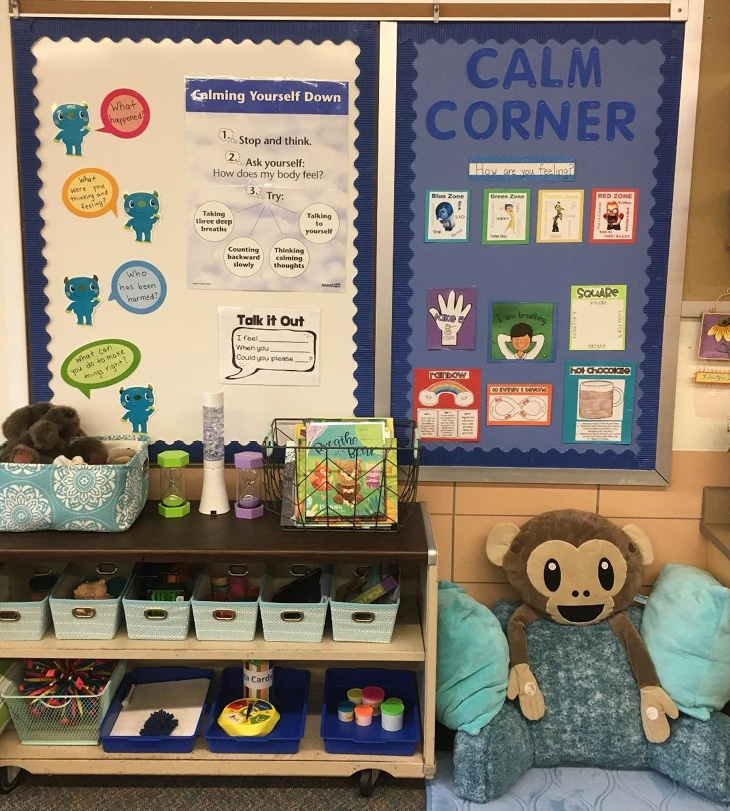
An example of some of the items and signs a Calm Corner could include.
What Is Mindfulness?
Mindfulness is the practice of focusing on the present moment.18 It is a commitment to channeling both your mental and physical being, allowing you to answer two key questions—What are you feeling in your body? and what emotions are you experiencing? We attempt to answer those questions by practicing two actions simultaneously: focused attention and mindful relaxation. Focused attention is the effort to concentrate on the present moment, using breathing as a guide. Mindful relaxation is a conscious effort to open the mind to non-judgmental compassion. We often refer to the skills by the acronym RAIN:
- Recognize your emotion
- Allow the emotion to be present
- Investigate the emotion with kindness
- Non-identifying with emotion
Collectively, these practices, influenced by hundreds of years of Eastern traditions, have physiological,19 mental,20 and emotional benefits.21
Because of common misunderstandings, it is also beneficial to know what mindfulness is not—it is not turning off the brain, escaping from reality by avoiding difficult feelings, or practicing religion (although some religious practices do incorporate mindfulness and meditation). In fact, mindfulness requires us to examine our feelings and asks us to focus attention on the relationship between our feelings and actions. We need to understand
- our red flags or triggers;
- what cognitive/emotional signs accompany stress;
- what our thoughts are while under stress; and
- how we cope.
How Can Mindfulness Practice Benefit Teachers and Students?
Approximately 80 percent of school-age youth meet the criteria for a severe mental disorder across their lifetime.22 Research shows that highly stressful environments create deficits in children’s working memory, attention, and inhibitory control skills,23 and mental health issues may also impact academic functioning.24 Although students encounter many barriers to emotional regulation and school success, including lack of self-control, anxiety, experience of trauma, and inability to delay gratification, teachers can introduce mindfulness to provide effective coping mechanisms. Teachers who practice focused attention and mindful relaxation have been shown to improve healthy relationships at school and home, particularly as it relates to social emotional learning.25 Mindfulness helps to boost resilience and positive coping, and also addresses common social and emotional learning goals.
Collaborating to Promote Mindfulness
Creating a peaceful environment has long been a goal for school librarians.26 Changing the physical space within the public-school classroom or in common areas in public libraries is one way in which librarians collaborate to promote a calming environment (e.g., creating a reading rug area). Teachers can also work with librarians to build a collection of children’s literature that promotes mindful practices. Times of mindfulness can also be opportunities for librarians to enter the classroom and participate in group reading sessions or co-coordinate engagement in calming activities.
A mindful classroom provides a safe and comfortable environment and requires a focused and thoughtful change in routines. We will outline the general classroom arrangement, including the Calm Corner and describe daily routines and procedures for practicing mindfulness.27
The Calm Corner
Although teachers are typically limited by the physical space and classroom furniture to which they are assigned, a mindful classroom incorporates some standard adjustments. Teachers should create a sense of openness by arranging desks in small working groups, allowing for students to access a variety of seating options (e.g., comfortable cushions, beanbags, yoga mats). Adding other features (e.g., lighting that can be adjusted, lava lamps), background music, and a Calm Corner are also low-cost ways to create a more peaceful and mindful space.
A Calm Corner is a safe space in a classroom that allows students to self-regulate using a variety of tools. The goal is to provide a physical space in the classroom where students can physically check in and out, as needed. It is important to note that the teacher does not send the student to the Calm Corner; when students are feeling anxious or distracted, they choose to go to the space. They also decide how long to stay, after considering the seriousness of the dysregulation they are experiencing. For example, sand timers can be utilized to provide students with time boundaries for using the Calm Corner (i.e., “little problem” uses a five-minute timer, while a “big problem” uses the larger ten-minute timer) and allow them to return to the classroom when they are ready to learn. All Calm Corners should include tactile (e.g., students can be taught to focus their attention on how a lump of clay feels when they hold it in their hands), visual and auditory tools, and be collaboratively created with the students.
Routines and Procedures
A mindful classroom requires a focused and thoughtful change in routines and consistent interaction with quality children’s literature.
Mindful Mornings
As students enter class, greet them by name and with soothing background music, e.g., nature sounds from the Calm app or mindfulness videos from GoNoodle (https://www.gonoodle.com/). Ask them to practice their mindful breathing as they unpack and get settled at their desks. The teacher uses mindful language, such as “put your mindful body on,” meaning that students are paying attention to the sensations inside of their bodies, while being aware of the space around them.28 As part of this routine, the students will use their personal journals to set an intention for the day, which is a way to bring the students’ focus to the moment, and identify two positive self-affirmations.
Morning Meeting with Quality Children’s Literature
After all students have arrived, grab their attention for a morning meeting. Students sit in a circle so that they can see one another, perhaps on the classroom’s reading rug. A student leads the class in a breathing exercise by counting breaths and modeling the use of the Hoberman ball (a ball connected by joints that can expand and contract with gentle pressure that changes the apparent size of the ball). When using the ball, the student slowly counts aloud and opens the ball as the class inhales and closes the ball as the class exhales. Prompt students with questions to create awareness of movements within a still body, such as “what movements do you notice in your body when you are trying to be totally still? How does your body feel after doing the mindful movements?”
Next, the teacher begins by greeting the student to their left or right with a handshake, high-five, fist bump, pinky shake, elbow bump, silent eye greeting, or another creative greeting. Students should look at each other in the eye when greeting one another around the circle. Next, the teacher reminds students of the expectations of mindful listening, authenticity, and empathy. Use a “talking piece” (i.e., a single object that indicates which student can contribute to the discussion); this helps create consistency to have one student speaking at a time. Everyone else is invited to practice mindful listening to hear the speaker. The teacher poses a question, such as “what are you grateful for this morning?” and passes the talking piece around the circle so that each child may share their response. Allow students to borrow items from the Calm Corner as students share emotions, positive affirmations or personal celebrations, and daily intentions from their journals. Invite students to identify/discuss problems that we need to address as a group and select a class goal for the day.29
After sharing, engage in a whole group activity. This could include reading and discussing one of the books (see the sidebar “Books with Mindfulness Themes” for suggestions), and practicing the students’ favorite yoga poses. If a book includes additional materials (e.g., a CD with guided meditations from Sitting Still Like A Frog), incorporate the activities into the morning routine to help students approach the day calm and ready to learn. Students can also practice breathing exercises or guided activities from popular apps like Smiling Mind (https://www.smilingmind.com.au/smiling-mind-app) and Stop, Breathe, and Think (https://www.stopbreathethink.com/kids/).
The sidebar “Librarian and Teacher Resources” provides additional professional resources and classroom ideas for teachers and librarians. The curation of these resources can be an opportunity for teachers to form stronger relationships with their school librarians. These activities also provide an opportunity for librarians to visit classrooms and interact with students outside of the library setting. Close the morning meeting with a mindful listening activity. It can be fun to find different sounds for the students to listen to, such as bells, rattles, singing bowl, or chime. Students close their eyes and focus their attention on the sound. When students can no longer hear the sound, they raise their hand. Once the entire class has raised their hand, the teacher invites the class to now focus their attention to their own breath. When ready, students open their eyes and transition to the next activity silently and mindfully.
Brain Breaks
Throughout the day, a mindful classroom engages in mindfulness breaks. This allows students to calm their minds and reinforce regular mindfulness practices.30 These breaks give students a chance to check in with their minds and bodies and refocus awareness and attention. For example, in the middle of a math lesson the teacher may ask students to put their pencils down, take a brain break, and take five deep breaths before continuing with the lesson. With a partner, you could pretend to pitch the baseball and swing the bat, complete a wheelbarrow race (e.g., one student does a plank on the floor and the second student carefully grabs the planking student’s ankles and takes small steps forward on their hands). The teacher may also ask the students to individually give themselves a hand massage, listen to a new sound, stand on their tippy toes, look at a new picture, listen to music, describe their thoughts or body sensations in a journal, or walk slowly or backwards with focused attention. Students may be asked to draw a picture to illustrate their mind and emotions in the present moment. Encourage students to engage in a mindful moment when they need a rest.
Problem-Solving: Rethink/Redo
Cultivating mindfulness builds on prior experience noticing and writing about thoughts, feelings, and sensations. When a student engages in behavior that does not align with the class compact agreements, the student can complete a “rethink, redo” self-reflection. The student reflects on the following questions: What happened? What were you feeling? What did you want to happen? Who was hurt? What will you do to repair the connection and make things right? This reflection encourages students to become aware of their inner experience while also focusing attention to their behavior and the impact it has on others in the classroom.
Ending the Day
At the end of the school day, a mindful teacher says goodbye to each student as they walk out the door. The teacher may remind students to take a mindful moment as the day is ending. Once the student leaves the classroom and heads to the bus, the student may take a deep breath and look at the sky or focus on nature. Shift attention away from the school to the new environment. Personal time for rest and recovery is important and healthy. A mindful teacher strives to nurture themselves in the same manner that they support their students.
Conclusions
Mindfulness has positive benefits for both teachers and students. Practicing mindfulness impacts the brain in areas of emotional regulation and attention and provides students with specific skills to improve problem-solving and reduce anxiety. Although integrating mindfulness practices (e.g., daily self-affirmations) and creating physical spaces for a Calm Corner require a shift in language and message, it may provide great benefits in the classroom. Teachers who embrace the opportunity to employ mindfulness may see changes in their own behavior and those of their students. &
References
- Kathleen Ries Merikangas et al., “Lifetime Prevalence of Mental Disorders in U.S. Adolescents: Results from the National Comorbidity Survey Replication- Adolescent Supplement (NCS-A),” Journal of American Academy Child Adolescent Psychiatry 49, no. 10 (August 2010): 980–89, https://doi.org/10.1016/j.jaac.2010.05.017.
- Dan Chisholm et al., “Scaling-Up Treatment of Depression and Anxiety: A Global Return on Investment Analysis,” The Lancet Psychiatry 3, no. 5 (April 2016): 415–24, https://doi.org/10.1016/S2215-0366(16)30024-4.
- Wendy W. Fuchs, Nancy J. Mundschenk, and Brian Groark, “A Promising Practice: School-Based Mindfulness-Based Stress Reduction for Children with Disabilities,” Journal of International Special Needs Education 20, no. 2 (2017): 55–66, https://doi.org/10.9782/2159-4341-20.2.56
- Richard Amundsen et al., “Mindfulness in Primary School Children as a Route to Enhanced Life Satisfaction, Positive Outlook, and Effective Emotion Regulation,” BMC Psychology 8, no. 71 (2020), https://doi.org/10.1186/s40359-020-00428-y
- Patricia Montiel-Overall, “A Theoretical Understanding of Teacher and Librarian Collaboration (TLC),” School Libraries Worldwide 11, no. 2 (2005): 24–48; Vera John-Steiner, Creative Collaboration (New York: Oxford University Press, 2000).
- Evelyn Montañez et al., “Turn 2 Us: Outcomes of an Urban Elementary School-based Mental Health Promotion and Prevention Program Serving Ethnic Minority Youths,” Children and Schools 37, no. 2 (April 2015): 100–107, https://doi.org/10.1093/cs/cdv004.
- Mei-Ling Lin et al., “Mental-Health Benefits of a Mindfulness-Based Prevention Program on Elementary Schoolchildren,” American Journal of Occupational Therapy 74, no. 4 (August 2020), https://doi.org/10.5014/ajot.2020.74S1-PO4128; Kim D.Rempel, “Mindfulness for Children and Youth: A Review of the Literature with an Argument for School-Based Implementation,” Canadian Journal of Counselling and Psychotherapy 46, no. 3 (2012): 201–20.
- David A. Langer et al., “Mental Health Service Use in Schools and Non-School-Based Outpatient Settings: Comparing Predictors of Service Use,” School Mental Health 7 (2015): 161–73, https://doi.org/10.1007/s12310-015-9146-z; Jon L. Quach et al., “Can a Teacher-Led Mindfulness Intervention for New School Entrants Improve Child Outcomes? Protocol for a School Cluster Randomized Controlled Trial,” BMJ Open 10, no. 5 (2020), https://doi.org/10.1136/bmjopen-2019-036523.
- Brandy R. Maynard et al., “Mindfulness-Based Interventions for Improving Cognition, Academic Achievement, Behavior, and Socioemotional Function of Primary and Secondary School Students,” A Campbell Systematic Review 5 (March 2017): 1–145, https://doi.org/10.4073/csr.2017.5; Randye J. Semple, Vita Droutman, and Brittany Ann Reid, “Mindfulness Goes to School: Things Learned (so far) from Research and Real-World Experiences,” Psychology in the Schools 54, no. 1 (November 2016): 29–52, https://doi.org/10.1002/pits.21981.
- Kim D.Rempel, “Mindfulness for Children and Youth: A Review of the Literature with an Argument for School-Based Implementation,” Canadian Journal of Counselling and Psychotherapy 46, no. 3 (2012): 201–20, https://mindfulnessinschools.org/wp-content/uploads/2013/09/remple.pdf.
- Gina Biegel et al., “Mindfulness-Based Stress Reduction for the Treatment of Adolescent Psychiatric Outpatients: A Randomized Clinical Trial,” Journal of Consulting and Clinical Psychology 77, no. 5 (2009): 855–66, https://doi.org/10.1037/a0016241.
- Mei-Ling Lin et al., “Mental-Health Benefits of a Mindfulness-Based Prevention Program on Elementary Schoolchildren,” American Journal of Occupational Therapy 74, no. 4 (August 2020), https://doi.org/10.5014/ajot.2020.74S1-PO4128.
- Wendy W. Fuchs, Nancy J. Mundschenk, and Brian Groark, “A Promising Practice: School-Based Mindfulness-Based Stress Reduction for Children with Disabilities,” Journal of International Special Needs Education 20, no. 2 (2017): 55–66, https://doi.org/10.9782/2159-4341-20.2.56.
- Erica M. S. Sibinga et al., “Mindfulness-Based Stress Reduction for Urban Youth,” Journal of Alternative and Complementary Medicine 17, no. 3 (March 2011): 213–18, https://doi.org/10.1089/acm.2009.0605.
- Joshua Felver et al., “The Effects of Mindfulness-Based Intervention on Children’s Attention Regulation,” Journal of Attention Disorders 21, no. 10 (August 2014): 872–81, https://doi.org/10.1177/1087054714548032.
- Nimrod Sheinman et al., “Preliminary Investigation of Whole-School Mindfulness in Education Programs and Children’s Mindfulness-Based Coping Strategies,” Journal of Child and Family Studies 27 (June 2018): 3316–28, https://doi.org/10.1007/s10826-018-1156-7.
- Yi-Yuan Tang et al., “Improving Executive Function and Its Neurobiological Mechanisms Through a Mindfulness-Based Intervention: Advances Within the Field of Developmental Neuroscience,” Child Development Perspectives 64, no. 4 (June 2012): 361–66, https://doi.org/10.1111/j.1750-8606.2012.00250.x.
- Thich Nhat Hanh and Katherine Weare, Happy Teachers Change the World (United States: Parallax Press, 2017).
- Britta K. Holzel et al., “Mindfulness Practice Leads to Increases in Regional Brain Gray Matter Density,” Psychiatry Research: Neuroimaging 19, no. 1 (January 2011): 36–43, https://doi.org/10.1016/j.pscychresns.2010.08.006; John Kabat-Zinn, Leslie Lipworth, and Robert Burney, “The Clinical Use of Mindfulness Meditation for the Self-Regulation of Chronic Pain,” Journal of Behavioral Medicine 8, no. 2 (1985): 163–90, https://doi.org/10.1007/BF00845519; Kenji Sanada et al., “Effects of Mindfulness-Based Interventions on Biomarkers and Low-Grade Inflammation in Patients with Psychiatric Disorders: A Meta-Analytic Review,” International Journal of Molecular Sciences 21, no. 7 (2020): 2484, https://doi.org/10.3390/ijms21072484.
- Catherine Malboeuf-Hurtubise et al., “Effects of Mindfulness-Based Intervention on the Perception of Basic Psychological Need Satisfaction among Special Education Students,” International Journal of Disability, Development, and Education 65, no. 1 (2017): 33–44, https://doi.org/10.1080/1034912X.2017.1346236; Michael D. Mrazek et al., “Mindfulness Training Improves Working Memory Capacity and GRE Performance While Reducing Mind Wandering,” Psychological Science 24, no. 5 (March 2013): 776–81, https://doi.org/10.1177/0956797612459659.
- Gina Biegel et al., “Mindfulness-Based Stress Reduction for the Treatment of Adolescent Psychiatric Outpatients: A Randomized Clinical Trial,” Journal of Consulting and Clinical Psychology 77, no. 5 (2009): 855–66, https://doi.org/10.1037/a0016241; Lisa Flook et al., “Mindfulness for Teachers: A Pilot Study to Assess Effects on Stress, Burnout, and Teaching Efficacy,” Mind, Brain & Education 7, no. 3 (August 2013): 182–95, https://doi.org/10.1111/mbe.12026 ; Filip Raes et al., “School-Based Prevention and Reduction of Depression in Adolescents: A Cluster-Randomized Controlled Trial of a Mindfulness Group Program,” Mindfulness Journal 5 (2014): 477–86, https://doi.org/10.1007/s12671-013-0202-1.
- Kathleen Ries Merikangas et al., “Lifetime Prevalence of Mental Disorders in U.S. Adolescents: Results from the National Comorbidity Survey Replication-Adolescent Supplement (NCS-A),” Journal of American Academy Child Adolescent Psychiatry 49, no. 10 (August 2010): 980–89, https://doi.org/10.1016/j.jaac.2010.05.017.
- Angeline Maughan and Dante Cicchetti, “Impact of Child Maltreatment and Interadult Violence on Children’s Emotional Regulation Abilities and Socioemotional Adjustment,” Child Development 73, no. 5 (January 2003): 152–42, https://doi.org/10.1111/1467-8624.00488.
- Susan Fread Albrecht et al., “A School-Wide Three-Tiered Program of Social Skills Intervention: Results of a Three-Year Cohort Study,” Education and Treatment of Children 38, no. 4 (November 2015): 565–86, https://doi.org/10.1353/etc.2015.0023.
- Daniel J. Rechtschaffen, The Way of Mindful Education: Cultivating Well-Being in Teachers and Students (US: Norton, 2014); Deborah Schoeberlein-David, Mindful Teaching and Teaching Mindfulness: A Guide for Anyone Who Teaches Anything (Canada: Wisdom Publications, 2009).
- Rolf Erikson and Carolyn Markuson, Designing a School Library Media Center for the Future: Second Edition (Chicago: ALA Editions, 2007); Anna Carello, “The Impact of School Library Design on the Development of Multiple Literacy Skills in Early Childhood Students,” Dissertations available from ProQuest, AAI10265345 (2017), https://repository.upenn.edu/dissertations/AAI10265345.
- Daniel Hayes et al., “Promoting Mental Health and WellBeing in Schools: Examining Mindfulness, Relaxation, and Strategies for Safety and Well-Being in English Primary and Secondary Schools: Study Protocol for a Multi-School, Cluster, Randomized Controlled Trial (INSPIRE),” Trials 20, no. 640 (2019), https://doi.org/10.1186/s13063-019-3762-0.
- Cristiano Crescentini et al., “Mindfulness-Oriented Meditation for Primary School Children: Effects on Attention and Psychological Well-Being,” Frontiers in Psychology 7, no. 805 (June 2016), https://doi.org/10.3389/fpsyg.2016.00805.
- Sarah E. Montgomery, Maya Van Driel, and Kim Vandendriessche, “Mindfulness: Promoting Peace in a Kindergarten Classroom,” Social Studies and the Young Learner 32, no. 1 (September-October 2019): 26–31.
- Crescentini et. al., “Mindfulness-Oriented Meditation for Primary School Children”; Joshua Felver et al., “The Effects of Mindfulness-Based Intervention on Children’s Attention Regulation,” Journal of Attention Disorders 21, no. 10 (August 2014): 872–81, https://doi.org/10.1177/1087054714548032.