Newbery Metrics: The Newbery and the Illustrators
 Steven Herb worked in support of the literature choices and literacy rights of children for over 45 years in classrooms, public libraries, and academic libraries. He served as 1996–97 ALSC President and followed that honorable assignment with three years of service as chair of ALA’s Intellectual Freedom Committee. He also served on the 2006 Newbery Award Committee.
Editor’s Note: Steven Herb was excited to contribute to this special issue; sadly, he passed away in December 2021 before publication.
I began reading Newbery Medal and Honor Books in elementary school, so I have been aware of the award for nearly three quarters of the life of children’s literature’s most famous prize. Johnny Tremain by Esther Forbes (1944)1 was an early favorite of mine, probably because of the Boston setting and Johnny’s painful adventure with molten silver.
My discovery of baseball statistics, and especially the use of SABRmetrics2 (or Sabermetrics, for spelling convenience) began when I became a serious fantasy baseball practitioner twenty-five years ago—someone who “owns” an imaginary baseball team made up of real players from the major league teams each year.3 A fantasy team combines the actual batting and/or pitching statistics of the real players drafted or acquired by an owner, and then is ranked against other league owners’ daily, weekly, or monthly statistics. Sabermetrics, this fascinating (and quite nerdy!) empirical analysis of baseball adds an extra layer of excitement I have not experienced with numbers since I decided not to major in mathematics in college after all. Three of my favorite statistical measures are on-base percentage (OBP),4 slugging percentage (SLG),5 and wins above replacement (WAR).6
This article is my tribute to two of my lifelong passions: reading and baseball, in metric syncopation.7
Newbery Honor Stats
Number of Honor Books Per Decade
The numbers of Newbery Honor titles vary from year to year, ranging from no titles (three times in the 1920s) to eight titles (twice in the 1930s), and everywhere in between, except seven.8
The 326 Total Newbery Honors, By Decade
27 honors in the 20s
50 honors in the 30s
41 honors in the 40s
40 honors in the 50s
26 honors in the 60s
24 honors in the 70s
28 honors in the 80s
26 honors in the 90s
34 honors in the 00s
30 honors in the 10s
326 total Newbery Honors9
Number of Honor Books Per Year
- 1923, 1924, 1927
- 1926, 1965, 1974, 1979, 1980, 1991, 1999
- 1925, 1928, 1943, 1955, 1963, 1964, 1969, 1976, 1977, 1978, 1981, 1982, 1986, 1988, 1989, 1992, 1995, 2002, 2004, 2012, 2015, 2019
- 1933, 1935, 1938, 1956, 1960, 1961, 1962, 1966, 1967, 1970, 1971, 1973, 1985, 1987, 1990, 1993, 1994, 1998, 2000, 2005, 2007, 2008, 2013, 2016, 2017, 2018
- 1936, 1940, 1941, 1942, 1944, 1945, 1946, 1949, 1951, 1958,1959, 1968, 1975, 1984, 1996, 1997, 2001, 2006, 2009, 2010, 2011, 2014, 2020
- 1922, 1939, 1947, 1948, 1950, 1952, 1953, 1954, 1957, 1972, 1983, 2003, 2021
- 1929, 1930, 1932, 1937
- None
- 1931, 1934
Longest repeated sequence—Between 1940 and 1946, only 1943 didn’t produce four Honor titles.
Longest gap between a repeated number—It was 39 years between two single Honor Book years (1926 to 1965).
Longest wait for a repeated number, and counting—It has been 94 years since the last 0 Honor Books year.
Average Honor Books per year—3.26
Three Newbery Metrics
Multiple Appearances on the Newbery Medal/Newbery Honor List
Nine writers have had their work recognized four times among Newbery Medals and Honors. They are:
- Jeanette Eaton—A Daughter of the Seine: The Life of Madame Roland (1930 Honor); Leader by Destiny: George Washington, Man and Patriot (1939 Honor); Lone Journey (1945 Honor); and Gandhi, Fighter Without a Sword (1951 Honor).
- Eleanor Estes—The Middle Moffat (1943 Honor); Rufus M. (1944 Honor); The Hundred Dresses (1945 Honor); and Ginger Pye (1952 Newbery Medal).
- Genevieve Foster—George Washington’s World (1942 Honor); Abraham Lincoln’s World (1945 Honor); George Washington (1950 Honor); and Birthdays of Freedom, Book One (1953 Honor).
- Russell Freedman—Lincoln: A Photobiography (1988 Newbery Medal); The Wright Brothers: How They Invented the Airplane (1992 Honor); Eleanor Roosevelt: A Life of Discovery (1994 Honor); and The Voice That Challenged a Nation: Marian Anderson and the Struggle for Equal Rights (2005 Honor).
- Elizabeth Janet Gray—Meggy MacIntosh (1931 Honor); Young Walter Scott (1936 Honor); Penn (1939 Honor); and Adam of the Road (1943 Newbery Medal).
- Virginia Hamilton—The Planet of Junior Brown (1972 Honor); M.C. Higgins, the Great (1975 Newbery Medal); Sweet Whispers, Brother Rush (1983 Honor); In the Beginning: Creation Stories from Around the World (1989 Honor).
- Cornelia Meigs—The Windy Hill (1922 Honor); Clearing Weather (1929 Honor); Swift Rivers (1933 Honor); and Invincible Louisa: The Story of the Author of “Little Women,” (1934 Newbery Medal).
- Scott O’Dell—Island of the Blue Dolphins (1961 Newbery Medal); The King’s Fifth (1967 Honor); The Black Pearl (1968 Honor); and Sing Down the Moon (1971 Honor).
- Jacqueline Woodson—Show Way (2006 Honor); Feathers (2008 Honor); After Tupac and D. Foster (2009 Honor); and Brown Girl Dreaming (2015 Honor).
Two writers have had five books recognized. They are:
- Meindert DeJong—Hurry Home, Candy (1954 Honor); Shadrach (1954 Honor); The Wheel on the School (1955 Newbery Medal); The House of Sixty Fathers (1957 Honor); and Along Came a Dog (1959 Honor).
- Laura Ingalls Wilder—On the Banks of Plum Creek (1938 Honor); By the Shores of Silver Lake (1940 Honor); The Long Winter (1941 Honor); Little Town on the Prairie (1942 Honor); and These Happy Golden Years (1944 Honor).
Ages of Newbery Winners
- Average age of Newbery Medal winners over the first Newbery Century—47.99.10
- Oldest Newbery winner—Carolyn Sherwin Bailey, 71, for Miss Hickory in 1947.
- Youngest Newbery winner—For 82 years, Elizabeth Enright held that distinction for receiving the Newbery Medal for Thimble Summer (1939) at 31 until Tae Keller won the Newbery Medal in 2021 for When You Trap a Tiger at 27.
- Charles Boardman Hawes, author of The Dark Frigate, won the third Medal in 1924, and he is the only Newbery Medal winner to die before the announcement and the ceremony, at age 34. His widow, Dorothea Cable Hawes accepted the award.
- Despite Hawes’ sadly premature death, apparently, Newbery Medal winners exceeded life expectancy for the United States, males and females, 59 percent of the time. That includes seventeen who lived into their nineties.11 They are Sid Fleischman (90), Scott O’Dell (91), Betsy Byars (91), Jean Craighead George (92), Jean Lee Latham (93), Elizabeth Coatsworth (93), Paula Fox (93), Irene Hunt (94), Walter D. Edmonds (94), Harold Keith (94), Marguerite Henry (95), Elizabeth Yates (95), Elizabeth Janet Gray (97), Elizabeth Borton de Treviño (97), Marguerite de Angeli (98), Ann Nolan Clark (99), and Beverly Cleary (104!).
Did You Ever Wonder about Newbery Illustrators, e.g., Who Worked on the Most Titles?
Apparently, I have.
There are three seven-time illustrators and their authors whose books have graced the lists during this Newbery century. To be asked that often to work with top writers is quite a tribute, but to be part of seven books to win the Newbery Medal or an Honor citation—extraordinary!
- Maurice Sendak. His Caldecott Medal for Where the Wild Things Are in 1964 is on many best Caldecott (and best picture book) lists since its publication nearly 60 years ago. In addition, he was the first American illustrator to win the Hans Christian Andersen Award for children’s book illustration and the first recipient of the Astrid Lindgren Memorial Award. He illustrated more than 150 books, with seven receiving Caldecott Honors; another seven won the Newbery Medal or Newbery Honor citation for their respective authors. The Newbery Honors went to Hurry Home, Candy (Meindert DeJong) in 1954, Shadrach (Meindert DeJong) in 1954, House of Sixty Fathers (Meindert DeJong) in 1957, Along Came a Dog (Meindert DeJong) in 1959, Animal Family (Randall Jarrell) in 1966, Zlateh the Goat (Isaac Bashevis Singer) in 1967, and the Newbery Medal to The Wheel on the School (Meindert DeJong) in 1955. That total of fifteen award books between the Caldecott and Newbery categories makes Maurice Sendak the book award champion.
- Kate Seredy was born in Hungary and moved to the United States at age 23. She briefly owned a children’s bookstore which helped her connect with children and to understand the expanding world of children’s books. Always thinking of herself as an illustrator first, writer second, Kate did something in 1936 no one had ever done before nor has done since—she illustrated the Newbery Medal book Caddie Woodlawn by Carol Ryrie Brink; wrote and illustrated The Good Master which received a Newbery Honor; and illustrated the cover and endpapers for Young Walter Scott by Elizabeth Janet Gray, also an Honor Book—the first time someone had a hand in three books receiving the Newbery Medal and Honors in the same year. Kate’s other four illustrated books (to bring her to seven) are an Honor Book in 1937 for Winterbound by Margery Blanco and an Honor Book in 1947 for The Wonderful Year by Nancy Barnes. Kate Seredy also received an Honor Book citation in 1940 for The Singing Tree, written and illustrated by Seredy; and the Newbery Medal in 1938 for The White Stag, also written and illustrated by Seredy.
- Lynd Ward was said to have noticed in first grade that his name spelled backwards was “draw,” and took that as career advice. He also illustrated seven Newbery Medal or Honor Books from 1930 to 1944. The first four of these he did while also producing his well-known wordless graphic novels, starting with Gods’ Man in 1929, published the week the stock market crashed in October. Astoundingly, it went through six printings in four years and sold over twenty thousand copies. Throughout the 1930s Ward created five additional wordless novels leading many to credit Ward as the father of the graphic novel of today. His work with children’s book authors included an Honor Book for Little Blacknose by Hildegarde Hoyt Swift in 1930; Spice and the Devil’s Cave by Agnes Danforth Hewes in 1931; Bright Island by Mabel L. Robinson in 1938; Runner of the Mountain Tops by Mabel L. Robinson in 1940; and Fog Magic by Julia L. Sauer in 1944.
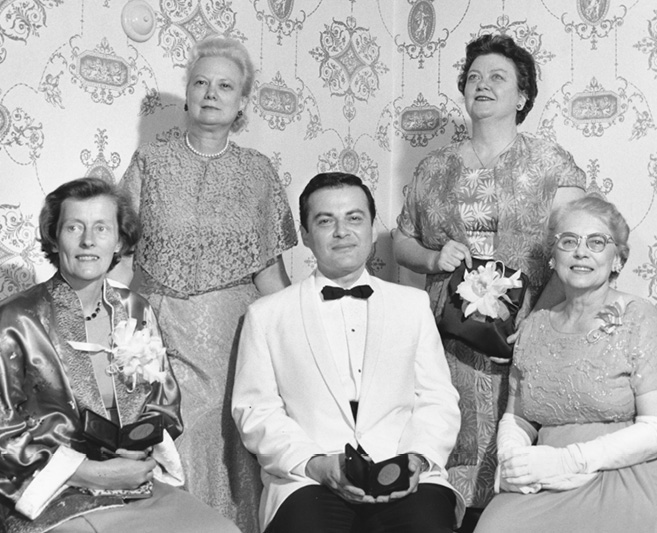
Pictured in this 1964 photo are, from left, Emily Neville, winner of the Newbery Medal; Maurice Sendak, winner of the Caldecott Medal; and Ruth Gagliardo, President of the Children’s Services Division. Standing left to right: Helen Sattley, chair of the Newbery-Caldecott Awards Committee and Ursula Nordstrom, juvenile editor of Harper & Row, publisher of both the winning books.
Like Sendak and Seredy, Ward also illustrated more than one Newbery Medal or Honor Book in the same year. In Ward’s case, he did it twice. In addition to Spice and the Devil’s Cave in 1931, Ward also illustrated the Newbery Medal winner—The Cat Who Went to Heaven by Elizabeth Coatsworth. He did it once more in 1944—sharing Fog Magic with the Newbery Medal Winner—Johnny Tremain by Esther Forbes. &
References
- All years associated with book titles in this article will be the Newbery or Caldecott year, rather than the copyright year, so the actual copyright year may be gleaned by simply subtracting one.
- SABR comes from the Society for American Baseball Research, founded in (the actual) 1971.
- I must acknowledge the inspiration of seven major league baseball heroes of my childhood and teen years—Henry Aaron, Roberto Clemente, Bob Gibson, Micky Mantle, Willie Mays, Frank Robinson, and Carl Yastrzemski. Great players all, and also statistical legends who helped start me on the sabermetrics path. I chipped my front tooth biting my thumb nail watching Clemente play in the 1971 World Series, but dropped any blame before the game even ended.
- In baseball statistics, on-base percentage (OBP) is the percentage of plate appearances where a batter reaches base for any reason other than an error or a fielder’s choice.
- Slugging percentage represents the total number of bases a player records per at-bat. Unlike on-base percentage, slugging percentage deals only with hits and does not include walks and hit-by-pitches in its equation. Slugging percentage differs from batting average in that all hits are not valued equally.
- WAR measures a player’s value in all facets of the game by deciphering how many more wins he’s worth than a replacement-level player at his same position.
- My Newbery metric choices focus on things one can’t find in any list, anywhere, without some time and arithmetic —and ignores the easy-to-find facts. For example, can you find the list of the six two-time Newbery winners? Try it—see, not so hard. Kate DiCamillo for The Tale of Despereaux in 2004 and Flora and Ulysses in 2014; E. L. Konigsburg for From the Mixed-Up Files of Mrs. Basil E. Frankweiler in 1968 and The View from Saturday in 1997; Joseph Krumgold for . . . And Now Miguel in 1954 and Onion John in 1960; Lois Lowry for Number the Stars in 1990 and The Giver in 1994; Katherine Paterson for A Bridge to Terabithia in 1978 and Jacob Have I Loved in 1981; and Elizabeth George Speare for The Witch of Blackbird Pond in 1959 and The Bronze Bow in 1962.
- This article was completed in November 2021 at the conclusion of the year that the one-hundredth Newbery Medal was named, along with five Honor Books. Since the Newbery moves on to 101 in 2022, many metrics will change, but these numbers may be considered a snapshot of the Newbery at 100.
- All decade-by-decade data are organized and presented from one to ten (for example 1961 to 1970), as decimal data are typically presented. The only exception is that 2021 is presented with the 1922 to 1930 numbers to allow for ten relatively equal decades.
- Since the announcement and awarding dates shifted during the 100 years of Newbery, a uniform date was selected to represent the annual awarding, mostly for the determination of winners’ ages. To accentuate the celebration of books written in the United States, July 4 was selected.
- Sixty-four Newbery Medal winners have passed away and thirty-six were alive as of November 2021.