The Pandemic and Preschoolers: COVID Kids and How Libraries Can Support Them
 Tess Prendergast worked as a children’s librarian for over twenty years. After completing a doctorate in early literacy education, she began teaching librarianship and children’s literature courses at The School of Information, University of British Columbia, in Vancouver, Canada. She has served on many ALSC committees and has recently completed her term on the 2023 Geisel Award committee. She is facilitator of the ALSC Preschool Discussion Group.
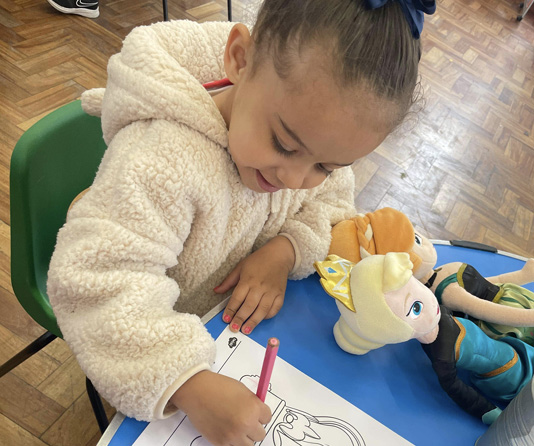
Librarians around the nation must learn how to address preschoolers in a post-pandemic world.
In an article called “COVID Babies,” Adam Clark explores various ways that the pandemic has affected children’s development.1 Clark begins with a vignette about a two-year-old named Charlie who is in speech therapy to help him learn to speak more than one-word utterances. Nancy Polow, one of the speech pathologists interviewed in the article, notes, “I have never seen such an influx of infants and toddlers unable to communicate. We call these children COVID babies.”
Shuffrey et al. studied two cohorts of babies born shortly after the pandemic began: those whose mothers had COVID-19 while pregnant and those whose mothers did not have COVID-19 while pregnant.2 Compared to an older cohort of children born before the pandemic, both pandemic-era cohorts showed significantly lower scores on gross motor, fine motor, and social skills than the pre-pandemic cohort. While exposure to the virus in utero does not seem to be implicated, the researchers speculated that the stress that pregnant mothers experienced during the first part of the pandemic might have contributed to some of the developmental lags they saw. They urge long-term monitoring of children born during the pandemic to better understand the impact of being gestated and born during this time period.
Similarly, Deoni et al. conducted a study that indicated that babies born since the start of the pandemic show significantly lower general cognitive scores when compared to children born between 2011 and 2019.3 Not surprisingly, they also pointed out that the negative impacts of the pandemic are most apparent in lower socioeconomic families and surmised that more affluent families had more resources to draw on to help them through the toughest months of isolation. This likely reduced the pandemic’s harm on their children while poorer children were more vulnerable to its negative effects.
Another study conducted by Raffa et al. explored parental perspectives on the effects that COVID-19 has had on their children’s development.4 Echoing the concerns voiced by the researchers mentioned earlier, parents indicated that the economic hardships of the pandemic imposed difficult conditions on their families, especially those who lost their jobs. They also noted an upside of pandemic life when describing the extended amount of time they spent with their children, which they believed strengthened their bonds. However, they also voiced concerns about their children’s many lost opportunities for social development.
In terms of education, as we know, while libraries provided curbside service and virtual storytimes, children were in virtual classrooms with varying levels of support from their caregivers who may have been busy with younger children or working themselves. In a recent blog post, Dr. Timothy Shanahan said, “Primary grade kids missed out on a lot of teaching in the teeth of the pandemic. Some managed to parlay their shortened Zoom lessons and mom and dad’s kitchen table efforts into adequate and appropriate decoding ability. Hooray! But, sadly, for too many others . . . things haven’t worked so well.”5
These studies likely confirm what many of you have already experienced or observed. As much as we might wish we could put the pandemic years behind us, the truth is that the effects of the past few unprecedented years are still being tabulated. We are seeing, and will continue to see, all of these impacts in our daily interactions with people, and we can also be sure that these same impacts are being felt by the families we don’t see in the library. Importantly, we should be asking ourselves how can we help to address some of the ongoing harms brought to children and families by the pandemic?
What are the impacts of this pandemic era on children, parents, and caregivers? We all have personal anecdotes to share.
My friend Fay told me that by the time lockdown was lifted, her three-year old daughter Kennedy was extremely wary of new places and new people. She said, “It took her so long to learn social skills…it took her four months to properly settle into preschool. I put a lot of it down to lockdown.”
She explained that Kennedy needed time to figure out how unfamiliar environments worked before she could engage at all. Fay recently told me that Kennedy will soon start junior kindergarten. Plus, she said that the group reading they did at Kennedy’s preschool “really brought her imagination to life.”
“For her graduation play, they acted out The Very Hungry Caterpillar by Eric Carle, and Kennedy was so proud to play the part of Swiss cheese!” Most importantly, Fay credits the preschool staff with bringing her “little lockdown baby out of her shell.”
I think this is a hopeful sign. Children who had lags in their social and emotional domains can catch up with the addition of targeted supports. In addition to high quality, affordable, and accessible early childhood education like what Fay described, I also think that children’s libraries can play a role in helping to make up for what lockdown took away from kids. Also, since we already know a lot about how to make things inclusive for children with disabilities, we can apply all those same resources to include kids who are still catching up. These are kids who might have language, motor, and social delays. These might be toddlers who did not have the benefit of in-person babytime when they were infants. These might be kids heading off to kindergarten who have not yet had a chance to be coaxed out of their shells like Kennedy was. These might be school age kids who have missed out on countless outings and playdates with friends and forgot how to share and take turns. These are also school age kids that Shanahan referred to who are still struggling with their reading skills because of their inadequate instruction during Zoom school. Now that libraries are fully open, and storytimes and other programs are in person again, it is important to make sure that these COVID-era kids and their families get what they need to thrive.
We can work together on this. At the ALA Annual Conference in Chicago this year, I facilitated the ALSC Preschool Services Discussion Group. As I am no longer a children’s librarian in a public library role, I was curious about what my colleagues out in the field were seeing in their libraries. I was so inspired by the work they were doing and how they were supporting families who had made their way into the library, some of them for the first time.
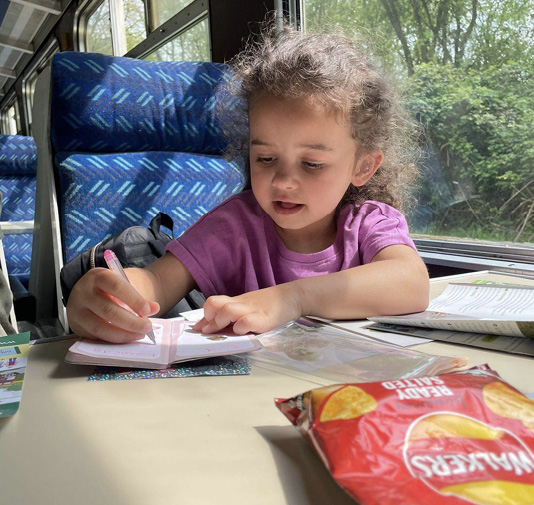
We talked about how some folks might have no prior knowledge of what a storytime is, what it’s for, and how to behave. If the parents don’t know, neither do their kids. We talked about slowing things down and using visual schedules to help everyone understand what was happening, and what was happening next. We talked about being welcoming above all else, even when things are not going great. We talked about various approaches to providing resources that point parents towards developmental supports like speech-language therapy. We also talked about my favorite soapbox topic when it comes to inclusiveness—group size.
We agreed that different communities need to take different approaches to how they make decisions to manage their storytimes. What was clear to me was that no one was being turned away and that librarians are working extremely hard to meet their communities’ needs for stimulation and socialization. If parents brought kids to storytime for socialization before the pandemic, they are definitely going to bring them in to socialize now because they know their kids need it. Finally, we discussed some recommendations to share.
- Contact the speech-language and other early intervention support services in your area and encourage them to send their caseload families to the library. Talk to speech therapists about what they are seeing and ask what you can do to help the families they serve. Remind them that your storytimes are a great place to support early literacy and language growth and that you welcome children of all abilities all the time.
- Direct parents to resources and supports (like speech therapy and learning disability services) if they voice concerns about their children’s development or reading skills to you. Encourage them to return to the library even if their child has a developmental issue that needs to be addressed. They can go to speech therapy and storytime! They can get help with their reading skills and join in fun, book-themed programs! In the US, as part of the Individuals with Disabilities Education Act (IDEA), every state and territory provides publicly funded early intervention for free or reduced costs for any child (up to age three) who is eligible. If a caregiver has concerns about a child’s development, they can contact the early intervention program and have their child evaluated (at no cost) to determine if the child is eligible for early intervention services.
Beyond the child’s third birthday, evaluation and services are offered through local school districts. A caregiver can call the local school district (and request to speak with someone in special education) about having the child evaluated (at no cost) for preschool special education services. Depending on the school district and the services the child needs, the child may qualify for preschool (and other services such as speech therapy that would be offered while at preschool) or for services (e.g., speech and language therapy) offered separately from a preschool classroom.
More information about early intervention services is detailed at https://www.cdc.gov/ncbddd/actearly/parents/states.html.
In Canada, free therapeutic services for infants and toddlers with delays and disabilities are typically covered by provincial infant development programs as well as regional health services. Canadian librarians should connect with their local services to learn how to make referrals as needed
- Adjust your storytimes for a wider range of development. Pandemic era three- or four-year-olds with little social experience might act more like younger toddlers for a while, and that’s fine. It’s okay if your preschool storytime looks like toddler storytime for a while. If a child is reluctant, let parents know that starting out with just a few minutes or even a few seconds of storytime is great: they should be encouraged to keep coming back to build their child’s confidence in the storytime environment. So many of us have stories about kids like this, and we know they slowly come out of their shells and grow to love storytime!
- Make and use visual schedules in all your programs, not just storytime. You can start with this ALSC Blog post: https://www.alsc.ala.org/blog/2018/06/visual-schedules-making-programs-accessible-for-all/.
- Encourage honest conversations with parents and caregivers about post-pandemic family life and ask what the library can do to help them. They might have some fantastic ideas that you could easily fulfill to make their lives easier. Just acknowledging what they went through (and are still going through) is a good place to start. Remember that many families are still very wary of exposure to COVID-19 due to risk factors that might not be immediately apparent. This is a great reason to continue offering some virtual resources like Zoom storytime. Some families simply cannot come back to the library.
- Finally, focus on the joy of shared language, literacy, stories, hands-on creation materials, toys, spaces, and all the wonderful activities that you have for families to engage with at the library as well as the resources you can provide for them to use and enjoy at home. The children’s library should be a place where families can connect with other families and just let their kids play together. The children’s library should be a place they go to get help and ideas about supporting their kids’ development and learning, and we all have an important role to play. &
References
- Adam Clark and NJ.com/TNS, “‘Covid Babies’ Aren’t Talking as Much as They Should. How Much Is the Pandemic to Blame?” Disability Scoop, October 18, 2022, https://www.disabilityscoop.com/2022/10/18/covid-babies-arent-talking-much-how-much-pandemic-blame/30084/.
- Lauren C. Shuffrey et al., “Association of Birth during the COVID-19 Pandemic with Neurodevelopmental Status at 6 Months in Infants with and without in Utero Exposure to Maternal SARS-CoV-2 Infection,” JAMA Pediatrics 176, no. 6 (2022): e215563–e63, https://doi.org/10.1001/jamapediatrics.2021.5563.
- S. C. Deoni et al., “The COVID-19 Pandemic and Early Child Cognitive Development: A Comparison of Development in Children Born during the Pandemic and Historical References,” medRxiv (preprint), August 16, 2022, https://doi.org/10.1101/2021.08.10.21261846.
- Brittany J. Raffa et al., “Parental Perspectives on the Impact of the COVID-19 Pandemic on Infant, Child, and Adolescent Development,” Journal of Developmental and Behavioral Pediatrics 44, no. 3 (2023): e204–e11, https://doi.org/10.1097/DBP.0000000000001166.
- Timothy Shanahan, “If You Want Higher Reading Achievement, You’re Going to Have to Deal with the COVID Aftermath,” Shanahan on Literacy (blog), April 15, 2023, https://www.shanahanonliteracy.com/blog/if-you-want-higher-reading-achievement-youre-going-to-have-to-deal-with-the-covid-aftermath.