To run a successful DML, you need to think of everything in advance. People will attempt to bend the rules and ask questions you never expected. Situations will arise where you have to make a split-second decision. This chapter will guide you on the questions to anticipate before they happen.
Staff Training
Your community is full of smart people, but a DML will expose them to equipment and software they may never have had the opportunity to work with before. Therefore, while the activities in your DML may mostly rely on the knowledge of patrons, people will also need help to get started on projects.
There are a variety of options to fulfill the people-centric need of patrons. You can hire knowledgeable employees or train volunteers to staff your DML. Personal assistance may be on an appointment, drop-in, or program-led basis. Your patrons will present your staff with common questions such as how to get started scanning, to challenges such as how to use a particular piece of software. Staff can be trained using the same resources that can be found in the Patron Education section below.
Job Description
If you have funding for it, sometimes the best way to staff the DML is to hire expert help. While it is important to make sure the person is personable and provides excellent customer service, they also need to be comfortable with technology. At my library, the DML is partially staffed by whomever is working the computer labs. When we created a new position description, I broke down the job duties to list software frequently used and common tasks that may require assistance.
As far as skills go, the ideal candidate would need to
- get people started using the DML’s equipment
- refer patrons for further assistance with using specific resources
Other libraries may be hiring someone to take full responsibility for the DML, assist on digital projects, or act as an outreach person. Table 3.1 lists some specific duties for DMLs from five libraries.
Manuals and Instructional Materials
When staff members are not present to assist patrons, you have some fallback options such as manuals and other resources. Remember that the DIY movement is based upon people who are internally motivated. They will read a manual, do research, etc., to work on their project if no staff help is available. Your manual is for those people. Other patrons will be unable to follow the steps or be unwilling to teach themselves. See the section Patron Interactions later in this chapter for help in dealing with patron behavior problems.
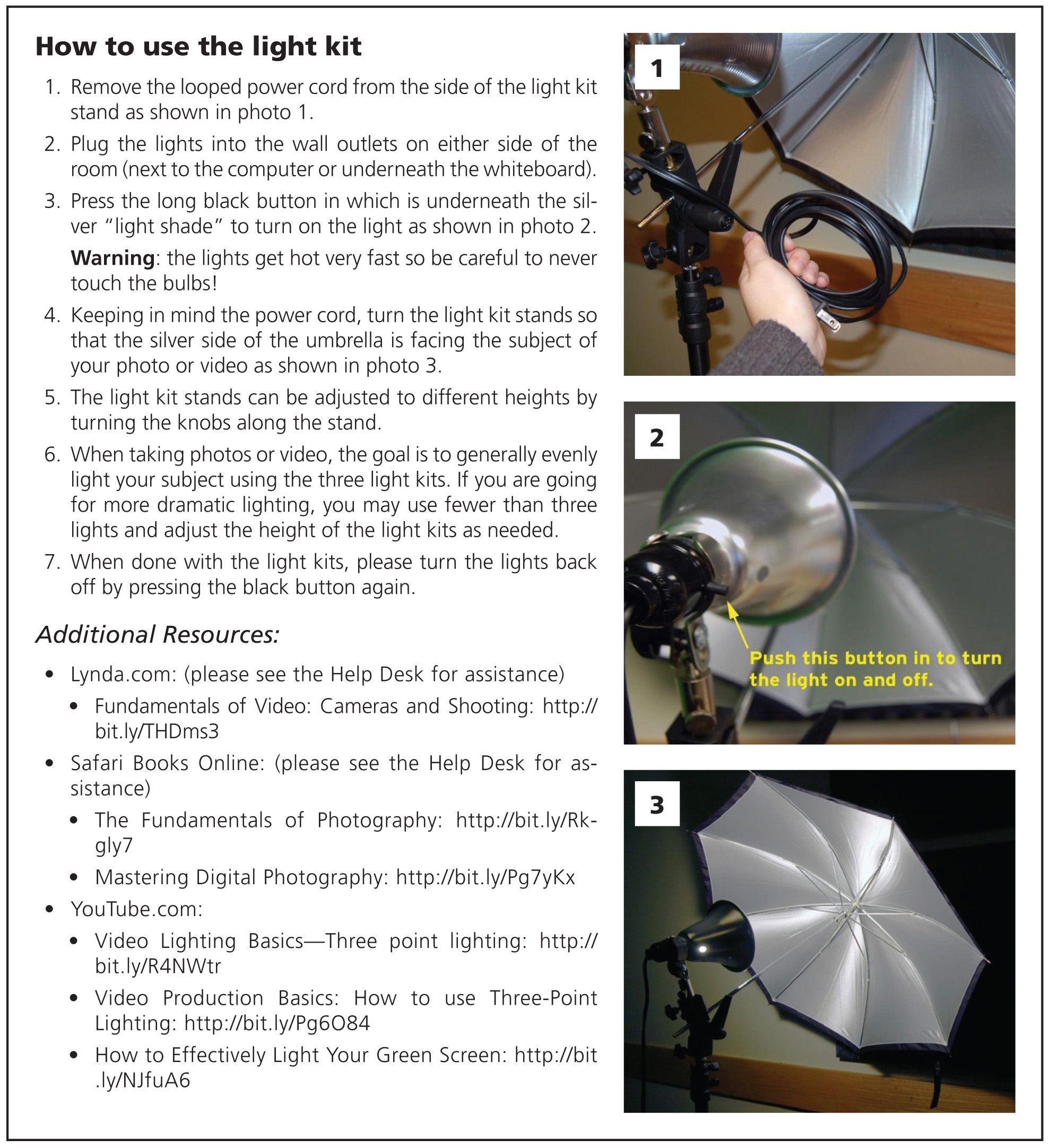
For my DML I created a handbook of tutorials that includes photos and screenshots to accompany the steps. At the end of each section is a list of further resources, which I handpicked from YouTube, Safari Books, and Lynda.com. A sample is included here to show how a tutorial is put together (figure 3.1).
Patron Education
To teach yourself something takes a certain kind of self-starter. Libraries are great at providing resources for people to use to entertain and teach themselves. The DML is no different. While it is more likely that most patrons will look for some human assistance, you can also give patrons the DIY option.
YouTube
“More than 1 billion unique users visit YouTube each month.”1 YouTube has the largest audience of hosted video websites, thus making it the primary choice for people wanting to share their knowledge on a variety of topics. Anyone with a webcam can create how-to videos for free. There are three types of videos: with text only, with people doing voice-overs but not showing their faces, and with people looking straight into the camera as they talk about their subject. Often overlooked or discounted in favor of paid options, YouTube is a great place not only to learn everything about a topic but also to just look up tips and tricks.
Lynda.com
If you are looking for high-quality professional videos from experts, Lynda.com is worth the money. The company is friendly to libraries and offers a range of price schemes. There are entire courses on software, hardware, and subjects such as user experience and marketing. Recently, the company has expanded into areas such as interviews with experts in their fields.
The main difference between YouTube and Lynda.com, aside from cost, is that the Lynda.com courses are several hours in length while YouTube video creators often go for a tip per video. However, Lynda.com breaks the courses down into main topics with several videos exploring each topic, along with captions and transcriptions. Exercise files are available if your subscription plan allows it. Lynda.com is the choice for the serious student.
Safari Online Books
Like Lynda.com, Safari offers a range of plans and access to its online catalog of books. The benefits of a subscription:
- access to some new books as they are being written
- saving of shelf space by using e-books
- frequently updated collection
A library can choose a subscription level that grants access to a preselected collection of e-books available for that level of service. For an individual subscriber, the entire collection of technology books is available.
Experts: Paid or Volunteer
Several libraries rely on workshops or one-on-one appointments to teach patrons how to best use the equipment in their DML. You do not need to hire an outside expert but can use a knowledgeable staff member instead. You can build partnerships with local organizations to help run workshops on special DML-related activities.
MOOCs
Next to everyone learning to code, massive open online courses (MOOCs) are the other hot thing in education. The idea here is that an instructor will set up an online class that is open to anyone who wants to enroll (though some classes limit enrollment). The course is usually composed of video lectures; some offer interactive quizzes, forums, and a way to submit your work. A course may run for an entire semester or for a few weeks. MOOCs are generally free, though providers and universities are experimenting with having students pay a fee to receive some sort of verified credit that they successfully completed the work.
While the educational effectiveness of MOOCs is debatable, they are another free option to add to your patron self-paced training arsenal. One thing to keep in mind, though, is that many MOOCs are open for only a limited amount of time. So a patron could not join a MOOC that ended last semester. However, others are open with no teacher support. Some of the more popular MOOC sites are listed below.
MOOC Sites
Canvas Network
https://www.canvas.net
Coursera
https://www.coursera.org
edX
https://www.edx.org
Future Learn
https://www.futurelearn.com
Policies and Liability
In surveying librarians about what they were most interested in learning about operating a DML, I found that everyone wanted to know how to protect the lab and its patrons. Your library should consider how to handle damage to library property, appropriate versus inappropriate usage of the lab, and patron injuries. There is no one-size-fits-all policy for any of these scenarios. The best prevention is to think ahead about what is outlined in your preexisting policies and what your board may or may not support and, if needed, get legal counsel as you draw up your policies and liability forms.
DML Policies
A policy covers how your room is to be used. It may cover how many people may use the DML at once, which activities are not allowed (e.g., just browsing the web), whether food and drinks are allowed, etc. The broader you keep the policy, the easier it will be to apply to a variety of situations. You can often rely on your behavior, technology, and Internet use policies when constructing guidelines for your DML.
Sample DML Policies
Appleton Public Library Policies
www.apl.org/about/policies
Park City Library: YouCreate Lab Policy
http://youcreate.parkcitylibrary.org/policies
Penn Libraries: Vitale Digital Media Lab Policies
http://wic.library.upenn.edu/wicfacilities/policies.html#lab
Liability Forms
Eventually someone may get injured in your DML. While this day is a dreaded one, you can try to warn people about dangers in the DML by having them read and sign a liability form. This form may not stand up if challenged in court, but it is proof that the person has acknowledged their responsibilities in using the DML. Likewise, the liability form lets the patron know that they are agreeing to pay any fees related to restoring or replacing equipment they break while in the room.
Sample Liability Forms
Frankfort Community Public Library: Policy for Use of Digi-Dock
http://fcpl.accs.net/digidockcontract.pdf
Skokie Public Library: Youth Digital Media Lab Permission Form
www.skokielibrary.info/s_kids/kd_surf/DML/DML-permission-form.pdf
Fayetteville Free Library Fab Lab Maker Agreement
http://fflib.org/images/pdfs/fflfablabmakeragreement.pdf
Copyright
You cannot screen what people do in the DML or be held responsible for everything a patron does with the equipment. Along with your usual policies and liability form, you should consider how to handle copyright violations and piracy. Libraries generally cover these issues in a policy on Internet use. However, since users of the DML are going to be content creators, they should know the basics of copyright. For example, just because audio, images, sound, or text is available online does not mean that it is free for them to use in their projects. To help communicate copyright requirements to your patrons, consider a poster, a handout, or an explanation in a manual that stays in the room.
Piracy
People may torrent or download copyrighted materials to your computers. The downloading of protected materials may result in your library being served with a copyright violation notice. Check with your library board to see how violations of the Digital Millennium Copyright Act are handled.
Questions to Consider
The following questions were gathered by asking librarians on Facebook and Twitter about their concerns about running a DML. These questions give you some ideas on what to think about before opening your DML to patrons. Some of these questions were presented to the libraries surveyed; their answers appear in chapter 4.
Equipment
- Will you let people check things out? Your library should consider this question before ordering equipment. If you do allow checking out equipment, you can order an extra camcorder, lightbox, portable scanner, etc., for patrons. Items can be assigned to the DML as the location, and patrons can go there to pick up the items. If you require a liability waiver for other equipment, use a modified version of the same form to save yourself some work. Patrons will be thrilled if you allow them to have a mobile DML experience by taking the equipment home with them, but it is okay if you cannot afford to do so.
- How do you handle broken equipment? Let’s face it: any equipment handled by the public (or staff) may get broken. Your library board may require that patrons pay up or be banned from the library or DML for nonpayment. Or you may have flexibility for how you approach such situations. Factors to consider may include the cost, such as for lightbulbs, which were going to need replacement anyway. Also, was the damage done intentionally or not? As discussed in the Maintenance section in chapter 2, you need a plan for how to handle broken items. You can also have a statement in your liability form as to what a patron would be responsible for in case of an accident.
Remember, though, if something gets broken, keep calm. Your first priority is to ensure everyone’s safety, then to remove the damaged item. Refer back to your policy and liability form for what to do next.
- Do you allow dangerous tools in the DML? Your usual DML equipment should not pose any dangers other than how hot lightbulbs can get. If you decide to add something like X-Acto knives, Shannon Barniskis offers these suggestions from her experience of kids and soldering irons:
- Have a liability form.
- Have adequate supervision.
- Make sure each patron is fully trained in safety.2
- Will you let people drink or eat in the DML? The equipment in your DML may not be on the same replacement schedule as the other items in your library. Whether you allow food or drink in the room stems first from the entire library’s outlook on food and drink. If consuming things is permissible in your library, you may wish to consider it for your DML. Patrons will often be working hard at a station for hours, so a drink and a snack would be nice. If you decide to go that route, think about these considerations:
- smelly food
- greasy food
- food wrappers
- drinks—replaceable lids
- sticky drinks
- crumbs and other debris from eating
Patron Interactions
- Should people be allowed to run a commercial venture using tools from the DML? This question came from a patron of mine who wanted to edit his professional videos. I took this question back to my boss, who determined that while demand for the room was slow, it was not an issue. So the main issues here are answered in the following questions: Is a business owner monopolizing the DML? Is it fair to use public property like a DML to run a for-profit business? Along the same lines, does your library allow small businesses to work in other locations throughout the building? If so, as long as the DML is not being monopolized, there may not be a conflict of interest in how one business group is being treated versus another. As for the business being for profit, this issue is similar to whether your library grants meeting rooms to other business patrons. While ultimately the decision lies with your library, make sure that you are treating all groups equally in what services they may access.
- What do you do if someone is using the room all the time? The first step to preventing this issue is to look to your policy regarding the DML. Is there a daily time limit? A weekly limit? If not, go ahead and revise your policy to include one. Otherwise, you may face patrons who want to keep the DML to themselves. By thinking this through ahead of time, you will not be singling a person out but letting them know at the start about the time limits.
However, if you already have a DML and have this problematic patron behavior going on, you will run into a different issue. You can try to be nice and point out that they are monopolizing, but the patron may become angry and feel singled out. To combat those feelings, see the American Library Association Allied Professional Association (ALA-APA) article that says:
- Listen
- Breathe
- Pay attention
- Lower your voice
- Watch body language
- Call for backup3
You should not approach the patron until you have a changed policy in hand. As for what to do for that day, allow the patron to spend the rest of their time in the DML. Then let them know that next time they come in, they will be held to the new policy.
- How do you handle patrons who complain that their usage should have priority? This question stems from someone believing that their project is more important than another patron’s work. You may run into this priority issue when an adult is unhappy about a teen experimenting with the tools in the DML. You have to be firm. Everyone’s use of the DML is equal and valid as long as none of your policies are being broken. Ask the patron if they would like to go ahead and schedule the next available time slot or for tomorrow.
- What do I do if a patron wants me to do their work for them? It is unlikely that you have enough budget to assign a personal assistant for everyone who walks through the DML’s door. However, many patrons will expect a staff member to sit next to them the entire time. In order to stop that at the source, your staff members need to communicate up front that they are there to help, not to do the work for the patron. Make it clear that you will be nearby, but that you cannot sit next to them and watch them record their oral history if that is not within the scope of your DML. Some patrons may be unwilling to believe you, but please refer to the ALA-APA’s steps mentioned above in communicating with the unruly user.