Figures
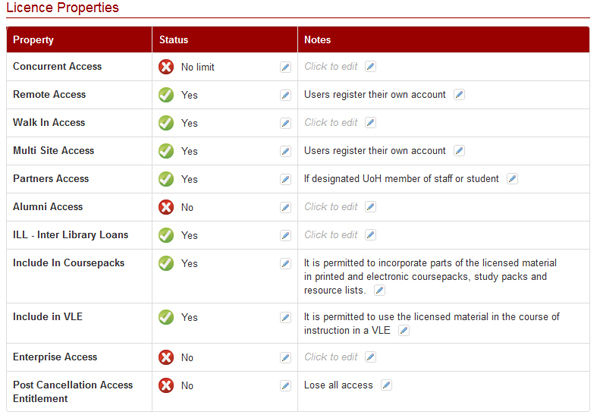
[Figure ID: fig1] |
Figure 3.1
Knowledge Base + resource license properties (reproduced with kind permission from Jisc Collections) |
| Chapter 3: Acquisition of New Content | |
| Jill Emery | |
| Graham Stone | |
|
|
|
| Abstract |
Acquiring resources once they are selected can be very straightforward or very complicated, depending upon the resource to be purchased. Chapter 3 of Library Technology Reports (vol. 49, no. 2) “Techniques for Electronic Resource Management” discusses the steps that usually occur when acquiring new content and services. |
Acquiring resources once they are selected can again be very straightforward or very complicated, depending upon the resource to be purchased. When setting up a demand-driven plan, the criteria for establishing the titles to be offered sets the plan in motion while not selecting specific resources for purchase up front. The following acquisitions steps usually occur when acquiring new content and services.
Once a request has been made to purchase electronic content or a service that supplies electronic content, both the seller and the purchaser need to agree on what is being purchased and how it will be purchased. A selection criteria grid (for an example, see appendix 2.1) can be sent directly to the seller to verify that you are both in agreement about what is to be purchased. In addition, you may need to profile the criteria to be used for demand-driven plans much like the profile mechanisms used for approval plans. The criteria could be focused on specific publishers to be included or excluded, or it could be focused on specific subject areas. From this point, you must now reach agreement on how the purchase will occur, for instance:
If a contract is not needed for the electronic resource, the negotiation will occur primarily for the payment terms. There will probably also be a need to create some sort of order for your purchase in your integrated library system (ILS) or purchasing management system along with posting the invoice details for payment. If presented with a contract for content, ask if the provider will accept the SERU guidelines for purchasing as the first negotiation point if a regional or national agreement is not in place. If you have to negotiate a contract with the provider for content or service, it is best to have a model record of terms that are acceptable to use as a starting point. Here is a list of the top fourteen usual deal breakers for academic institutions when licensing electronic resources:
The Publisher reserves the right at any time to withdraw from the Licensed Material any item or part of an item:
- for which the Publisher no longer retains the right to publish and for which the Publisher has been unable to secure the provisions as set out in Clauses 8.7 and 8.8; or
- for which the Publisher has reasonable grounds to believe it infringes copyright or is defamatory, obscene, unlawful or otherwise objectionable.
In the event of a withdrawal, the Publisher shall give written notice thereof to the Institution. If the withdrawn material represents more than ten per cent (10%) of the Licensed Material, the Publisher shall make a pro rata refund of the Fee to the Institution. The refund will take into account the amount of material withdrawn and the length of the Subscription Period remaining.1
SERU Guidelines
Project COUNTER
LOCKSS
CLOCKSS
Portico
www.portico.org/digital-preservation
SHERPA/RoMEO
You can measure any license you are given against these guidelines. If you feel really confident and have full support from your institution, you can give your license model to the provider and see if the provider will agree to the terms you have outlined. In your model license agreement, separate terms that must be in the license and terms that can be acceptable or left as-is in a provider’s license.2
When working out payment terms, first settle on the amount to be paid. Do not be afraid to ask for discounts if you have purchased a number of other resources from the same provider or if you are setting up a significant deposit account. Find out if you can start out purchasing by number of users, or if site license is the only option available. Since uptake does sometimes take up to two years, you may want to start with a lower user base prior to upgrading to a site license. If there are plans to upgrade in the future, make sure to include pricing increases due to user limit changes in future budget forecasts. You do not want a nasty surprise when your subscription costs go up if you want to move to unlimited users a few years down the line. If the content or service to be purchased will be used by a niche or small group of people, then see if you can negotiate for the smallest number of users possible or base pricing on the intended user base from a dedicated department or area within your institution. For example, if you acquire a specialist chemistry resource, you might want it priced for the chemistry faculty only and not for FTEs in the whole institution, as nobody else is likely to use it. In addition, make sure you understand where the users can access the resource from; always try to negotiate for unlimited access from on and off campus. Make sure you check that this access covers all campuses and needed access points, as many contracts specify a single site. When looking at the contract details, check to see which country’s law the contract uses for governing law (e.g., US law, UK law). Always negotiate to get this altered to your own country’s law, and if needed in North America, to province or state law. Clarify what is part of the contract and what constitutes additional services. Is training free? What about MARC downloads usage information, etc.? Find out if the MARC records or XML metadata about the resource will come directly from the provider or from a third-party supplier, and on what schedule. Also check to see what the reuse conditions are. Can you import MARC or XML records into shared resource platforms or union catalogs? When negotiating price, compare the resource to other resources you may take from that vendor. If there is a 30 percent crossover, ask for a 30 percent discount! Find out when the provider expects the renewal to be processed annually so you can set the appropriate dates in your purchasing system or ERM system. Check the period of renewal required. Many contracts state up to three months’ notice is required for cancellation.3
The provider will usually want to provide a clean copy of the license for signature and will promise to incorporate any agreed-upon changes and send it back to you. Make sure to reread the entire document to ensure the changes have been incorporated correctly and nothing else has changed. In these volatile budgetary times, be sure to include an “out clause.” An out clause allows your institution the ability to cancel or back out of any agreement prior to any given cancellation terms due to financial hardship. An example of an out clause would be:
In the case of a significant decline in financial support to (X library) by their main funding source, (X library) reserves the right to cancel significant portions and potentially cancel this subscription with 30 day notification.4
If you are setting up a deposit account for funding a demand-driven plan, make sure the date of when the funding should be deposited is explicitly stated, along with when additional funding is needed to continue the plan.
After you have fully checked and reviewed the license agreement, submit your changes and make-or-break contract provisions back to the provider for further negotiation. This may result in numerous back-and-forth e-mails or phone calls before you reach agreement on language that both you and the provider find acceptable.
It is important not to rush into an agreement or succumb to pressure to get the resource out there as quickly as possible without an adequate license that covers and protects both parties. It is far harder to change or add options (e.g., including walk-in users, alumni, satellite campuses, etc.) after the license has been signed.
One of the first things you should find out when you take an electronic resources position is who can legally sign off on agreements for content. The signing authority varies from one institution to another. If you have signing authority, after the agreement terms have been negotiated, then you can sign the agreement. If the signing authority lies elsewhere in your organization, negotiate the terms the library needs first, then forward the agreement to the signatory body for signature. If the agreement needs to be signed by another party in your organization, set realistic expectations as to when the signed copy will be delivered to the provider. Allow time for the signing authority to review the agreement and to ask any questions in order to finalize the signing of the agreement. If your signing authority reviews contracts from all parts of your institution, allow the time needed to process everything within the queue.
Once the agreement has been signed and the purchasing terms finalized, record all pertinent aspects of the payment terms, service terms such as MARC/XML metadata provision, and license terms within your ERM tool and your accounting system as well as possible. Include the type of agreement signed, whether it was a SERU Guidelines agreement or full-fledged contract. Be sure to set your renewal dates at least thirty days out to allow for cancellation as needed.5
In the United Kingdom, the Knowledge Base + (KB+) project provides a facility for all nationally negotiated licenses to be available in ONIX-PL format. “ONIX for Publications Licenses (ONIX-PL) is part of a family of XML formats for the communication of licensing terms under the generic name ONIX for
Licensing Terms. ONIX-PL is specialized to handle the licenses under which libraries and other institutions use digital resources, particularly but by no means exclusively electronic journals.”6 KB+ then allows individual institutions to add their own versions of the licenses, for example, with core content, pricing, and other details pertinent to the institution. There is also a facility within KB+ for institutions to scan and add their own licenses for locally negotiated content. This means that institutions can store all licenses at a central point electronically without having an ERM system.
Knowledge Base +
The benefit of reading the data in ONIX-PL format is that KB+ can offer a traffic-light system where institutions can easily see certain criteria, such as walk-in users (see figure 3.1), as was mentioned in the previous chapter. This means that the electronic resources manager does not need to keep referring to the licence whenever a question is raised about these areas.
In October 2012, Serials Solutions became the first ERM vendor to map ONIX-PL license expressions for all Jisc Collections license agreements to 360 Resource Manager. Thus, the licenses can now be used to populate an ERM system. Mark Bide, executive director of EDItEUR, is quoted as saying that “with the inclusion of Jisc Collections license data in 360 Resource Manager, we are starting to see the potential of ONIX-PL to improve the availability and quality of licence information throughout the supply chain. As EDItEUR begins a review of ONIX-PL we look forward to working with Jisc Collections, academic libraries, publishers, and systems vendors to build on this work and improve the usability of ONIX-PL.”7
Jisc Collections
Serials Solutions 360 Resource Manager
| 1. | Jisc Collections, “The Model NESLi2 Licence for Journals, ” most recently amended May 2009, accessed November 6, 2012, www.jisc-collections.ac.uk/Help-and-information/How-Model-Licences-work/NESLi2-Model-Licence- |
| 2. | For standard license agreements, see LicensingModels.org, accessed November 6, 2012, www.licensingmodels.com |
| 3. | Miller, Rachel. “Acts of Vision: The Practice of Licensing, ”Collection Management 2007;32(no.1–2):173–190.doi:10.1300/J105v32n01_12 |
| 4. | International Coalition of Library Consortia (ICOLC), “Revised Statement on the Global Economic Crisis and Its Impact on Consortial Licenses, ” January 19, 2009, accessed November 6, 2012, http://icolc.net/statement/revised-statement-global-economic-crisis-and-its-impact-consortial-licenses |
| 5. | Rathmel, Angela. “Innovative Practices in Electronic Resources and Acquisition Management, ”Against the Grain 2010;23(no. 1):61–62. |
| 6. | EDItEUR, “ONIIX-PL, ” accessed November 6, 2012, www.editeur.org/21/ONIX-PL |
| 7. | Mark Bide, quoted in Liam Earney, “Jisc Collections Licence Information to Be Included in Serials Solutions 360 Resource Manager, ” news release, October 15, 2012, accessed November 6, 2012, www.jisc-collections.ac.uk/News/Jisc-Collections-licences-in-360-Resource-Manager |
|
[Figure ID: fig1] |
Figure 3.1
Knowledge Base + resource license properties (reproduced with kind permission from Jisc Collections) |
Article Categories:
|
|