Figures
[Figure ID: fig1] |
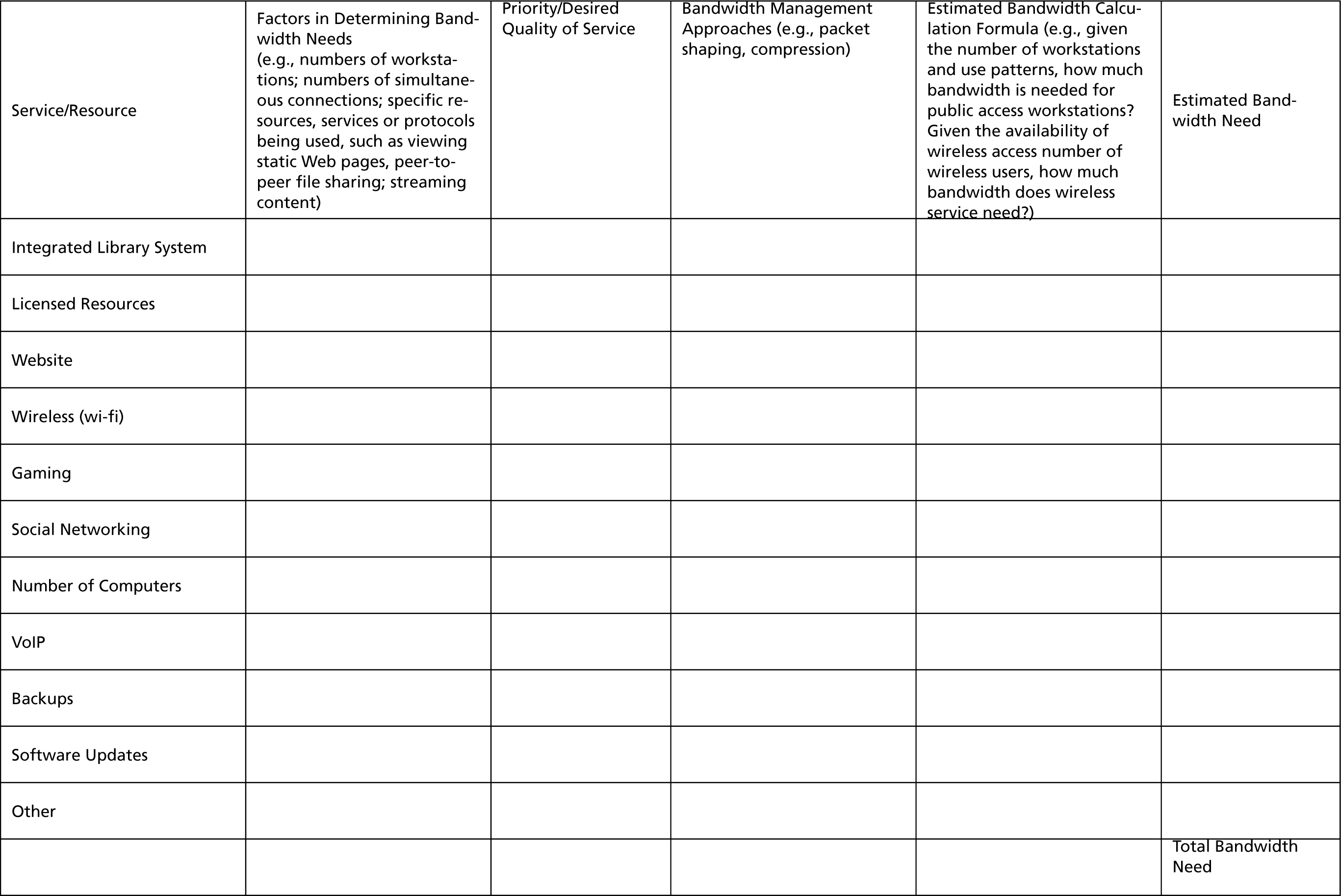
Figure 21
Capacity planning worksheet. |
| Chapter 8: Capacity Planning for Broadband in Public Libraries: Issues and Strategies | |
| John Carlo Bertot | |
|
|
|
| Abstract |
Almost anyone who has worked in a library understands that librarians are constantly working on a tight budget, even when the economy is strong. With state and local governments struggling to stay afloat, budget cuts for libraries have already begun, and more are expected. Ironically, as the economic crisis forces libraries to slash spending, demand for library services actually increases as cash-strapped families try to use more free sources of entertainment. With this issue, we aim to assist librarians in budgeting and planning for library technology during a difficult financial crisis. By offering both a detailed analysis of the current state of library technology funding and expert-authored, practical guides to stretching your budget and planning for maximum efficiency, the content of this issue can help librarians fulfill their technological needs while weathering the ongoing economic storm. |
The current context of public library public access technology provision is paradoxical. On the one hand, libraries continue to offer a substantial number of public access services—workstations, licensed resources, training programs, digital reference, and wireless access, to name a few. On the other hand, public libraries are clearly compromised in their ability to continue enhancing the services they offer. Librarians face budget cuts in a tough economy, building issues like space availability, adequate power, and cabling, resource availability, staff skills and access to broadband connectivity. In spite of these obstacles, the content, services, and resources of the network-based environment are evolving rapidly. Though it is difficult to predict the exact development of the Internet in the coming years, it is clear these new technologies are essential to public library services, in terms of both business functions and user resources. Today, these services are more interactive, more complex, and more bandwidth-intensive. Thus librarians find themselves with strained resources, but the need to continually implement and update increasingly complex and demanding network-based services. This chapter focuses on issues associated with building broadband capacity within public libraries to meet the connectivity needs of public access services.
The traditional view of building broadband capacity for one-way traffic into the library is outdated. With oft-accessed Internet-based resources like YouTube, Second Life, Facebook, Hulu, and a host of others, the broadband needs of today's libraries should encompass a robust bidirectional network. But the pressure is not just from library users, as users and libraries alike generate their own content and engage in these interactive, real time services and resources. Rather, there are multiple pressure points that must be addressed in order to ensure adequate broadband capacity in libraries.
Public libraries adopted the Internet in its early stages, and continue to provide network-based services and resources. The most recent 2007–2008 Public Library Funding and Technology Access survey found:1
This technology infrastructure includes an array of services like licensed databases; homework resources; audio content, such as podcasts and audiobooks; digital reference; gaming; e-books; integrated library systems; as well as dozens of other services and resources. In a general sense, the more interactive Web 2.0 environment is placing increasing pressure on the library's limited bandwidth.
Two recent reports by the U.S. Internet Industry Association and Scarborough Research indicate that broadband adoption by U.S. consumers is up substantially and available to 99% of households in the nation (defined as available to at least one person in a particular zip code).2
These reports were based on the historical definition of broadband (200 kbps in either direction, upload or download) adopted by the Federal Communications Commission (FCC) and reflect the type of data the FCC requires ISPs to report.
On March 19, 2008, the FCC adopted a five-tiered definition of broadband:3 200 kbps to 768 kbps (“first generation data”); 768 kbps to 1.5 Mbps (“basic broadband”); 1.5 Mbps to 3 Mbps; 3 Mbps to 6 Mbps; and 6 Mbps and above. The FCC will also require that broadband be measured in both directions (upload and download), not just one direction as it had been in the past. The new guidelines also implement new reporting requirements for ISPs. The new definitions are still based on residential access and fail to consider the broadband needs of a public access venue like a public library. Moreover, the United States suffers from a lack of a national broadband vision and policy that encompasses clear goals and a timeline towards promoting ubiquitous broadband.4
Closely tied to the bandwidth issue is the federal E-rate program. The E-rate program was established as part of the federal Telecommunications Act of 1996. It provides an important source of revenue (in the form of discounts on bills of 20 to 90 percent) to support K–12 school and public library Internet access and telecommunication services. The latter includes discounts on broadband circuits that support Internet access and other services and applications, including shared integrated library systems. The program is funded at $2.25 billion annually and is part of the broader universal service fund collected from the telephone companies.
Taken together, these reports, studies, and the E-rate program provide a complex and competing picture of broadband issues within the context of public library public access. The telecommunications industry, and to some extent the FCC, indicate that broadband is available throughout the United States at affordable rates. On the other hand, the library community indicates that broadband is not accessible, not affordable, does not meet the needs of their public access services, and requires substantial planning and management—regardless of E-rate. Both call into question the quality of public access Internet services that public libraries can offer their communities.5
Given the current context of public library broadband deployment, capacity barriers, services offered, and increasing demands of Internet-based applications, we must ask how libraries should plan, build, and implement robust networks that meet today's broadband demands—but also grow to meet the demands of applications yet to come.
There are a number of factors that can impact a library's bandwidth. These include:
The above planning considerations are not definitive and serve as a beginning point for libraries to consider their bandwidth needs. Moreover, libraries should not view their networks as static since:
Given this fluid and dynamic broadband environment, libraries need to continually assess their broadband needs and consider approaches that can help to meet demand.
Regional Cooperatives and IT Planning
By Nancy Bolt
Regional cooperatives can be a huge source of support for library IT planning. Cooperatives offer many services, including:
- Helping local libraries to plan for broadband deployment
- Planning for network growth and development of new services
- Planning for the capacity that each library will need and implementing that capacity before a library's network is overwhelmed
- Reaching out to member libraries to facilitate planning and services and to ensure that they will have enough available bandwidth
- Monitoring and tracking peak use at member libraries and for the network as a whole to determine when increased bandwidth is needed
- Implementing high level configuration to the network so that all libraries receive adequate broadband and the network itself can handle the total load
- Forecasting new shared services that can reside on the network such as digitations of local documents or video conferencing
- Managing all services of the network
The planning considerations presented above, though simplified, may be beyond many libraries that do not have the technical expertise to engage in successful capacity-planning efforts. And yet these planning efforts are critical to library networked services. Libraries that do not have the expertise to develop capacity plans or have difficulty in understanding telecommunications issues may find assistance from their telecommunications providers, network/telecommunications consultants, city or county technology and telecommunications staff, state library agencies, regional library consortia, ILS vendors, and others. Increasingly, it is through networks that information flows in and out of the library. Indeed there is almost no service in a library now that does not rely on network transmission, whether its circulation systems, e-mail, and interlibrary loan, or public access services such as wireless access, workstations, licensed databases, or digital libraries. Without sufficiently planned and managed bandwidth, a host of library services will at best slow to access and use or at worst impossible to access and use.
| 1. | Libraries Connect Communities: Public Library Funding and Technology Access Study 2007–2008 (Chicago, IL: American Library Association, 2008). |
| 2. | U.S. Internet Industry Association, Deployment of Broadband to Rural America(Alexandria, VA: U.S. Internet Industry Association, 2008), www.usiia.org/pubs/Rural.pdf (accessed October 20, 2008); Scarborough Research, The Need for Internet Speed: Broadband Penetration Increased More Than 300% Since 2002. (New York: Scarborough Research, 2008), www.scarborough.com/press_releases/Broadband%20FINAL%204%2015%2008.pdf (accessed October 20, 2008). |
| 3. | Broache Anne, FCC Approves New Method for Tracking Broadband's Reach, CNET News(2008), www.news.com/8301-10784_3-98981s18-7.html (accessed October 20, 2008). |
| 4. | Windhausen John, A Blueprint for Big Broadband (Washington, DC: Educause, 2008), http://connect.educause.edu/Library/Abstract/ABlueprintforBigBroadband/45996 (accessed October 20, 2008). |
| 5. | Carlo Bertot, John; McClure, Charles R. Assessing Sufficiency and Quality of Bandwidth for Public LibrariesInformation Technology and Libraries 2007;26(no. 1):14–22. |
Article Categories:
|
|