Laura Tovey suggests asking four questions before beginning any competency assessment:
- What is the nature of the organization? Is it structured and hierarchical, operating in a relatively stable industry or is it fast moving and in an industry [that] is “high-tech” related?
- What is the purpose of competency assessment? Will it serve as a basis for all activities in the management development cycle: selection, assessment, development, and/or succession? Is it required for a specific element described above for a competency-based performance management system?
- For which levels of the organization do you want to identify competencies? All levels, non-managerial, supervisory/junior management, middle/senior management?
- How can competencies be defined so that they are meaningful to the organization in question?1
Let me try to answer these questions generically on behalf of most libraries. Those at your individual library will want to think about and answer these questions as well.
- Most libraries are quite structured and hierarchical, though you may be lucky and work in one of the more laterally organized libraries. The industry is fast moving and definitely high-tech.
- The purposes of a competency assessment are, as outlined in the previous chapter, to create clear expectations from management, save money in the long run, improve the accuracy of job descriptions and classifications, create a culture of learning, redistribute the technology workload fairly, improve customer service, and build a coordinated technology-training program for staff. Most libraries do not have succession planning or “management development cycles.” Competency assessment is required to create a competency-based performance management system (e.g., folding competency descriptions into staff reviews and evaluations).
- Most libraries would like competency descriptions to exist for all staff positions.
- Ahh … this one is tricky, and herein lies the purpose of this report: How exactly do you define competencies that are meaningful? In short, by asking the people involved and listening to their answers, by doing your own research into what has worked for other similar organizations, and by doing your best to synthesize the two.
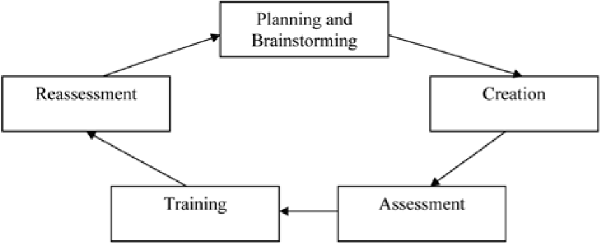
Competency creation is a cycle (see figure 1).
The first thing needed is a little thinking—planning, organizing, making some preliminary basic decisions, and getting some staff input.
Step 1: Create a Competencies Task Force
Some libraries have left the creation of technology competency descriptions to one staff member, either a manager, a technology-support person, or a training coordinator. I highly recommend against this one-person approach for two key reasons. First, that person will be overwhelmed with the amount of work required. Second, the quality of the end product increases when you add more brainpower to it.
Instead, create a small task force composed of representatives from the various departments or staff positions within your institution. The makeup of a task force may look something like this:
- branch manager
- supervisory-level librarian (adult/teen/children services)
- nonsupervisory-level librarian (adult/teen/children services)
- circulation supervisor
- library assistant
- branch aide
- training coordinator
- technology support analyst
Or like this:
- circulation representative from main library
- librarian representative from main library
- circulation representative from large library X
- librarian representative from large library X
- circulation representative from small library Y
- librarian representative from small library Y
- representative from administrative support
- representative from technology support
- representative from training support
Please note that both lists include staff responsible for technology and training. I think it is essential in any competencies task force to tap the knowledge of these staff members if you are lucky enough to have them. These are the people who work with all of the staff positions; they're the ones who already have a pretty good feeling for knowledge gaps and even for who knows what at an individual level. Their contributions to the task force will be invaluable.
In forming the task force, you may want to ask for volunteers for the project from the various groups you wish to have represented. You could also ask the various committees (e.g., circulation, children's/teen/adult librarians, branch managers) to select representatives. Or you may simply want management to appoint people based on who they think will do a good job. Of these three methods, I would encourage the first, as it will result in a positively engaged task force with an interest in the project.
The task force should schedule regular face-to-face meetings (biweekly or monthly seems to be the preference for most libraries), but members should also be available to communicate via e-mail or instant messaging (IM). The task force may also wish to consider setting up a wiki, discussion board, or blog to foster communication about the project and to preserve the process as it occurs.
Someone needs to head the task force, and it needn't be the highest-ranking manager in the group. Instead, I would encourage libraries to have their training coordinators lead the task force. In the absence of a training coordinator, choose the staff person on the task force who is most likely to keep the group on task and focused on getting the project done in a timely fashion.
Step 2: Write a Purpose Statement
Why are you creating descriptions of technology competencies? This is the first question the task force needs to answer. The task force's first meeting should consist of brainstorming possible elements of a purpose statement, ending the meeting with one in hand. The purpose statement can guide the planning process and serve as a beacon document as the task force moves forward with creating the competency descriptions. The purpose statement can also match the competency descriptions with the library's strategic goals and objectives—that's management-speak for “make sure that what you're asking your employees to know reflects where the organization needs to go in the future.” For example, if you'd like to hold training classes for the public on more advanced topics and have staff members teach those classes, then perhaps you should include competencies about how to train, instead of competencies about understanding network architecture. The purpose statement should be disseminated to all staff members—along with a brief explanation of the process and the task force's activities.
Possible elements to include in a purpose statement are:
- all those things listed in chapter 1 under “Benefits of a Competencies Program”
- helping staff meet user needs
- stimulating service excellence
- answering the question “What do I need to know to do my job?”
- explaining the components for success in a job
- planning continuous staff development
- improving the staff's ability to be self-sufficient
- educating others (e.g., governing bodies and users) about what we do
Some sample purpose statements from existing lists of competencies for libraries are:
- Oakland Public Library: “Library staff have to deal with technology issues every day, and it sometimes feels as if our skills can never keep up with the constantly changing technologies that surround us in our work. Many staff have asked ‘What's expected of me? What do I really need to know to do my job?’ This document attempts to answer those questions with regard to the technological hardware and software that are used here.”2
- Public Library of Charlotte and Mecklenberg County: “The PLCMC Information Technology Core Competencies are set up as building blocks for staff to provide a firm foundation in using computers and technology. Core Competencies Training will give staff the opportunity to learn more about computers and technology and the opportunity to strengthen their existing technology skills—all of which will enable staff to perform their jobs better and to assist the public more effectively.”3
- New Jersey Library Association: “The document is intended for several purposes:
- To educate communities, governing bodies and funding agencies about the importance of the knowledge and skills of professional librarians;
- To develop job descriptions and evaluation tools for professional positions;
- To design policies, particularly as these policies relate to the organization and staffing of libraries;
- To guide students attending graduate library school;
- To apprise library school faculty members who are involved in the development of curricula of the continuously changing needs of the profession;
- To assist in planning staff development programs; and
- To motivate professionals to take responsibility for managing the development of one's own career.”4
- California Library Association: “This set of competencies is intended to serve as a base model for technology competencies among California library workers. California's libraries are incredibly diverse; there are many different types and sizes of libraries, different staffing, and different technology. The purpose of these competencies is not to be the guidepost by which all libraries measure technology skills, but rather to serve as a starting point for libraries to use in assessing their staff's technology proficiencies, and to assist libraries in building their own sets of tailored competencies to fit with their unique staff and library.”5
Step 3: Set a Time Line
Once a purpose statement has been created, the task force should create a realistic time line. The task force should set a date by which it wishes to accomplish each of the steps outlined in this report (and any other steps it may need to add due to local circumstances). I suggest that the overall process, from writing the purpose statement to developing a training plan based on the self-assessments, should take no longer than six months. Depending on the size of your library, you may be able to complete the process in much less time, and if that's the case, more power to you.
Step 4: Determine Local Approval Requirements
Find out from administration which governing and other decision-making bodies may need to approve the competencies list before they are implemented. Groups may include your commission or board, a parent organization like a county or city board of supervisors or a university regulations board, the library's administrative team, specific staff members (like the director), and your employee unions. Many libraries now have unionized employees, perhaps even employees in more than one union. Determine early on in the process whether the union needs to formally approve any competency descriptions you put in place, or whether perhaps approval is required only if the competencies are tied to pay increases and decreases or promotions and demotions. This is an extremely important step in the process—and not one to be missed or taken lightly.
Step 5: Complete a Literature Review
At this point, each member of the task force should be given some required reading. Now this is very, very important: this reading should be done on work time, not personal time. Despite a famous First Lady saying that the most enjoyable part of being a librarian was getting to read books all day, we all know that being able to read anything on work time is not an element of the librarian jobs we have and know. However, it is essential that task force members be given work time to read through some of the following in order to better prepare themselves for the discussions ahead. Asking an employee to read materials required for work on personal time is tantamount to unpaid overtime. So, now that we're on the same page, here are some of the things the task force could consider reading:
- Choose three or more lists of technology competencies from Appendix 1.
- Choose three or more lists of general competencies from Appendix 2.
- Choose some of the articles about technology and competencies listed in the Works Cited and Consulted for this report.
The head of the task force should consider reading more sample competency lists and articles than the other members so that one person will be familiar with all of the materials being discussed.
Here are three excellent articles about technology skills the task force members should read (in addition to the three from the third bullet above) to get some ideas of competencies to include, as well as some of the overall themes and ideas of what library staff truly need in today's information society.
- Tennant, Roy. “The Most Important Management Decision: Hiring Staff for the New Millennium.” Library Journal 123, no. 3 (February 15, 1998): 102 (1). Roy Tennant lists a number of personality traits that library administrators should be seeking in their new hires in this article. Instead of listing particular programs, languages, and technologies, he recommends going after staff members who can learn those specifics but who have the necessary personality traits to make their ongoing learning and “keeping up” a benefit for your organization. Read Tennant's article for more information, but consider including statements about the traits he listed:
- the capacity to learn constantly and quickly
- flexibility
- an innate skepticism
- a propensity to take risks
- an abiding public service perspective
- an appreciation of what others bring to the effort and an ability to work with them effectively
- skill at enabling and fostering change
- the capacity and desire to work independently
- Farkas, Meredith. “Skills for the 21st Century Librarian.” Information Wants to Be Free, July 17, 2006 http://meredith.wolfwater.com/wordpress/index.php/2006/07/17/skills-for-the-21st-century-librarian. Meredith Farkas describes a unique set of skills in this blog post. She posits, and quite rightly so, that library schools are failing their students by not teaching them “how to really be able to keep up with technology, make good decisions about its implementation, use it and sell it to others.” She lists two tiers of competencies for staff: Basic Tech Competencies and Higher Level Competencies.
Basic Tech Competencies
- ability to embrace change
- comfort in online medium (“way beyond basic catalog and database searching”)
- ability to troubleshoot new technologies
- ability to easily learn new technologies
- ability to keep up with new ideas in technology and librarianship (enthusiasm for learning)
- an appreciation of what others bring to the effort and an ability to work with them effectively
- skill at enabling and fostering change
- the capacity and desire to work independently
Higher Level Competencies
- project-management skills
- ability to question and evaluate library services
- ability to evaluate needs of all stakeholders
- vision to translate traditional library services into the online medium
- critical of technologies and ability to compare technologies
- ability to sell ideas/library services
A fascinating discussion ensues after Meredith's post, discussing other skills needed by modern librarians and how library schools can better prepare their outgoing students to have these skills.
Karen G. Schneider wrote two follow-up posts on her own blog, Free Range Librarian, to Meredith's post. The first was “Libraryland Skills for Any Century.”6 She notes some other skills that librarians need to thrive in today's environment: cunning, impatience, and pessimism. Karen points out that cunning leads to political acumen, impatience leads to forward movement and time lines, and pessimism leads to planning for emergencies. In a follow-up comment to Karen's post, Dorothea Salo adds “‘frustration tolerance,’ and only because I've seen bad, bad things happen to librarians who lacked it.” Schneider's second follow-up post, “Libraryland Skills, Part Deux,” notes a few more: stubbornness (stick-to-it-iveness), high grubbiness tolerance (unpleasantness of all sorts—smells, management tasks, and people), a caution about hubris (staying realistic about what you have now and might not have tomorrow), being lucky (“Enjoy the good times, live them to the max, shine when you can, but don't get too smug.”), and knowing how to be in the moment (enjoy the high notes).7
- 3. Turner, Laura. “20 Technology Skills Every Educator Should Have.” T.H.E. Journal, June 1, 2005, www.thejournal.com/articles/17325. Laura Turner lists twenty technology skills that every educator should have—secondary, elementary, special education—everyone. Librarians have long considered ourselves to be allied and on the same footing as our teacher counterparts. Likewise, many of the same skills are required by both groups for the assistance of the students we serve. Here are her twenty items:
- word-processing skills
- spreadsheet skills
- database skills
- electronic presentation skills
- Web navigation skills
Web site design skills
- e-mail management skills
- digital camera skills
- computer network knowledge applicable to your school system
- file management and Windows Explorer skills
- downloading software from the Web (including e-books)
- installing computer software onto a computer system
- WebCT or Blackboard teaching skills
- videoconferencing skills
- knowledge of computer-related storage devices (disks, CDs, USB drives, zip disks, DVDs, etc.)
- scanner knowledge
- knowledge of PDAs
- Deep Web knowledge
- educational copyright knowledge
- computer security knowledge
Turner goes into detail on each of these skills, including the types of things you should be able to do, and even links to a number of online tutorials that educators can use to help them achieve these skills. Although some of the tutorials no longer exist, the bulk of them are still there—and an excellent resource to tap to find tutorials to train staff on some of the competencies on your list. But I'm getting ahead of myself. We'll get to training soon enough.
At a future meeting, the task force should come prepared to discuss in detail what they learned in their readings; what they liked and didn't like in terms of content, categorization, wording, layout, and organization; specific competencies they would like to include; and so on. All of the information discussed at the meeting should be captured in minutes or some other form of record keeping. This information will be essential as the task force moves forward with the creation of competency descriptions.
Step 5: Answer Questions about Your Library
In a 2001 article, Bruce E. Massis proposes a number of questions to pose to library managers and administrators to assess the climate for staff technology training.
- Who is the target audience?
- What are the staff skills?
- What is the staff's motivation level?
- What kind of training have staff members specifically requested?
- What kinds of definite, perceptible information is available that indicates training was needed?
- In the past, how was training delivered?
- Has training traditionally been on-site or off-site?
- How successful has technology training been in the past?
- If training has not been successful, why hasn't it?
- Is there enough money in the budget to fund a training program?
- Is funding incorporated into the annual budget as a regular line item or must capital be raised to finance the program?
- What methods of training are planning to be employed?
- How does the staff learn most effectively?
- What is to be included in the training program?
- What are the successful outcomes of a training program?8
The task force can meet with managers to discuss these questions, which should be distributed to all attendees ahead of time. Once these questions are answered, the task force can avoid many potential problems it may encounter with staff as the program is implemented.
Step 6: Decide the Scope of the Competencies List
Lists of competencies are like snowflakes—each is just a little bit different. Deciding what types of competencies to include in your library's list is an essential and sometimes difficult step. The decision should be based on the purpose statement for the list of competencies, which should reflect management's goals for the project.
Let us return to our definition: Competencies are the abilities, qualities, strengths, and skills required for the success of the employee and the organization. Abilities and skills are quite easy to articulate and test. Qualities and strengths, however, are somewhat amorphous and nearly impossible to test objectively. Any assessment of an individual's qualities and strengths requires subjective evaluation on the part of a supervisor, peer, or the individual, thus, those at the library may want to focus solely on abilities and skills in a list of technology competencies.
Similarly, the librarians working on competencies may wish to differentiate between abilities or skills and values. In 1999, the ALA suggested that core competencies should be defined as separate from the core values of the library profession.9 Confusing a value with a skill is surprisingly easy to do. For example, I might want to establish a competency statement for my staff along the lines of protecting user confidentiality and privacy. But protecting confidentiality and privacy is a value of the profession, not a competency. On the other hand, skills that uphold the value can be incorporated into the list of competencies, such as “can delete computer user logs nightly” or “describes appropriate steps to take if law enforcement requests user records.” In short, keep values in mind, but set measurable actions that you can quantify for the competencies list.
Below are some additional factors to consider in deciding the overall scope and nitty gritty of the list of competencies. The task force may revisit these decisions as it gets further along in the process, but it is important to think about these issues up front and even make some preliminary decisions.
- Technology alone or everything? Does the library want to create a list of technology competencies or include these competencies in a large project to list all competencies required for the staff? If you decide “everything,” then be aware that this report focuses only on technology competencies.
- What constitutes technology? Telephones? Book theft protection devices? The online catalog? Hardware? Software? Fax machines? Microform readers/copiers? Equipment for users with disabilities? Barcode readers? Digital cameras? Patron computers and staff computers? Anything with a plug?
- Should the list be core or more extensive? The very concept of a list of competencies implies that a list that is somewhat core and not exhaustive—that the skills listed are the minimum required to succeed in the position, but that there are other skills that may also prove helpful. I like the criterion that Krissoff and Konrad list for inclusion into a list of competencies: “The bottom line for inclusion in the inventory was the potential impact that a particular item would have if it were missing from the chain that binds together our library services.”10 For example, if you don't know how to right-click, you won't know how to save an image from a Web page to your hard drive—and if saving an image from a Web page is a requirement, then so is right-clicking. If you are beginning with a truly core list of competencies, I recommend encouraging staff to take advantage of training opportunities and learn more than the minimum required for their positions.
- How specific should the competency descriptions be? Do you want to have specific software- and hardware-based competency descriptions that will change as your hardware, software, and online resources change? Or do you want the statements to be more general? Do you want to get into specific effective search strategies in your catalog rather than just a simple “know how to search by keyword, author, title, and other fields”? For example, if staff members are required to create documents in Microsoft Word or another word-processing program, the task force needs to consider how to best quantify the knowledge staff members need to perform those tasks. Much depends on what types of documents they will be creating (e.g., text-only documents, chart-filled reports, research proposals, flyers, bookmarks). Do library workers need to know how to format text? Create headers and footers? Create a graphics-heavy document with inserted auto-updating Excel spreadsheets? Do you want to be specific about using the different toolbars and features, or do you want to simply state what types of documents staff should be able to create effectively in the software without getting into specific step-by-step tasks? If the competency descriptions are specific, staff members can get a very clear picture of what they have to know how to do: “Put X into Y.” If the statements are less specific, staff members may be confused, and a great amount of leeway will exist as to whether or not a staff member has a particular competency, as the description may be completely subjective in nature. If the competency statements are general, however, they may require less frequent updates and may be easier and shorter to write. A balance may be worked into the mix here: write very specific descriptions of tech competencies based on your current systems and subscriptions, but keep the descriptions of behavior- and learning-based competencies general enough to apply to almost any situation in the foreseeable future. Thus, some parts of the competencies list will need frequent updating, while other parts remain more stable.
- Who is required to have the competencies? Are all staff members required to have the competencies, or only full-time or regular-hire staff members? Are part-time staff members included? How about substitutes? Volunteers? Staff members two years from retirement? A staff member who started just a month ago? Only those wanting a pay increase or promotion? Only people in certain classifications or locations? I have heard the argument time and time again “Well, she's retiring soon, and she really doesn't like computers, so I think we should make an exception for her.” This is often coming from that soon-to-be retiree's supervisor. How soon is this person retiring? In a month? A year? Five years? How many years of inadequate service and sub-par job performance from this person should the organization tolerate in light of his or her pending retirement? Personally, I believe that everyone should be held to the same standards—whether that person started working at the library two years ago or twenty. If staff members have had enough time to be trained on the things they needed training on, they should all be able to have the same skill set. If the library allows exceptions based on near-retirements or other mitigating factors (“She's busy and doesn't have time to learn new things,” or “She's the director—it's demeaning to make her learn how to add a bookmark”), it will only foster resentment among staff members who are required to have the competencies and who are left to wonder, “Why does that person get a pass and I don't?”
Step 7: Identify Some Initial Competencies
The task force can do quite a bit of work in coming up with some initial competencies by looking at existing documentation and information in the organization.
- Review the mission, services, and long-term strategic plan of the organization.
- Review existing position descriptions or job requirements.
- Review any existing requirements or competency descriptions from the library's parent organization (e.g., university, city, county).
- Identify system failures—where are the trigger points that cause consistent issues for your customers, either internal or external? What hot spots waste the most staff time or cause the most equipment downtime?
- What are the library's customers required to know? At a school or university library, what do the students need to know? Should library staff know the same? What about at a public library? Should library staff members know what local students are required to know how to do? To what grade level? As an example, the Association of College and Research Library's “Information Literacy Competency Standards for Higher Education” is a wonderful place to start for academic libraries looking for what their users need to know.11 These standards focus not so much on technology as on information seeking, analysis, and retrieval skills that, if the library's users need to know them, then some library staff members most certainly need to as well.
- Think about what staff members need to know how to do, and then break each task down into its component parts. Are there separate pieces of knowledge they need to put together in a string in order to do certain tasks? For example, a patron has called in from home to get help finding a list of e-books on the library's Web site. The staff person needs to know how to use a mouse and keyboard, use a Web browser to open the library's Web site, know where the e-books are listed on the site (on a separate Web page or within the library's catalog, in which case catalog-searching techniques are also required), navigate among multiple windows, communicate all of these steps to the person over the phone, and what to do if any of these things isn't working correctly. Additionally, think of the three things necessary for any technology—know what it is, know how to use it, and know what to do if it doesn't work as it should.
When exploring the above areas, remember not to make judgments or evaluative statements about individual items yet. The task force is still in the exploratory and brainstorming phase. Everything should stay on the list until it is eliminated later. Make a comprehensive list of any competency subjects or specific competencies identified in the above areas. In some cases, the task force might need the help of outside staff members or agencies. Library tech support is perhaps the best for letting the task force know about system failures. Local teachers or principals can let you know what your student customers are required to know. Gather all of this information in one place. Keep it on hand as reference for when you actually start writing up the competency descriptions.