Choosing a cell phone today is an intricate process that involves researching mobile devices, manufacturers, carriers, available features, and package plans. It can seem overwhelming to the uninitiated. Still, with a little priming, almost everyone can manage to make a smart and informed decision on their next device.
Mobile Phone Devices
There are many different types, styles, and models of mobile phones available on the market today. They range from smartphones and PDAs to camera phones and multimedia phones to touchscreens, with much overlap between them.
The standard-size “flip” “slider” and “candy bar” style phones, such as the Motorola RAZR and Samsung's UpStage, are most often multimedia phones that allow users to download music and ringtones, watch TV and videos, and send multimedia messages. And frequently, they are also camera phones, enabling their owners to take photos and shoot video. More than half of all cell phones sold today have a built-in camera, making the mobile phone a candidate to one day supplant the digital camera completely.
Smartphones, such as Research in Motion's (RIM) BlackBerry, Motorola Q, Nokia N Series, and Palm Treo, are devices that offer computing capabilities in addition to conventional mobile phone functions. A relative of the PDA, a smartphone typically runs its own operating system, allows users to install applications, frequently sports a QWERTY keyboard, and offers device owners advanced features such as e-mail, instant messaging, mobile Web browsing, office applications, expandable memory, and desktop synchronization. More than 115 million of these smart devices shipped in 2007 alone.1
The lines of delineation between types of mobile phones are becoming increasingly amorphous, as hybrid phones now offer crossover in form and functionality. The T-Mobile Sidekick is a camera phone with a built-in MP3 player that offers games, e-mail, IM, a mini SD memory slot, and a full QWERTY keyboard. The sleek BlackBerry Pearl looks like a typical bar phone, but this compact model offers smartphone functionality, including Web access, e-mail, and expandable memory. In short, cell phones are offering much more functionality than mere voice capabilities at this point, and the size and shape of the phone is no longer an indication of its potential.
Another phone that could be considered a hybrid is the touchscreen smartphone, such as the HTC Touch, which lets users interact with the device by touching the screen or using a stylus. The most recognizable touchscreen mobile device to date is the iPhone. Hailed as the “mobile Web killer” by Forrester analysts, the iPhone presents whole Web pages via its Safari browser, rather than simplified ones made for the mobile Web. This offers iPhone users the full browser experience of the desktop Web, rather than dealing with bare-bones Web pages that have been designed to be viewed on the portable Internet. This multimedia phone sold more than half a million devices in its opening weekend.2 Yet even among enthusiasts, there were criticisms of the shortcomings of the device, including the slow Web connection via AT&T's EDGE network, which is not a 3G technology; no initial Microsoft Exchange support; and lack of compatibility with Flash and Java technologies.
Mobile Phone Manufacturers
Mobile phone manufacturers strive to offer consumers a range of devices and are in a constant competition to outdo one another. The current global market leader is the Finnish Nokia Corporation, which shipped a total of 60.5 million smartphones in 2007.3 But there are several other major contenders, including the Sony Ericsson Company, which is a partnership between Japan's Sony Corporation and the Swedish Ericsson telecommunications company. The two decided to cease creating their own mobile phones and team up in a venture reminiscent of an '80s Reese's Peanut Butter Cup ad campaign, one adding electronics expertise, the other a communications specialization.
RIM, the Canadian company Research in Motion, which is known for producing the BlackBerry, is also one of the largest mobile device manufacturers on the market. Other competitors in the mobile phone market include the Illinois-based Motorola, Inc., made famous by the oft-imitated RAZR phone; Samsung and LG, both companies from South Korea; and most recently, Apple. Although Apple's iPhone launched late in the year and in a limited number of countries, it managed to match Motorola for third place in the global market in the fourth quarter of 2007 (see table 1).4
According to a January 2008 AdMob Metrics Report, which seeks to identify trends in the smartphone market by tallying ad impressions served on mobile phones, the top device manufacturers worldwide include Nokia, Motorola, and Sony Ericsson respectively (see table 2).5
Operating Systems
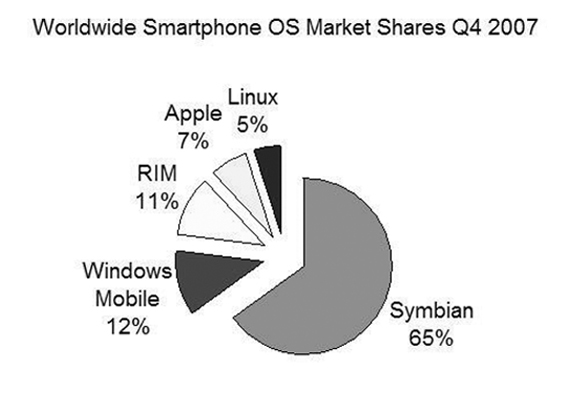
One of the principal reasons why application development for mobile devices is such an arduous task is the dizzying number of operating systems found on today's phones. Between 30 and 40 mobile operating systems are currently available, and device manufacturers may choose to use a number of them in their product lines. From this overwhelming crowd emerges a handful of platforms that can be found on the majority of devices (see figure 5).
The Symbian operating system is owned by a consortium of manufacturers of mobile devices, including Nokia, Sony Ericsson, Samsung, Siemens AG, and Panasonic. It can be found on more than 200 million phones worldwide.6 It provides a framework for location-based services, digital TV, advanced camera features, VOIP, push e-mail (see Mobile Phone Features below), and syncing. The Symbian platform can be found on Nokia phones as well as on Motorola, LG, and Samsung devices.
Microsoft Windows Mobile can be found on over 35 million mobile phones across the globe, including those from Motorola, Samsung, Sony Ericsson, and Palm.7 We may also see Windows Mobile running on the T-Mobile Sidekick before long, as Microsoft bought the Sidekick manufacturer, Danger, in early 2008. The popular OS features push e-mail, Windows Media Player, Microsoft Office Mobile, Bluetooth, and GPS support.
RIM's BlackBerry operating system is a proprietary platform designed specifically for the manufacturer's devices. It provides support for the side thumbwheel, synchronization with Microsoft Exchange Server e-mail, and Lotus Notes.
Google has organized a consortium called the Open Handset Alliance, which is an initiative made up of major manufacturers, operators, and software companies, to develop open standards for mobile phones. Such major players as Motorola, T-Mobile, Sprint Nextel, NTT DoCoMo, LG, and Samsung have all signed on. Together they are working to develop Android, a Linux-based operating system for mobile phones.
The Linux OS is used primarily in China and Japan on phones from companies such as Motorola. A consortium called LiMo has been formed recently with the mission to co-develop a Linux-based platform for mobile phones, which seems to be a direct response to the Google-run initiative. LiMo includes major device manufacturers and mobile phone carriers, including Motorola, Samsung, NTT DoCoMo, Vodafone, LG, and others. It is interesting to note that some of the same companies have attached themselves to both ventures, and it is unclear yet what their primary motivation might be.
Other operating systems to be aware of in the market are the Palm OS, which can be found running on many of the company's Treo devices. It comes standard with applications such as the address book, calculator, date book, expense program, memo pad, to-do list, and syncing capabilities. Apple's iPhone uses a version of the Mac OS X operating system. It comes with a Safari browser, iPod support, and applications such as weather, calendar, calculator, notes, and iTunes.
Mobile Phone Carriers
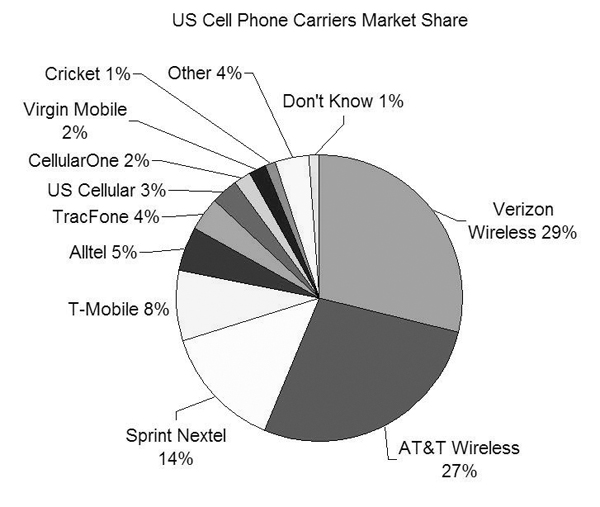
There are hundreds of mobile phone operators, or “carriers,” around the world, but five major competitors dominate the U.S. market: Sprint Nextel, AT&T Wireless, Verizon Wireless, T-Mobile, and Alltel. And a full 70% of cell phone subscribers receive their services from just three of those companies (see figure 6).8
Mobile Phone Features
There are a wide range of features available for today's handheld devices. Some of these features come preinstalled on devices, and others may be added on through carrier plans. With features, it is important to note that, although they are heavily dependent on the phone's inherent capabilities, they also vary according to mobile carrier. And manufacturers will sometimes release different versions of the same model phone to competing carriers. This can all be very confusing for consumers, who may find the same smartphone with a 2.0 megapixel camera at one carrier and a 1.3 megapixel camera at another. Likewise, a phone may be capable of a 3G network connection, but users may find that only one mobile operator in the area offers that service. Alternatively, a customer's carrier of choice may offer a music package, but it may not be compatible with all of the devices sold by the carrier. To further complicate matters, it is also possible to purchase through online retailers an “unlocked” phone, which is not tied down to any carrier in particular.
Purchasing a mobile device with so many options and variations takes some skillful research and a fair amount of patience, but it can be done. Most mobile phone manufacturers offer a “compare” function on their Web sites, which lets users produce feature matrices of different phones or even different versions of the same phone. Potential buyers of mobile phones will want to research not only the device capabilities, but also their carrier's offerings, such as packaged plans, before making a decision. Having an idea of what kinds of features are available provides a helpful starting point. Informed shoppers will have list of must-haves or “requirements” for a new device in order to narrow down the selection process. Without delving too deep, the following are presented to illustrate the range of features on the market today. We will touch upon many of these in further detail in the next chapter, which outlines what can be done with the mobile Web.
- Bluetooth—Phones and PDAs with Bluetooth Wireless technology are able to communicate with accessories, such as headsets with microphones, within ranges up to 10 meters without being connected by wires or being within line of sight.
- Camera—Digital cameras in many of today's cell phones range in quality from 1.3 to 5.0 megapixels and are capable of capturing high-resolution images. Some of these devices are also camcorders with the ability to shoot video footage.
- Desktop synchronization—This is the ability to connect a mobile device with a PC or laptop computer. Software is provided by the mobile carrier for installation on the computer, which will then be able to interact with the mobile device for adding and deleting programs and transferring ringtones, music, photos, and video files to and from the phone.
- Downloadable content—It is possible for many phones to download mobile games, third-party ringtones, wallpaper graphics, and applications. These applications may be bought through a carrier's store, found by browsing the mobile Web, or transferred from an owner's PC.
- E-mail—The mobile e-mail feature available on today's handhelds can mean very different things depending on the provider and the type of phone. E-mail–capable phones may simply provide the user with Internet links to Web-based e-mail accounts such as Yahoo! and Hotmail. This type of feature necessitates accessing the mobile Web in order to interact with e-mail. Some devices offer what is referred to as “push” e-mail, which delivers e-mail messages directly to the phone and alerts owners when they have new messages. And “hybrid” e-mail services are available, which offer new-message notifications but require users to access the Web to acquire their e-mail.
- Games—The majority of mobile devices on the market offer games to their users, and many phones have several of these on-the-go sources of amusement preinstalled and available with the device purchase. Most carriers also make it possible for game lovers to shop for and download new diversions through 1-click access to mobile stores.
- GPS (global positioning system)—A GPS-enabled phone is able to use the global navigational satellite system to always identify its location. This feature allows users to utilize applications such as mapping and navigating software with turn-by-turn directions, emergency locater services, and location-aware social networks.
- IM—Cell phones with instant-messaging abilities enable owners to take part in live text chats with IM buddies through an installed application without the need to open a Web browser. Not all instant- messaging clients are available for mobile IM at this time; however, AIM, Yahoo!, and Windows Live messengers are widely offered. Owners may need to download these applications themselves.
- Live TV—This service, offered by most carriers, allows cell phone owners to watch live, full-length television programs on their phones. The service provides a program guide with scheduling information, and some carriers enable users to sign up for reminder alerts for their favorite shows. It is useful to note that different carriers, and also different plans, offer different channel lineups.
- Memory card slot—Phones with memory card slots allow users to expand the phone's memory by adding a removable Flash memory card.
- Mobile office applications—Software such as Microsoft Word, Excel, and PowerPoint can be found on many smartphone devices.
- Music—Many phones have music capabilities. They come pre-packaged with built-in MP3 players and allow users to listen to radio channels and download songs through carrier portals. Others allow users to listen to music through media players such as Windows Media Player or iTunes and transfer songs from their PC to their mobile devices.
- Phone as a modem—Since smartphones have continual access to the Web, many of them have the capability to act as a modem for a laptop computer, providing a high-speed Internet connection for travelers or those without access to a network.
- Picture and video multimedia messaging—Similar to text messaging, this more recent feature allows some phones to instantly send photos and video files to contacts across the country.
- Productivity tools—Organizational and productivity tools such as planners and schedulers, task lists, memo pads, alarm clocks, and calculators can be found on many of today's mobile phones.
- Quad band—This means that the mobile device supports four cellular frequency bands and can operate anywhere in the world. Phones with this capability are often referred to as “global” or “world” phones.
- QWERTY keyboard—This feature indicates the presence of a full English-language keyboard on the body of the phone. The term QWERTY is derived from the first six letters on the top left of the keyboard.
- SMS text messaging—This feature enables phone owners to instantly send and receive short text messages to and from other wireless users.
- Speakerphone—This hands-free option allows talkers to take part in a conversation while doing other things. This type of feature is usually built in to the device rather than offered as a service.
- Video—Video playback on camera phones with camcorders is a common feature. However, there are also phones capable of showing cellular video clips, such as music videos, movie and DVD trailers, short TV episodes, sports clips, and weather reports. Users of devices with media players can also transfer video files from their desktop computers for viewing on their phones.
- Voice dialing—The voice-activated dialing feature lets callers speak the name of the person they are calling in order to automatically contact that number. Device owners must take part in a setup process that provides the application with voice samples and patterns.
- Web-enabled—Many of today's mobile devices offer some level of Internet access, but the experiences can vary greatly. Camera phones and multimedia phones that have Web access will most often have a carrier-specific interface with a numbered list of options to access Web-based information such as news, e-mail, sports, search, etc., making it very difficult if not impossible to browse to specific Web sites. Smartphones, PDAs, and other mobile devices that have their own operating systems will very likely have HTML Web browsers with address bars for typing in URLs.
Mobile phones are now able to acquire high-speed Internet connections through different cellular technologies and standards, offering varying speeds of data transmission. Use of these technologies varies between carriers and phone models, but the latest quality standard is the 3G broadband network connection, which indicates the third generation in mobile phone technology. Not all of today's offerings are 3G, however. Table 3 shows the approximate speeds of these technologies. To give some perspective, it may be helpful to keep in mind the transmission speeds of the Internet as accessed from a desktop computer are 56 Kbps (kilobits per second) for a dial-up connection and a minimum of 1.5 Mbps (megabits per second.) for a cable modem connection.
As previously mentioned, it is quite important to feature-shop on multiple carrier Web sites in order to get a clear picture of what is included with each device. It will also be helpful to have an idea of the types of data plans that each carrier in a particular geographic area offers, as they may vary greatly in terms of content and price.
Data Plans
Mobile phone carriers have a surplus of voice, feature, and data plans available for consumers to choose from. Many of the features mentioned above, such as live TV, are dependent on activating packages offered by carriers. But for users interested in having access to the mobile Web and e-mail regularly, there are data plans available that entitle device owners to varying amounts of bandwidth usage per month. The most appealing of these packages is the unlimited data plan, which is offered by nearly every carrier, starting at approximately $15 per month. Having an unlimited data plan lets phone owners utilize the Web to their heart's content, alleviating concerns about usage throughout the month. It is especially useful for those who take part in high-bandwidth activities such as downloading videos.
One aspect of data plans that is not always clear from the plan summaries is whether or not they include text messaging. Text messages, which are becoming an increasingly popular form of communication, cost both the sender and the receiver up to $.20 per message if they don't have plan coverage. Messaging bundles can be added on to a shopper's plan for as little as an additional $5 per month and would be highly recommended for those who have any intention to start texting.
Other Devices
In addition to the cell phone, there are many other mobile devices on the market today that offer access to the mobile Web. The iPod Touch is an MP3 player and Internet device that is very similar to the iPhone in appearance and functionality. It is available with storage capacities of up to 32GB, runs the same operating system as the iPhone, and is able to run nearly all of the same applications as its sibling. The Touch lacks a built-in camera, Bluetooth support, cellular service and EDGE technology, and instead accesses the Web via WiFi networks.
Many other non-phone-enabled devices, such as the HP iPAQ series, are available that allow Internet access and computing abilities. These gadgets can be referred to as Pocket PCs, PDAs, handhelds, or simply Internet devices and are manufactured by companies such as Dell, Hewlett-Packard, Nokia, HTC, and others.
Computer laptops are shrinking in size as the push for mobility increases among buyers. New Ultra Mobile PCs (UMPCs), such as the HTC Shift, are scarcely as large as a paperback book, with screen displays ranging from 4 to 7 inches. And the slightly bigger subnotebooks weigh in at around 2 pounds. Owners of Amazon's Kindle e-book readers have the ability to browse the Web as well as take e-books, blogs, and newspapers with them wherever they go. Even some handheld game systems, such as the Sony PSP and Nintendo DS, allow users to surf the mobile Web.
Although it may not have direct access, the Apple iPod is able to download and store large amounts of information from the Web, such as podcasts, videos, audio files, and so forth, to take on the go, and is a device to consider when creating mobile content.
Mobile Devices Resources and Reports
- “Android (Mobile Phone Platform).” Wikipedia, http://en.wikipedia.org/wiki/Android_mobile_phone (accessed Feb. 24, 2008).
- Ferraro, Ric. “Mobile World Congress 2008—A Summary.” Createlf, Feb. 22, 2008, www.createlf.com/content/view/354/4 (accessed Feb. 24, 2008).
- Fitzgerald, Michael. “Mobile Web: So Close Yet So Far” New York Times, Nov. 25, 2007, www.nytimes.com/2007/11/25/technology/25proto.html?ex=1353646800&en=1ede36007f8baff4&ei=5124&partner=permalink&exprod=permalink (accessed Jan. 3, 2008).
- Golvin, Charles S. “Benchmark 2007: The Five-Year Forecast for Devices and Access.” Forrester Research, Sept. 20, 2007.
- “iPhone.” Mahalo, www.mahalo.com/IPhone (accessed Feb. 17, 2008).
- Kharif, Olga. “A Warm Welcome for Android.” BusinessWeek, Jan. 22, 2008, www.businessweek.com/technology/content/jan2008/tc20080121_579060.htm?campaign_id=rss_tech (accessed Jan. 22, 2008).
- “LiMo Foundation.” Wikipedia, http://en.wikipedia.org/wiki/LiMo_Foundation (accessed Feb. 24, 2008).
- O'Hear, Steve. “Apple: iPod Touch First Mainstream Wi-Fi Mobile Platform.” Last100, Jan. 22, 2008, www.last100.com/2008/01/22/apple-ipod-touch-first-mainstream-wifi-mobile-platform (accessed Feb. 7, 2008).
- “Open Handset Alliance.” Wikipedia, http://en.wikipedia.org/wiki/Open_Handset_Alliance (accessed Feb. 24, 2008).
- “Palm OS.” Wikipedia, http://en.wikipedia.org/wiki/Palm_OS (accessed Feb. 24, 2008).
- “Personal Digital Assistant.”Wikipedia, http://en.wikipedia.org/wiki/Personal_digital_assistant (accessed Feb. 24, 2008).
- “Smartphone.” Wikipedia, http://en.wikipedia.org/wiki/Smartphone (accessed Feb. 24, 2008).
- Sorrel, Charlie. “Phone Industry Plays Catch-Up with Touchscreens, Software.” Wired, Feb. 13, 2008, www.wired.com/gadgets/miscellaneous/news/2008/02/gsma_wrapup (accessed Feb. 21, 2008).
- “Symbian OS.” Wikipedia, http://en.wikipedia.org/wiki/Symbian_OS (accessed Feb. 24, 2008).
- “Windows Mobile.” Wikipedia, http://en.wikipedia.org/wiki/Windows_Mobile (accessed Feb. 24, 2008).