Chapter 4. Exploring the Development of Deeper Learning Skills: A Case Study Analysis of a Python E-learning Course
Many academic, public, and school libraries utilize online learning to deliver programs and library-related instruction. In many cases, these online learning sessions are used to provide information literacy or general library instruction. There are numerous ways in which the consumption of course content, a program, or specialized instruction conducted online is characterized. They can be referred to as online learning, internet learning, distributed learning, or distance education.1
According to Welsh and colleagues, e-learning can be defined as the use of network technology to provide educational instruction or information to an individual.2 A broader approach to defining the term was undertaken in 2012, and many of the core elements, such as an approach to teaching and learning and communication to encourage interaction for new ways of understanding and developing knowledge, remain from early definitions of e-learning.3 Libraries benefit from e-learning courses by reducing overhead cost, increasing the reach of services, and providing directed learning.4
Over the past few years, e-learning has become extremely important. Massive open online courses (MOOCs) have increased the availability and reach of excellent instruction. For example, Stanford University has a MOOC, free for anyone to take before close of course registration.5 Coursera, FutureLearn, and OpenClassrooms are other popular examples of organizations that offer MOOCs. Within these types of online classrooms, there can be a diverse representation of students. While MOOCs have gained popularity over the past few years and will be the focus of this case study, the information gleaned from this chapter has implications for any e-learning course that involves the communication of information or knowledge to a group of students.
This case study will analyze an online Python development suite offered by the University of Michigan and explore how we use technology to engage students in deeper learning opportunities. The information gleaned from this case study will provide instruction librarians with additional insight regarding the technology they plan to integrate into their libraries and evaluating that technology so students gain optimal benefit from the instruction.
Learning and Library Instruction
Understanding Deeper Learning
There has been increased emphasis within higher education for deeper learning approaches.6 According to the 2017 New Media Consortium Horizon Report on emerging technology within education, deeper learning approaches within higher education pedagogy will become crucial to the learning process over the next several years. Deeper learning emphasizes that students should engage in higher order thinking (HOT) skills that include critical thinking and problem solving, collaboration, and self-directed learning to master the content.7
HOT skills are nonalgorithmic, tend to be complex, and require analyzing and synthesizing of the given content.8 We should be careful and proceed with caution for students lacking these abilities.9 In many MOOCs and asynchronous e-learning courses, students have to engage with the content, develop effective strategies to master the content, seek out additional sources, and be a part of the online community for that class.
Deeper learning and instructional technology are significantly intertwined when it comes to e-learning courses. According to the Association for Educational Communications and Technology (AECT), instructional technology is “the theory and practice of design, development, utilization, management, and evaluation of processes and resources for learning.”10 While it is important for students to engage in deep learning, instructional technology plays a vital role in this process as support.
Online Library Instruction
Whether academic, public, or school, librarians are being asked to do more with a limited amount of resources.11 The expectation remains that library instruction will be good. This includes being course- and assignment-related; involving active learning and collaboration; appealing to multiple learning modalities; and providing learning with clear objectives.12 Recent studies have used Dewald’s work as an abstract framework to study the effectiveness of online information literacy instruction. Many of these studies have highlighted “that the most effective online information literacy learning objects include interactivity in the form of active learning.”13
The concept of active learning in e-learning environments has impact for public, school, and special online library instruction. Active learning can be described as those activities that require analysis, synthesizing of concepts, and in-depth evaluation of the class content and the individuals’ learning process. It is estimated that roughly 40 to 80 percent of students drop out of online courses.14 Students benefit from online instruction that fosters collaboration with students and faculty members and involves a formative assessment of the learning process and knowledge acquisition based on formal tests or quizzes throughout the learning process.15
What Do We Want to Know?
This case study will analyze an online data science and python development suite offered through Coursera by the University of Michigan and explore the strategies they use to engage students in deeper learning opportunities. In addition to the content, the instructional technology that is employed for delivery of this course is extremely important. As an asynchronous course suite, interactivity and content engagement becomes vital for success.16 In addition, learning new software programs and using the interface of the learning system in Coursera presents a student with its own set of challenges.
Learning a new programming language requires an extensive amount of time and active learning. For novice unexperienced programmers, grasping the terminology alone can be seen as a major accomplishment. It requires a shift in logic and conceptual understanding of variables and binary approaches to answering questions. The research questions this case study seeks to address are:
- How are aspects of deeper learning incorporated in an e-learning computational programming course?
- What are the implications from this analysis for online library instruction?
By the conclusion of this chapter, you will be presented with essential themes to evaluate your own e-learning environment and the utilization of deeper learning approaches from the lens of a computational science designed e-learning course.
The Research
The case study method for this research project uses a single instrument case study, exploratory approach to identify the themes that will be derived from the study.17 I conducted the project. Sources of evidence for this study include documentation, direct observation, and my own participant observation.18 Documents included lecture transcripts, PowerPoint materials, and assigned readings. For this study, direct observation involved the interface of the learning module used. As the participant observer, I interacted with the functionalities and course content that assisted with the learning process.
Data Collection
The Applied Data Science and Python Specialization that is offered through Coursera by the University of Michigan contains five courses. Each course builds upon the previous course, and there is an expectation that students enrolled in this specialization suite have some previous experience with programming. This case study uses the introductory course as the unit of analysis. It is imperative that aspects of the introductory course keep students engaged and assist with creating deeper learning opportunities, which require more discipline by the students.19
Documents Used for Analysis
There are multiple interpretations of what is considered a document, and this argument has been discussed in detail with regard to the contemporary meaning of this word (see Buckland’s 1997 article “What Is a ‘Document’?”).20 However, this is not an attempt to define documents but to describe the artifacts that were included as documents and the justification for this decision. PowerPoint presentations, the assigned course readings, discussion forums, linked tutorials, lecture transcripts, Python coding information, and general text describing the aforementioned artifacts were labeled as documents. These documents also supported students enrolled in the course who require closed-captioning for disability-related reasons.
Direct Observation
Direct observation was concerned with the physical layout of the learning module and the interaction with the interface (figure 3.1). The left navigational panel provided the user with access to the weekly course material (figure 3.2) and additional information that was necessary for the course. An interesting feature offered here was the opportunity to translate subtitles for the course. While it may seem insignificant, this is very important when you have international students enrolled in your e-learning course. Not only does this assist them in the learning process, it also addresses the needs for community members that are differently abled and those that speak English as a second language. The homepage interface also provided a completion bar. Research has shown the benefits of incorporating a progress indicator when completing tasks.21
Discussion
The discussion will focus on three themes identified that are essential to deeper learning—critical thinking, communication, and self-directed learning22—and an unrelated concept of interaction. While the themes discovered are important, the conversation in this section will focus on the relationship that they have with conducting online library instruction. In case study research, a strategy to identify meaning from abstract concepts and variables is identifying the relationships that exist to develop a coherent understanding of the data.23
Critical Thinking
As a novice Python programmer and participant observer, I used critical thinking to understand the terminology used in the course, think abstractly regarding problems that were presented, and evaluate the documents that were used to answer questions. With many library instruction courses, there is an assumption that students have basic to no level of understanding with regard to database use, concepts of information literacy, and understanding of information-literate transferable skills. Critical thinking in the e-learning environment will depend largely on the supporting documents. They not only provide contextual information to continue the cognitive processing from the lectures, but they also provide a sense of support for information that is unclear. The supporting resources were intricate in this process.
For students enrolled in e-learning library courses, online journal notes can provide the library instructor with insight into the learning process of students enrolled in the course. Once a student’s preferred learning type is identified, it is necessary for librarians to develop personalized learning paths or suggested learning paths based on it. As noted, librarians are asked to do more with less. Customizable learning plans may be overreaching based on time constraints, but enough data generated can assist with generating categories of learners and provide predesigned learning paths as the librarian identifies cognitive barriers.
Communication
Outside the conversations that took place within the threads in the discussion area, there was minimal communication among students and the faculty instructor of the course. It is understandable, based on the number of students enrolled in this type of course, that communicating with hundreds of students can be difficult in this environment. From a participant point of view, communication was an essential element lost when compared to the face-to-face classroom. There were no emails, inbox notifications, or “checking-in” communication from the faculty instructor and course assistants.
Communication is handled differently, depending on how the library e-learning is constructed. Real-time communication during library instruction can be limited for asynchronous courses. Outside the context of emails, recorded lectures, and the learning management system communication tools, there is no direct communication with the instructor or other students. The issue with this form of communication is that text interpretation is up to the receiver. Therefore, when designing communication in this environment, it may be useful to integrate audio drop box features for students to communicate. Another user element is adding social media functionalities in the asynchronous course. What you choose is based on the technological support, integration, and interoperability of the current technology in place. One presentation at a recent Blended Learning in the Liberal Arts conference at Bryn Mawr College demonstrated how social media influence tools could assist with communication and assessing students’ cognitive progression in class.24
With synchronous e-learning, real-time feedback is provided, whether that is the use of whiteboard space, verbal communication during a class session, or the use of application sharing. However, when you have hundreds of students in your course, virtual breakout rooms may provide an additional method for communication that reinforces the concepts and discussion from the lecture. Use of such virtual rooms also allows you to let these groups be student-led and provides students with directed-learning opportunities. Creating these spaces for students to use when library instruction is given as a one-time interaction provides a cost-effective way to continue the conversation after the library instruction. However, the design, management, and technical functions of this virtual environment will depend on a number of factors.
Self-Directed Learning
One factor that I underestimated as the participant observer was the degree of self-directed learning that was involved with this course. Since the lectures were prerecorded and there was significant reliance on the documents, a student had to seek additional information to understand or simplify convoluted concepts. Self-directed learning required a significant amount of motivation and clarification of “What I am learning?” and “How do I learn?”
When a student enrolls in an e-learning course, the questions “Why am I learning this?” and “From whom I am learning it?” are addressed by the course objectives or defined within the syllabus. Students have to continuously evaluate what they are learning and understand how they learn within the e-learning environment. As part of self-directed learning, students encountering difficulty may need system-imposed measures to help with self-efficacy. Library instruction aimed at addressing self-directed learning may require recognizing motivation factors, such as clear direction and reward or recognition.25
Interaction
Consistent with previous conversations, interaction pays an important role.26 There were limited opportunities for interaction with classmates, the faculty instructor, and course assistants. While significant interaction was available with the course documents, there was a decrease in motivation to engage in significant deep learning that occurred during my tenure in the course. Moreover, limited communication further contributed to this low level of interaction.
The low level of interaction coupled with decreased motivation can be difficult to correct. As the participant observer, I found significant gaps between accesses of the course content. Critical thinking became less of a priority, and the completion of tasks with no in-depth engagement was the focus. It was apparent from my observation that the zeal for learning diminished and the completion of the course was now important.
Whether using a synchronous or an asynchronous e-learning environment, it will be critical for instructional librarians to keep students engaged. Conducting informal assessments, developing and maintaining good rapport with students, and continuously identifying the benefits as you move through topics or during a one-stop session are possible methods of maintaining motivation.
Conclusion
Many institutions have identified the critical role e-learning courses will play in the future. As budgets shrink for governmentally funded organizations, as learners require more mobility in their academic pursuits, and as e-learning courses try to meet the needs of the differently abled community, e-learning approaches and barriers will continue to be a topic of conversation. MOOCs and other forms of e-learning structures are addressing these demands, but it is imperative that the ability for students to engage in deep learning not be subdued by the change in delivery of quality education.
This case study allows us to identify themes that should be considered based on the documents that were scrutinized in the unit of analysis. The case study identified and provided insight into an interpretable understanding of important aspects of e-learning. Critical thinking, communication, self-directed learning, and interaction are evolving concepts that must be key elements in the online course design. External factors, such as policy and technology, will slightly shift how these concepts are defined, but the concepts will remain important if students or learners of online courses engage in deep learning.
While this was a single-case analysis that was exploratory in nature, using a multiple-case approach with a theoretical framework may provide additional or alternate perspectives. Also, this study should be compared with your organization’s supported e-learning courses. Coursera and similarly related courses do not have the same level of rigor and evaluation when it comes to learning objectives, observance of the learning outcomes, and emphasis on Quality Matters accessibility standards for online learning. Lastly, the case study was directed toward one course in a suite of five. It would be beneficial to identify whether similar themes derive from the more advanced courses.
Notes
- “What Is eLearning?” eLearningNC.gov, accessed March 7, 2018, www.elearningnc.gov/about_elearning/what_is_elearning/.
- Elizabeth T. Welsh, Connie R. Wanberg, Kenneth G. Brown, and Marcia J. Simmering, “E‐learning: Emerging Uses, Empirical Results and Future Directions,” International Journal of Training and Development 7, no. 4 (2003): 246.
- Albert Sangrà, Dimitrios Vlachopoulos, and Nati Cabrera, “Building an Inclusive Definition of E-learning: An Approach to the Conceptual Framework,” International Review of Research in Open and Distributed Learning 13, no. 2 (2012): 145–59.
- Sarah Chesemore, Rachel Van Noord, Janet Salm, and Cynthia Saletrik, Trends in E-learning for Library Staff: A Summary of Research Findings (Dublin, OH: OCLC, 2006), https://www.webjunction.org/content/dam/WebJunction/Documents/webJunction/Trends-in-E-Learning-for-Library-Staff.pdf.
- John W. Moravec, “The University as a Flag of Convenience,” Education Futures, December 13, 2011, http://www.educationfutures.com/2011/12/13/the-university-as-a-flag-of-convenience/.
- “Deeper Learning Approaches,” New Media Consortium, accessed March 7, 2018, https://www.nmc.org/horizon_topic/shift-to-deep-learning-approaches/.
- S. Adams Becker, M. Cummins, A. Davis, A. Freeman, C. Hall Giesinger, and V. Ananthanarayanan, NMC Horizon Report: 2017 Higher Education Edition (Austin, TX: New Media Consortium, 2017).
- Lauren B. Resnick, Education and Learning to Think (Washington, DC: National Academies Press, 1987); Lauren B. Resnick and D. P. Resnick, “Assessing the Thinking Curriculum: New Tools for Educational Reform,” in Changing Assessments: Alternative Views of Aptitude, Achievement and Instruction, ed. Bernard R. Gifford and Mary Catherine O’Connor (Boston: Kluwer, 1992), 37–75.
- Anat Zohar and Yehudit J. Dori, “Higher Order Thinking Skills and Low-Achieving Students: Are They Mutually Exclusive?” Journal of the Learning Sciences 12, no. 2 (2003): 145–81.
- “What Is Knowledge Base?” Association for Educational Communications and Technology, 2001, accessed December 1, 2017, https://www.aect.org/standards/knowledgebase.html (page discontinued).
- Amy Hall and Sarah Leeman, “Scaling Up: Rebuilding an Instruction Program with Limited Resources” (PowerPoint slides, webinar, Consortium of Academic and Research Libraries in Illinois [CARLI], December 7, 2016), https://www.carli.illinois.edu/products-services/pub-serv/instruction/ScalingUp-HallLeeman.
- Nancy H. Dewald, “Transporting Good Library Instruction Practices into the Web Environment: An Analysis of Online Tutorials,” Journal of Academic Librarianship 25, no. 1 (1999): 26–31.
- Katie Greer, Amanda Nichols Hess, and Elizabeth W. Kraemer, “The Librarian Leading the Machine: A Reassessment of Library Instruction Methods,” College and Research Libraries 77, no. 3 (2016): 259.
- Belinda G. Smith, “E-learning Technologies: A Comparative Study of Adult Learners Enrolled on Blended and Online Campuses Engaging in a Virtual Classroom” (doctoral dissertation, Capella University, 2010), ProQuest Dissertations and Theses database.
- Greer, Hess, and Kraemer, “Librarian Leading the Machine”; Marcie Lynne Jacklin and Keely Robinson, “Evolution of Various Library Instruction Strategies: Using Student Feedback to Create and Enhance Online Active Learning Assignments,” Partnership: The Canadian Journal of Library and Information Practice and Research 8, no. 1 (2013), www.criticalimprov.com/index.php/perj/issue/view/155.
- Chesemore et al., “Trends in E-learning for Library Staff.”
- Robert K. Yin, Applications of Case Study Research, 2nd ed., Applied Social Research Methods Series, vol. 34 (Los Angeles: Sage, 2002); Robert K. Yin, Case Study Research Design and Methods, Applied Social Research Methods Series, vol. 5 (Los Angeles: Sage, 2002).
- Yin, Applications of Case Study Research; Yin, Case Study Research Design and Methods.
- Brian Burnsed, “Curtailing Dropouts at Online Universities,” US News and World Report, October 20, 2010, https://www.usnews.com/education/online-education/articles/2010/10/20/curtailing-dropouts-at-online-universities.
- Michael K. Buckland, “What is a ‘Document’?” Journal of the American Society for Information Science 48, no. 9 (1997): 804.
- Frederick G. Conrad, Mick P. Couper, Roger Tourangeau, and Andy Peytchev, “The Impact of Progress Indicators on Task Completion,” Interacting with Computers 22, no. 5 (2010): 417–27.
- Adams Becker et al., NMC Horizon Report.
- Donna M. Zucker, “How to Do Case Study Research,” in Teaching Research Methods in the Humanities and Social Sciences, ed. Mark Garner, Claire Wagner, and Barbara Kawulich (Famham, UK: Ashgate, 2009), 171–82, accessed from http://scholarworks.umass.edu/nursing_faculty_pubs/2.
- Laura Zaylea, Tamara Sniad, and Kyle Harris, “Our Favorites! Tech Tools for Engagement in and beyond the Classroom” (presentation, Blended Learning in the Liberal Arts Conference, Bryn Mawr College, Bryn Mawr, PA, May 17–28, 2017).
- Kris M. Y. Law, Victor C. S. Lee, and Y. T. Yu, “Learning Motivation in E-learning Facilitated Computer Programming Courses,” Computers and Education 55, no. 1 (August 2010): 218–28.
- Chesemore et al., “Trends in E-learning for Library Staff.”
* George Shaw, Jr., is a fourth-year doctoral student in the School of Library and Information Science (SLIS) at the University of South Carolina. Shaw’s current doctoral research focuses on the intersection of computational science and public health. His research utilizes machine learning and text-mining methods to glean latent topics from Twitter regarding obesity to assist public health professionals with addressing obesity and other related chronic health conditions. When he is not in the doctoral “digs” working on his research, Shaw enjoys spending time with his family members and volunteering with Big Brothers Big Sisters of Greater Columbia.
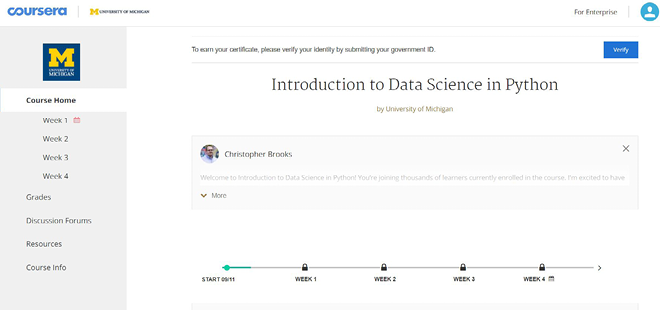
Figure 3.1
Screenshot of the Introduction to Data Science in Python course.

Figure 3.2
Screenshot of weekly module.