Chapter 1. Why Make Video?
Before I get into the nuts and bolts of video making, I’ll first answer the question “Why make videos?” Videos can take a long time to create. Creating a video requires skills that library staff don’t necessarily have, including how to operate a camera, how to properly record audio, how to work with different types of lighting, how to use video editing software, and how to feel comfortable in front of the camera.
The goal of this chapter is to help convince you that making videos is worth pursuing. I will focus on four areas:
- reasons to make videos
- business case for making videos
- using video in social media
- learning and video
Let’s take a deep dive into the world of video statistics!
Reasons to Make Video
There are a lot of current statistics that illustrate the popularity of video on the web. Here are some to consider:
- One-third of all online activity is watching video.1
- “Video made up 73% of global internet traffic in 2016; Cisco predicts it will make up 82% by 2021.”2
- “By 2021, the equivalent of 5 million years of video content will be watched every month.”3
- “69% of people worldwide watch video online, but 86% of those 18–26 do.”4
- “The average person spends around 30 minutes watching video on their smartphones every day.”5
Implications: It’s a good idea to periodically walk around your library and notice what people do on your library’s public computers. Most likely, they are watching videos. They are accessing and watching whole movies, how-to videos, or their favorite “YouTubers,” a person who frequently posts video to YouTube. My library’s databases now include video-heavy resources, like Hoopla, Lynda (see figure 1.1), and Treehouse.
Some of what’s being watched is definitely entertainment-based, but more serious learning resources are being accessed and watched as well. Even our digital inclusion database, DigitalLearn.org, is made up of self-paced video learning tutorials.
When you combine the statistics with observations, you can easily make a case for making videos. Your customers are viewing them, so it makes sense for your library to create content that customers want and expect—content in video form.
Business Case for Making Videos
The previous section discussed some general reasons to start thinking about creating videos for your library. A strong business case can also be made:
- “Almost 50% of internet users look for videos related to a product or service before visiting a store.”6
- Video content generates 1,200 percent more shares than text content and image content.7
- “Videos are more likely to be shared and in turn, generate more inbound links. Because of this, videos are 45 times more likely to rank on the first page of Google than text results.”8
- “Video . . . drives organic traffic [to your website] up by 157%.”9
- “92% of people who watch mobile video say they share videos with others.”10
- “Companies that create video content earn 41% more traffic from search engine results than those that don’t.”11
- “81% of businesses say that video has helped them effectively increase sales.”12
- “Using embedded video on your website makes you 53% more likely to show up on the first page of [search engine] search results.”13
- “After watching a video, 64% of users are more likely to buy a product online.”14
- “Including a video on a landing page can increase conversion rates by 80%.”15
- “Video in an email leads to a 200–300% increase in click-through rates.”16
Implications: Think like a business for a second. It makes a lot of sense for a business to use videos to connect with customers. From the statistics mentioned above, effectively using video content helps sell products.
After customers watch a video, they are very likely to share that video on social media, which increases the chance that other interested people will click through to the company’s website. Because video is so popular right now, and because Google likes to insert relevant videos (especially YouTube videos) into Google search results, videos have a good chance to appear on the first page of Google’s search results (see figure 1.2). Multiple companies say that making and sharing videos has increased their sales—their bottom line.
Now change the word businesses to the word libraries. The same things apply to us, if we effectively create and share videos:
- Our library customers are very likely to share our video on social media, which increases the chance that other interested people will click through to the library website.
- Our videos have a good chance to appear on the first page of Google’s search results.
- Making and sharing videos can help increase a library’s “sales”—our checkouts, program attendance, potentially even the number of people visiting the library building.
Sounds to me like libraries should start making videos!
Using Video in Social Media
Now let’s switch our focus to creating videos for use on our social media channels. How does using videos in social media settings affect what we do on our social media channels?
Here are some statistics about video use on Facebook (see figure 1.3):
- Video posts on Facebook have 135 percent greater organic reach than photo posts.17
- In the U.S from 2014 to 2015, Facebook videos posts increased by 94%.8
- “Facebook gets over 8 billion average daily video views.”19
- “85% of Facebook users watch videos with the sound off.”20
- “People are 1.5 times more likely to watch video daily on a smartphone than on desktop.”21
- “One in five Facebook videos is now a live broadcast.”22
- “Square videos [on Facebook] get 275% more views, 482% more shares, 523% more comments, and 349% more reactions than the average.”23
Statistics from Instagram and YouTube:
- “Video consumption [on Instagram] is up more than 80%.”24
- “YouTube is the second-most popular mobile app; 71% of all mobile users have it installed.”25
- People are watching a billion hours of YouTube a day.26
And some statistics about live video:
- “Live video will grow 15x by 2021, making up 13% of all internet traffic.”27
- “People spend 3x more time watching Facebook Live videos, on average, compared to a typical Facebook video.”28
- “Live videos earn 10x the amount of comments compared to pre-recorded videos.”29
Implications: These statistics point to the idea that if you create videos and share them on your social media platforms, your friends and followers will watch them, comment on them, and share them with their friends. People are likely to watch your video on their smartphone with the sound off (so make sure to include captions if needed).
Also, think about using a square video format on social media instead of the standard wide-screen format. Square videos fill more of a smartphone’s screen, so it’s easier to see, which helps people watch the video. You might also think about branching into live video.
Learning and Video
Now let’s focus on learning and video. How do people use videos to help them learn?
- “90% of information transmitted to the brain is visual and people retain 80% of what they see in comparison to only 20% of what they read.”30
- “95% of people have watched an explainer video to learn more about a product or service.”31
- “81% of people have been convinced to buy a product or service by watching a brand’s video.”32
- “69% of people have been convinced to buy a piece software by watching a video.”33
- When video and text are both available on the same page, 72% of consumers prefer video to learn about a product or service.34
- “85% of customers are more likely to make a purchase after watching a product video.”35
Implications: Remember the old adage that people like books with pictures? That definitely applies to our modern online world, and especially to learning settings. When we learn, we like to have options other than text only. We like to hear, to read, to watch, and to view. Visuals definitely help in the learning process.
This is great news for video creators because video is a visual medium. Statistics show that videos used to explain a product or service (i.e., explainer videos, which we will explore later) are a great way to help people learn. So it follows that making videos about library services will help people learn what it is we do as libraries. If you offer a video along with text to explain something your library does, people will watch your video.
Videos are great for learning, and they also help convince viewers about the usefulness of something. For example, think about the statistic above that says 69 percent of people were convinced to buy something based on watching a video about it. What does that mean for your library? It might mean that more people will use the library. For example, if you create a video about your library’s new makerspace and people watch the video . . . you will probably convince a majority of video viewers that your makerspace is a good thing. Those same people might come visit the library to try the new makerspace—all because you spent a little time to create a video about a new library service.
People Prefer Video
In the US, most library customers have grown up watching videos. They most likely own a television and have been to the movies. They have seen commercials their whole lives. Younger customers are also watching video from the online world. In addition to having a favorite TV show or movie series, they are probably binge-watching that show on Netflix. They might also have a favorite YouTuber they subscribe to and watch daily. And they most likely make and watch short videos on Instagram, Snapchat, and Facebook.
Your older customers might not be into YouTubers, but they are visiting YouTube to find how-to videos. They are probably also watching viral Facebook videos at least weekly.
That’s because videos are fun and informative. Videos have an emotional connection that’s pretty addictive. Think about this: “Video is a vehicle for transmitting emotion. We’ve all experienced watching a horror film that makes us leap, a video blog that makes us think, and a motivational montage that makes us throw on our training sneakers. In fact, because we already associate it with feelings like humor, curiosity, and awe, marketers can piggyback on these sentiments to form a quick emotional connection with their audience.”36
People connect with video; it moves us. When done well, even a simple video with a real person sharing what the library does can help the library authentically connect with its customers. It can help draw those customers into the library, or to the service, or to the website.
So Why Should Libraries Make Videos?
It seems to me that the statistics in this chapter make a good case for libraries to start making and sharing videos.
Our customers are already consuming videos. They are watching them on our library’s public computers. They are using our video-based databases and resources, like Lynda or Treehouse. If they don’t use our public computers inside the library, they are watching videos at home on their computers (and very likely on their mobile devices as well).
Today’s library customer is also used to seeing business-focused videos, which include commercials about a new product or service and videos that are more how-to oriented and show how a product or service works. They expect to see that same type of video content from your library. And if our customers like what they see from the library, they will share it with their friends.
Notes
- Ivan Kreimer, “5 Reasons Why You Should Use Video Marketing to Drive Sales,” Email Marketing (blog), July 6, 2017, Campaign Monitor, https://www.campaignmonitor.com/blog/email-marketing/2017/07/5-reasons-use-video-marketing-drive-sales/.
- Ken Tucker, “50+ Eye-Opening Video Marketing Statistics for Small Business Owners in 2018,” March 21, 2018, Change Scape Web, https://changescapeweb.com/50-eye-opening-video-marketing-statistics-small-business-owners-2018/.
- Tucker, “50+ Eye-Opening Video Marketing Statistics.”
- Tucker, “50+ Eye-Opening Video Marketing Statistics.”
- Tucker, “50+ Eye-Opening Video Marketing Statistics.”
- Think with Google, “3 Key Shopping Micro-moments for a Mobile World,” accessed July 9, 2018, https://think.storage.googleapis.com/docs/shopping-micro-moments-mobile-trends.pdf.
- James Ritchie, “5 Reasons Why Video Is More Effective Than Text,” IdeaRocket, August 8, 2017, https://idearocketanimation.com/17385-reasons-video-effective-text/.
- Ritchie, “5 Reasons Why Video Is More Effective Than Text.”
- Ritchie, “5 Reasons Why Video Is More Effective Than Text.”
- Tucker, “50+ Eye-Opening Video Marketing Statistics.”
- Tucker, “50+ Eye-Opening Video Marketing Statistics.”
- Tucker, “50+ Eye-Opening Video Marketing Statistics.”
- Tucker, “50+ Eye-Opening Video Marketing Statistics.”
- Mike Templeman, “17 Stats and Facts Every Marketer Should Know about Video Marketing,” Forbes, September 6, 2017, https://www.forbes.com/sites/miketempleman/2017/09/06/17-stats-about-video-marketing/2/#63745a361e11.
- Templeman, “17 Stats and Facts Every Marketer Should Know.”
- Templeman, “17 Stats and Facts Every Marketer Should Know.”
- Phillip Ross, “Native Facebook Videos Get More Reach Than Any Other Type of Post,” Socialbakers (blog), February 17, 2015, https://www.socialbakers.com/blog/2367-native-facebook-videos-get-more-reach-than-any-other-type-of-post.
- “The Facebook Video Statistics Everyone Needs to Know,” MediaKix, August 26, 2016, http://mediakix.com/2016/08facebook-video-statistics-everyone-needs-know/.
- Gordon Donnelly, “75 Super-useful Facebook Statistics for 2018,” TheWordStream Blog, last updated June 26, 2018, https://www.wordstream.com/blog/ws/2017/11/07/facebook-statistics.
- Donnelly, “75 Super-Useful Facebook Statistics for 2018.”
- Donnelly, “75 Super-Useful Facebook Statistics for 2018.”
- Donnelly, “75 Super-Useful Facebook Statistics for 2018.”
- Wochit Team, “2018 Social Video Statistics for the Video Savvy Brand,” Wochit (blog), February 7, 2018, https://www.wochit.com/blog/2018-social-video-statistics-video-savvy-brand/.
- Wochit Team, “2018 Social Video Statistics for the Video Savvy Brand.”
- Tucker, “50+ Eye-Opening Video Marketing Statistics.”
- Cristos Goodrow, “You Know What’s Cool? A Billion Hours,” YouTube Official Blog Broadcast Yourself, February 27, 2017, https://youtube.googleblog.com/2017/02/you-know-whats-cool-billion-hours.html.
- Tucker, “50+ Eye-Opening Video Marketing Statistics.”
- Tucker, “50+ Eye-Opening Video Marketing Statistics.”
- Tucker, “50+ Eye-Opening Video Marketing Statistics.”
- “7 Vital Reasons Why Your Business Needs a Video Marketing Strategy,” Ready Artwork (blog), accessed July 9, 2018, https://www.readyartwork.com/business-video-marketing-strategy/.
- Wyzowl, “Video Marketing Statistics 2018 Survey: The State of Video Marketing 2018,” accessed July 9, 2018, https://www.wyzowl.com/video-marketing-statistics-2018/.
- Wyzowl, “Video Marketing Statistics.”
- Wyzowl, “Video Marketing Statistics.”
- Wyzowl, “Video Marketing Statistics.”
- Douglas Karr, “Digital Marketing and the Impact of Video,” MarTech, February 10, 2014, https://martech.zone/digital-marketing-video/.
- Tyler Lessard, “3 Reasons Why Video Is Your Marketing Ace in the Hole,” LeadMD (blog), August 14, 2017, https://www.leadmd.com/blog/3-reasons-video-marketing/.
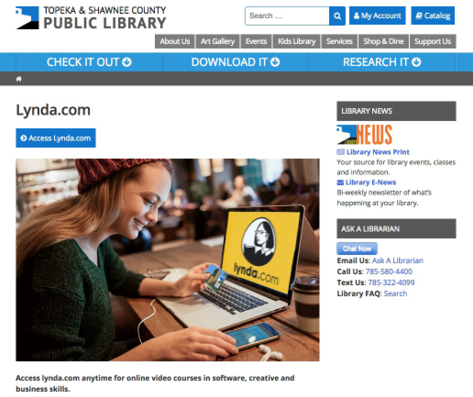
Figure 1.1
Screenshot of Topeka & Shawnee County Public Library’s Lynda.com page.
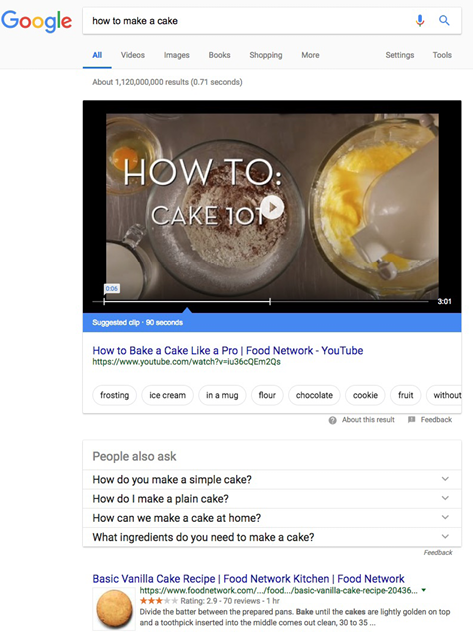
Figure 1.2
Screenshot of a Google search results page that includes video results.
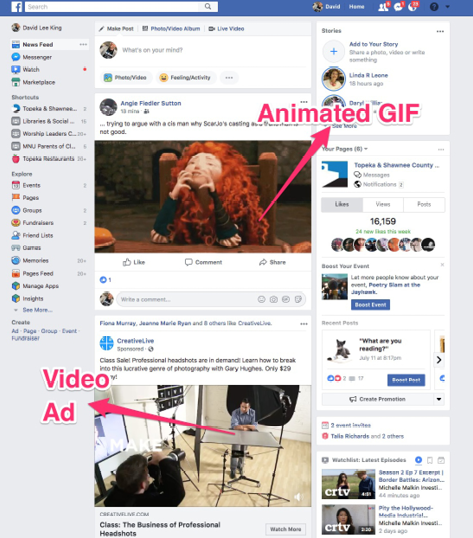
Figure 1.3
Screenshot showing video in Facebook.