Chapter 5. Libraries and Partners
Much about OCOL leads one to think that this is a philanthropic project that aims to create optimal conditions for people of all backgrounds hailing from every corner of the country—vastly developed urban areas and isolated rural areas—to be able to have access to education, culture, and knowledge. It certainly isn’t the first. For decades, many different organizations have been engaging in projects that tap into the power of technology to equalize access to knowledge. While it is true that the underlying mission of OCOL is to equalize access and opportunity (the platform accomplishes this on several levels, equalizing not only readers but also publishers, small and big; authors, known and unknown; and libraries, well endowed and barely keeping their doors open), it also recognizes that in order to create a sustainable approach, business models must be put into place that make sense for everyone.
Every side of the book ecosystem must be given its fair share. Users will be invited to read and learn, without a setup and without personal information being extracted to sell to third parties. Publishers and authors will be encouraged to participate by (a) getting some compensation and (b) getting the kind of exposure that may lead to more revenue streams. Educators will want to participate because they will be giving their students valuable tools to be used for learning, free of charge to them. And, finally, sponsors (those who take the burden of paying for the platform’s upkeep as well as the cost of reading) must be given a strong argument for why participation in this project gives them a new way to promote their brand, reaching new users while preserving the integrity and the interests of all involved. The fact is, without the influx of sponsorship funds, a project like OCOL cannot be sustained.
One thing that needs to be clarified about sponsorship is the decision to not call those that finance the project sponsors (although, in essence, that’s what they are). The word sponsorship is often associated with donations to projects that would not be realized without the good will of a large, powerful organization willing to step in. At least this is the case in Croatia. When one visits the websites of various corporations in Croatia and clicks on Sponsorships, one immediately encounters subheadings like “donations” and “social responsibility” and sees that various education and culture projects are often supported in their communities by local corporations seeking ways to gain the trust of the public. They usually donate a sum of money, and their logo is displayed where necessary to show to the public that their funds enabled a certain project or event. Public libraries, in particular, are no strangers to donations from community corporations. OCOL tries to raise the bar higher by giving potential sponsors the opportunity to be not passive donors but active participants. Hence, they are officially called partners of the project, not sponsors, and the benefits to becoming a partner are many.
Sponsorship Defined
As was the case with the business model for publishers, a number of questions needed to be asked in order to determine the types of sponsorships offered and the business model that would make sense to those willing to come on board as official partners of the library. These questions would eventually guide us in the direction of developing the concepts of “edutising” and three types of partners. And since many already gave significant donations to Croatian libraries, we needed to understand the library market and ways in which funds that would be potentially given to LoC might or might not intersect with the funds for various public and academic libraries. We therefore needed to know the answers to these questions:
- How many libraries are there in total in Croatia, public and academic?
- How big is the print collection of the largest Croatian library in the capital city of Zagreb?
- How many cities and towns in Croatia do not have any kind of library?
- How much money do Croatian libraries spend on buying new books?
- How much money do top corporations set aside in Croatia for sponsorship of various cultural and educational activities?
- What are the top ten private sponsors in Croatia? What industries are they in?
- What companies and organizations in Croatia have a history of supporting literacy, reading, libraries, and books in general?
- How many universities and colleges are there in Croatia?
- How many academic institutes are there in Croatia?
- How many people in Croatia currently have a library card?
- How much are public libraries visited and used in Croatia?
- What is the state of digital piracy in Croatia?
- What is the average circulation of a book in Croatian libraries? How many times is an average book checked out, on average, per year?
- How many people attend universities in Croatia (on average, at any time)?
- How do the biggest Croatian universities rank in the world and within the EU? How do their libraries compare?
- How much money do universities spend on library resources?
- How much on average do public libraries spend on their resources? What percentage goes to print versus digital resources?
- What are the most attended public events in Croatia, including book fairs, film festivals, concerts, Advent festivities, and so on?
After taking a closer look at the market we chose for our pilot and getting some concrete answers to these questions, it became evident rather fast that we’d be dealing with several types of potential partners that we needed to approach for sponsorship funds:
- Government partners—These included various government entities like the Ministries of Tourism and Education, various city government entities, and mayors’ offices. They also included libraries that wanted to participate by allocating their own digital funds to the project and taking an active role within the platform (without needing to develop their own for their own patrons).
- Educational partners—These included various schools and universities, private and public, that wanted to join the library as partners, with the goal of using it for educational purposes and to encourage learning and sharing of knowledge among their students as well as to support their own employees, particularly professors and scholars, in publishing their work. These institutions, as part of their partnership package, might partner with LoC to digitize their own publications or the publications of their faculty and make them widely available.
- Corporations—These include a wide range of private companies: large or regional banks, insurance companies, technology companies, and any type of corporation actively engaging in marketing and advertising activities online in an ongoing effort to attract attention to its brand or services.
- Tourism and hospitality industry—This includes mostly hotel chains and government organizations dealing with tourists and visitors to the country. They were given a separate category because their target user is not a citizen but a foreign person visiting the country for a specific, usually brief, period of time. His or her needs are different from those of the users who are permanent residents. Therefore, this type of partnership has some unique aspects, depending on how far these organizations (e.g., a well-known hotel chain, the National Tourist Board) are willing to go to fully engage and impress the tourists with innovative services.
- Small businesses—These includes private cafés, bed-and-breakfasts, and other types of small businesses in the hospitality industry that are interested only in small groups of people visiting their properties.
The OCOL platform is designed to offer three partnership types, although only the first one was offered when the platform was unveiled to the public as the others would require more IT investment. Each of these three partnerships may be exclusive (more expensive) or nonexclusive (less expensive), and they can last anywhere from three months to a full year. Therefore, long, exclusive partnerships were the most expensive, while short, nonexclusive partnerships were the least expensive:
- Public partner—Everything the partner does in the library or places inside the library is seen by all users, regardless of where the users are geographically.
- Location partner—Everything the partner does in the library or places inside the library is seen in specific locations (e.g., only inside hotels of a large chain and on their premises).
- Event partner—Everything the partner does in the library or places inside the library is seen only by users attending specific events (e.g., a film festival in a specific town, the Advent in the city’s center).
The partner’s benefits are diverse, and they depend on a range of factors. Since this part of the project needed to be learned through experience and through trial and error, we decided to treat each potential partner on a case-by-case basis, but in general, this is how the main partner benefits were communicated to interested parties:
- Greet readers upon entry into the app.
- Support a project committed to spreading reading and literacy.
- Show innovative approaches to marketing and advertising. (This is where the concept of “edutising” comes in.)
- Show responsibility toward their communities.
- Support the spreading of knowledge beyond urban areas.
- Support cultural and educational segments of the society.
- Support the country’s efforts to stimulate lifelong learning.
- Reach large numbers of users, including residents and visitors.
- Receive visibility inside the platform without invading reading.
- Have an opportunity to tie their brands to culture and education.
Several partner benefits were presented to interested parties and classified into two groups: inside-library benefits (including main greeting, embedded ad, and partner Profile) and outside-library benefits (web marketing, on-site marketing, PR campaign, and analytics). The benefits were described as follows:
- Main greeting—Greet users entering the platform on all devices and in all public spaces with a custom message showing your logo. In the web version, the greeting appears in the upper right corner for a few seconds and disappears; in the mobile version, the greeting displays across the entire screen before the reader enters the library.
- Embedded ad—Display company logo and relevant information inside the platform, linking to your LoC Profile. The purpose is to display the company logo and text that stays intact during browsing. The banner ad prominently displaying the logo and description of the partner’s business is never shown in combination with another logo of another participating partner.
- Partner Profile—Actively promote publications relevant to your business via your own partner Profile, prominently displayed on the home page. The Profile includes custom image, logo, a block of customizable text, link to the partner’s website, and a unique URL (e.g., www.libraryofcroatia.com/nameofpartner).
- Web marketing—Display authorized LoC badge on your organization’s website, pointing to your Profile and advertising partnership with LoC.
- On-site marketing—Display authorized marketing materials in your organization’s offices to promote official partnership with LoC to customers and your target audience in nonvirtual environments.
- PR campaign—Receive public recognition during LoC’s PR campaign, including exposure in media channels, with your logo and company mentioned as the official partner in LoC’s press materials.
- Analytics—Receive valuable insight via detailed reports showing reading habits, behaviors, and interests of users without compromising their privacy.
The Roles of Libraries
Where does this leave libraries? Are they to act as mere partners in this project and receive the same benefits as all others without any special visibility or credit? Is OCOL an attempt to build a national library that would directly compete with the national library that has existed for decades, possibly centuries? If one chooses to look at this from that perspective, one will easily come to that conclusion. That, however, is not the intention. First and foremost, OCOL, or in this case, LoC, is a digital library that has no physical, brick-and-mortar counterpart in any shape and form. It is a platform that utilizes technology to reach large groups of people. And technology allows us to blend roles and possibilities in ways we couldn’t imagine just a couple of decades ago. It is not national on purpose but by default. If an app may be accessed by any person anywhere inside the country, it automatically means the library has a national appeal. Further, technology allows us to combine types of libraries into one multipurpose entry point.
OCOL attempts to show how this is possible by unifying the needs of various users and eliminating unnecessary barriers (e.g., library cards, proof of residence). Further, it shows how to be the great equalizer. As mentioned before, OCOL equalizes users, authors, and publishers because all content is available in the same place and the playing field is leveled. Everyone gets the same chance, from the same starting point. More than this, OCOL equalizes all libraries, so that the national library in the city center has the same power in terms of its holdings as the small rural library on an island. Physical libraries have and will always have a strong, important purpose in their communities. The goal of open digital libraries is to do what they cannot, in ways that transcend zip codes, library cards, and various other proofs of belonging.
Public and academic libraries should certainly be partners in this project, but they can also launch similar projects on their own by using OCOL as the blueprint for their own undertaking. It is up to them to decide how active a role they want to play. As is already the case, some libraries have been proactively participating in transformative digital projects around the world, while others continue to trail behind. Some will have the resources and manpower to engage in large-scale national projects (and many already do) without needing to rely on new ideas and concepts such as OCOL. For many others, however, OCOL points the way. It shows them the path forward and inspires them to think outside the box and get the general public excited about the idea of an open library.
At is core, the OCOL idea will hopefully lead to people reading more because (a) it will be easy to access reading materials, (b) they will enjoy the new process and the new idea of an open library without restrictions, (c) they will appreciate that their privacy is guarded, as it always is in public libraries, and (d) they will be inspired to learn more and become lifelong learners eager to uncover new worlds in silence and away from the constant bombardment of social media.
Future Prospects
If there is one thing the world learned in 2020, in light of the unprecedented circumstances brought about by the presence of the COVID-19 virus, it is that we live in challenging times despite having access to information as never before in the history of mankind. We also now live in times that require us to shift many daily activities online, not by choice but by necessity (including working online, attending classes online, visiting libraries online, etc.). On the one hand, we have made great strides on just about every digital front; on the other, we continue to struggle to understand how best to use technology for the benefit of readers everywhere. Libraries are at the forefront of the digital revolution as they awaken to the importance of providing open access to quality information and research. OCOL by no means provides all the answers. It is an informed suggestion on how libraries may want to move forward—by joining forces with others to embrace the idea of open beyond unnecessary borders and restrictions and developing platforms that are able to simultaneously serve the needs of various users and patrons.
Much of what is proposed here will need to be tested to get a better idea of what works well and what needs more fine-tuning. Likewise, some features and possibilities were suggestions that were not included in the first phase of development but put on the wish list. And this list grew over time and many items need further consideration, including, for example:
- child mode, which allows users to filter out the content that may not be appropriate for children
- achievement/award system (allowing users with high Impact Scores to benefit in specific ways, not yet defined)
- the ability to create a type of scrapbook, allowing users to create their own books by dragging chunks of content (or entire chapters) into a newly created e-book (visible only to them. Note: the app must be able to recognize when a chapter from a book has been taken out and placed into this scrapbook so when and if the reading takes place, the reader knows where it’s coming from. For copyright reasons, the scrapbook would remain visible only to the user and creator.)
- accessing all licensed books outside the participating country for a period of time so that tourists and visitors can finish their reader (and not be denied entry when they leave the country)
- local sponsorships that allow small business to participate (Their messages would be visible only to users in small, targeted locations.)
- the inclusion of multimedia, including audiobook files, podcasts, video lectures, and even gamified fiction
Over the course of many months, the OCOL team reached out to a wide range of potential partners, while simultaneously engaging in conversations with publishers, both local and regional. While we were successful in securing contracts with a number of mainstream publishers, local and global, while also populating the library with OCOL’s own public domain and Open Access content, we were not successful in securing sponsorships from Croatian organizations. The sudden arrival of the coronavirus crisis in early 2020 played a role in delaying our efforts, but it also allowed us to take a break from the incessant conversations with potential partners in various fields and industries and let the feedback we had received sink in.
In retrospect, OCOL was and remains the most ambitious project I have embarked on in my career. I learned a great deal along the way of just how complex it is to attempt to build an open digital library of this magnitude, even if it covers only a small country the size of Croatia. I am proud of the many simplicities the library offers, as well as some unique features (particularly the concept of edutising, public marginalia, library-as-publisher, and the Impact Scores assigned to titles and readers), but I also recognize that some aspects need more testing and consideration. If we are soon able to activate the platform—either in Croatia or in any other region or territory interested in the concept and the idea in other parts of the world—the next phase of the learning journey begins. And it’s been a remarkable journey so far.
Figure 5.1
Image used for invitation to events presenting LoC
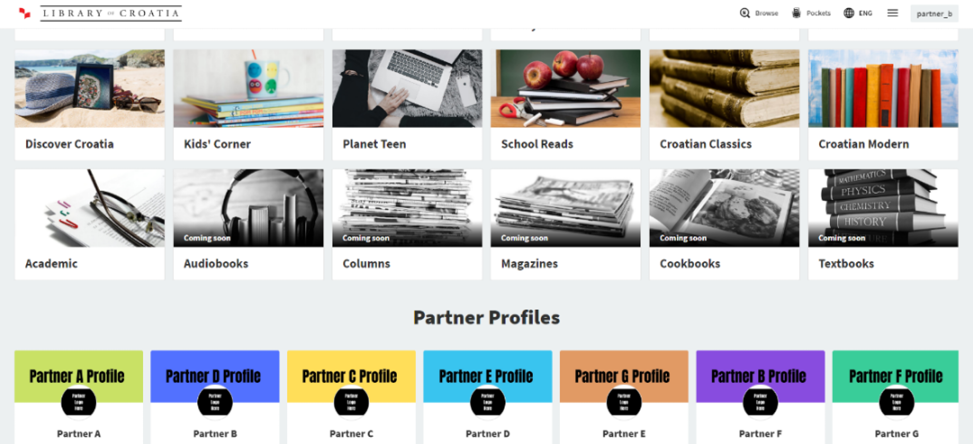
Figure 5.2
Location of partner Profiles on home page