Chapter 5. Scaling the Toolkit for Greater Reach
On the merits of the results of the Toward Gigabit Libraries (TGL) grant, in 2020 the IMLS funded a new grant, called Gigabit Libraries and Beyond (GLB; logo in figure 5.1) to further scale the project to impact more libraries in the US.
The purpose of the new project is to further leverage IMLS investment in the agency-level objective of building the capacity of libraries by scaling the successful TGL program to more US rural and tribal libraries and improving the well-being of their communities.
The key concept of the GLB project is to extend the use of the toolkit and training to empower and equip state library staff, move more significantly into tribal areas, and train the trainers.
In 2019, subject matter experts who contributed to the development of the TGL project were asked if the toolkit has been effective for the libraries they serve and whether and how the toolkit should be scaled. Respondents enthusiastically confirmed the positive results of the toolkit and offered specific suggestions to address unmet needs, including connecting with state library organizations, tribal organizations, and research and education (R&E) networks to deploy the toolkit.
The GLB project’s activities include the following:
- Perform minor updates to the TGL toolkit. The library community has been using the open-source toolkit since 2018, often remixing toolkit content into training materials at local, regional, and state levels. The project will continue to learn from reuse and remix activities to identify areas of improvement and refinement to the core toolkit.
- Expand toolkit use and effectiveness in rural and tribal libraries. The project will increase outreach and education opportunities for rural and tribal libraries, training materials, and train-the-trainer activities.
- Formally connect state library organizations, R&E networks, and other partners for toolkit deployment. The project will continue TGL’s practice of convening meetings of state library organizations and technology experts from R&E networks, universities, and tribal entities while building pathways, methods, and opportunities to sustain and expand these connections demographically and geographically.
- Enhance tribal library outreach. Of the fifty-eight libraries visited in the TGL project, eleven were tribal. This project will build upon and expand the use of the toolkit in tribal libraries.
- Simplify the toolkit and seek opportunities to make the content sustainable. Although TGL toolkit participants reported that it was easy to use, the GLB project will increase accessibility to promote easier understanding.
- Expand partnership opportunities. The project will engage in outreach to potential partners, including state library organizations, R&E networks, universities, the Association for Rural and Small Libraries, the Association of Tribal Archives, Libraries, and Museums (ATALM), and tribes and tribal universities.
- Explore libraries that are located in potential urban tech deserts and other library environments where the toolkit might be of benefit.
The Gigabit Libraries and Beyond Project Team
Project Codirectors
- Carson Block
- Stephanie Stenberg—Stephanie Stenberg is director of Internet2’s Community Anchor Program, where she works with regional networking partners, community anchor institutions, and Internet2 membership organizations to support mutually beneficial goals of bringing networking, trust and identity services, and advanced applications to community anchor institutions nationwide.
Project Support
- Therese Perlowski—Therese Perlowski is the program manager of the Internet2’s Community Anchor Program, where she works with internal and external stakeholders to demonstrate the value of advanced networking and identity services to community anchors across the nation.
- Bonnie Nichols—assistant, Carson Block Consulting, Inc. Bonnie Nichols provides office, research, and document assistance to Carson Block, after working in the circulation department of her local library for almost ten years.
The mission of the Community Anchor Program (CAP) is to connect regional research and education (R&E) networks with schools, public libraries, colleges and universities, health care, museums, and other institutions and advance broadband access and use throughout the country. This program works to:
- Connect community anchor institutions to advanced R&E networks
- Convene the Internet2-enabled formal and informal education community nationwide
- Catalyze effective uses of advanced networks to serve education
- Communicate impactful stories of learning and transformation2
Active Project Advisory Boards
There is a spectrum of roles for project advisory boards. For some projects, it’s appropriate to have members who focus on the big picture and offer advice on how to steer projects in the right direction. Starting with the TGL project, the team wanted a group that certainly possessed a big-picture view, but perhaps more importantly deep expertise in library technology and technology used by tribal libraries, as well as a willingness to roll up their sleeves.
Both the TGL and GLB projects have benefited from strong advisory boards: actual subject matter experts contributing strong and insightful ideas for all aspects of the toolkit, including topics, approaches, content, resources, and edit suggestions.
Having a group with such expertise offered a welcome challenge: finding the right middle ground when suggestions from one board member were seemingly in conflict with suggestions from another, or when a suggestion might lead the toolkit away from the goal of being layperson-friendly. An old joke that applied to many fields certainly resonates here: “How many technologists does it take to change a light bulb? One to change it, and four others to explain how it could have been done better.” To the uninitiated, it may seem that technology is a cut-and-dried process. Those in the field, however, know that there are many possible technological paths that could address a particular need. This tension was healthy; considering and balancing diverse opinions proved to be an excellent way to refine the toolkit content in an iterative manner.
One area in particular that the project team struggled with was the fine line between explaining a technology item too simply (glossing over important details) or explaining it too far in the weeds (sharing unnecessary details). The strong, expert, and sometimes opposing voices from advisory board members created a healthy tension to find the right middle path for the toolkit.
Of course, not all suggestions or ideas made it into the toolkit. The project team created a log of all suggestions, discussed and examined them, and then decided what action (if any) would be taken as a result. Naturally, some suggestions were an easy yes; many were difficult to fit in and needed more attention; and others we were unable to adopt (see figure 5.2).
In January 2021, a project advisory board composed of subject matter experts (figure 5.3) was convened for virtual meetings over two days. Advisory board members shared their experiences with the toolkit; provided suggestions for edits and improvements to the toolkit; discussed strategies for connecting with state library organizations, R&E networks, and others; participated in breakout groups to determine strategies for outreach to tribes, urban libraries, and rural libraries and ideas to simplify the toolkit; and evaluated who or what perspectives might be missing from the advisory board.
One key outcome from the advisory board meeting was suggestions for restructuring the toolkit to make it more friendly, accessible, and future-proof. One consistent experience reported by users is that once they start using the toolkit, they have excellent experiences. However, for the uninitiated, just cracking the cover open could be one of the biggest barriers to adoption. Board members offered substantial input for making the toolkit user-friendly, as well as ideas for approaching tribal libraries and for meeting the needs of urban libraries.
Several excellent suggestions for making the toolkit more accessible to users included the following:
- Reformat the toolkit into smaller, more manageable chunks to make working through it much less intimidating and make dropping in on different sections as needed easier.
- Make the appearance friendlier by using more graphics; consider adding graphics to the glossary.
- Create a workflow to “build as you go” when completing the toolkit. As a user works through the toolkit and discovers needs, have an easy path to start creating the list of services, maintenance, or equipment needed to address those needs.
- Create a basic version of the toolkit to create a friendlier on-ramp for tech assessments. (One-room/one-person libraries don’t necessarily need the full toolkit at first.)
- Create a more effective digital version of the toolkit.
- Bridge some gaps between the Broadband Funding section and the Broadband Improvement Plan by somehow adding information about broadband partners and organizations in areas near the library and integrating advocacy and rationales for better local funding for broadband.
- Add a section about exploring community needs and how the library might be able to help before even starting the toolkit.
- Document pathways libraries can take to form their own local technology support network, including other organizations and opportunities for volunteers to lend a hand.
- Suggest price ranges for the equipment and sources to help estimate costs for gear.
Board members also suggested strategies to create a deeper reach to tribes, including culture-appropriate approaches, and ideas to forge stronger relationships between state libraries and tribal libraries. These suggestions included the following:
- Document how some states (including New Mexico, South Dakota, California, and others) have created formal connections between state library organizations and Native American communities to allow tribal libraries to participate in E-rate discounts.
- Consider what would provide incentives to complete the toolkit, including increased funding opportunities.
- Form a subcommittee to focus on outreach to tribes to ensure that the toolkit is further developed as a tool for self-empowerment, not an external to-do list imposed from outside of the tribe.
- Survey the original tribal pilot participants, see how they used the toolkit after the initial pilot, and share their outcomes and challenges.
- Invite the initial pilot libraries to participate in train-the-trainer activities.
- Show that a toolkit outcome is creating avenues to long-term support, lasting partnerships, and ongoing opportunities for effective technology for users, increased opportunities for partnerships, and ongoing support for libraries.
The board also offered suggestions on how to properly focus GLB efforts on the new exploration of urban libraries. Group members suggested that the most important areas for urban outreach are probably not the biggest US cities, but larger library systems in smaller urban areas (including those surrounding big-city library systems) in need of help. Guidance in this emerging area included the following:
- Understand that the toolkit is probably not right for the largest urban centers in the US; these large library systems tend to have highly sophisticated and specialized technology support already.
- Recognize the intersectionality of some urban systems; some might be part of multiple technology support organizations (individual libraries, libraries that are part of a consortium, and others), yet there may still be gaps in the technology support available.
- As a possible target, consider bedroom communities around larger cities—places that are technically urban but don’t have the same level of support as larger city library systems.
Next Steps
As with the rest of the world, COVID has impacted the launch sequence for the GLB grant, requiring remote work for activities that were designed to be performed in person. Project managers have pivoted by developing new processes and techniques for remote engagement using prerecorded video, videoconferencing, new worksheets, and interactive workshop design to help people on both ends of the connection communicate powerfully.
Interestingly, COVID may have presented more opportunities to spread the word about the toolkit via webinars. In late 2020 and early 2021, project managers presented the toolkit to multiple audiences.3 Even as changes to public health conditions allow for live presentations and in-person activities become possible, a hybrid approach to outreach (online and live) is likely to continue throughout the GLB grant period.
During the first eight months of the GLB project, the team has reworked the schedule multiple times (see figure 5.4) to accommodate a COVID pivot; further tweaks are anticipated.
The project team anticipates that initial toolkit modifications (as suggested by the advisory board and other sources) will be completed by the early fall and a new working copy of the toolkit will be provided for users. As with the TGL grant, the project team will continue to incorporate iterative suggestions into the toolkit until the current GLB grant is complete. Due to the slow start caused by COVID, the project team may also file for a one-year no-cost extension of the GLB grant to allow time to launch and complete in-person activities. Any possible extension must be approved by the IMLS, so the team is also prepared to accelerate in-person efforts if an extension is not granted.
Also planned to be in progress by later summer 2021 is the formation of several subcommittees of advisory board members for tribal, rural, and urban outreach.
The area in most need of startup development is urban outreach; while rural and tribal needs are great, significant work has been done in both areas. Early conversations with our advisory board has indicated that defining the right urban areas and right approaches will take some care (since very large systems are probably fine, but smaller semi-urban or suburban systems may have gaps). The project team looks forward to defining urban outreach in more detail and is buoyed by the experiences that library people of all stripes have reported when using the toolkit to solve their technology problems.
Starting in early 2022, the project teams plan to
- perform more fieldwork and site visits to tribal libraries
- convene state library organizations and research and education partners to implement the toolkit more broadly in states
- launch train-the-trainer activities to equip state library organizations, R&E partners, and tribal libraries to implement the toolkit more widely
- perform ongoing work to make the toolkit more accessible and as future-proof as possible
For readers interested in the toolkit, you can contact Carson at Carson Block Consulting, www.carsonblock.com, or by e-mail at libraryland@gmail.com, or Stephanie Stenberg at Internet2, Contact Us, https://internet2.edu/contact-us/, or at sstenberg@internet2.edu.
Notes
- Internet2 home page, https://internet2.edu/.
- Internet2, “Community Anchor Program (CAP),” https://www.tx-learn.net/documents/I2-CAP.pdf.
- A listing of presentations is provided in the Resources chapter (chapter 6) of this document.
Figure 5.1
The Gigabit Libraries and Beyond logo; used for the second grant cycle.
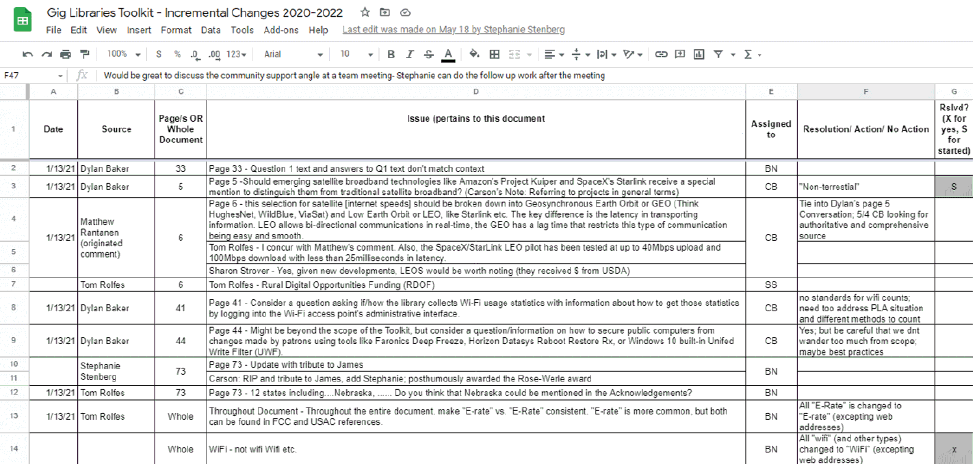
Figure 5.2
A screenshot of the spreadsheet used by the GLB project team to discuss and track incremental edits to the toolkit.
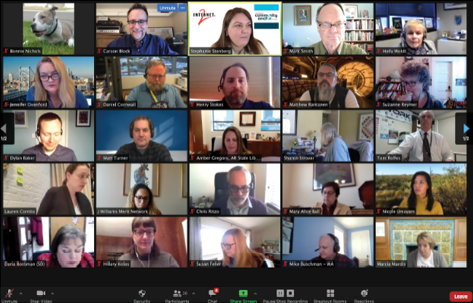
Figure 5.3
A screenshot from a Zoom meeting with the advisory board of the GLB project, featuring subject matter experts from around the country.
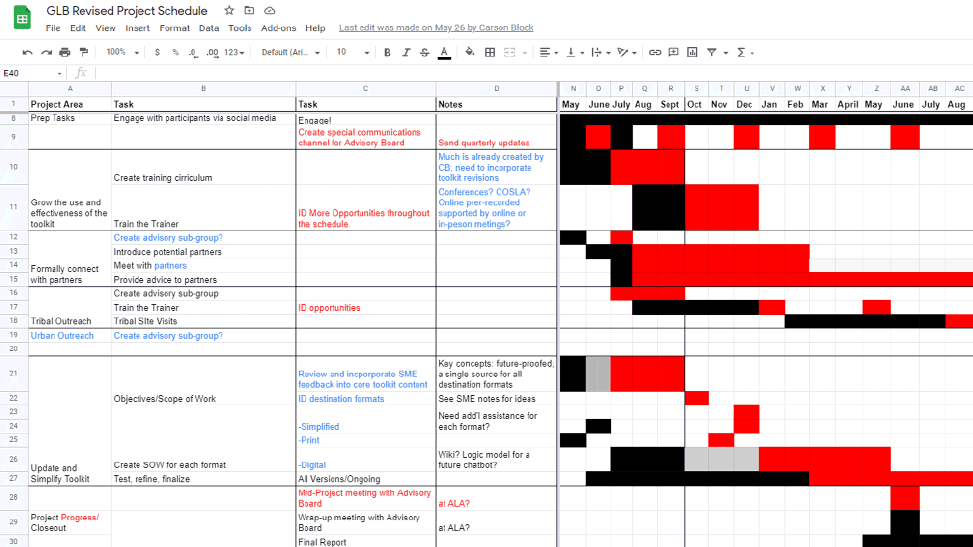
Figure 5.4
A screenshot of the revised schedule for the GLB project. The project team used varying color text and time blocks to compare and contrast adjustments to the project schedule as a result of COVID impacts.